
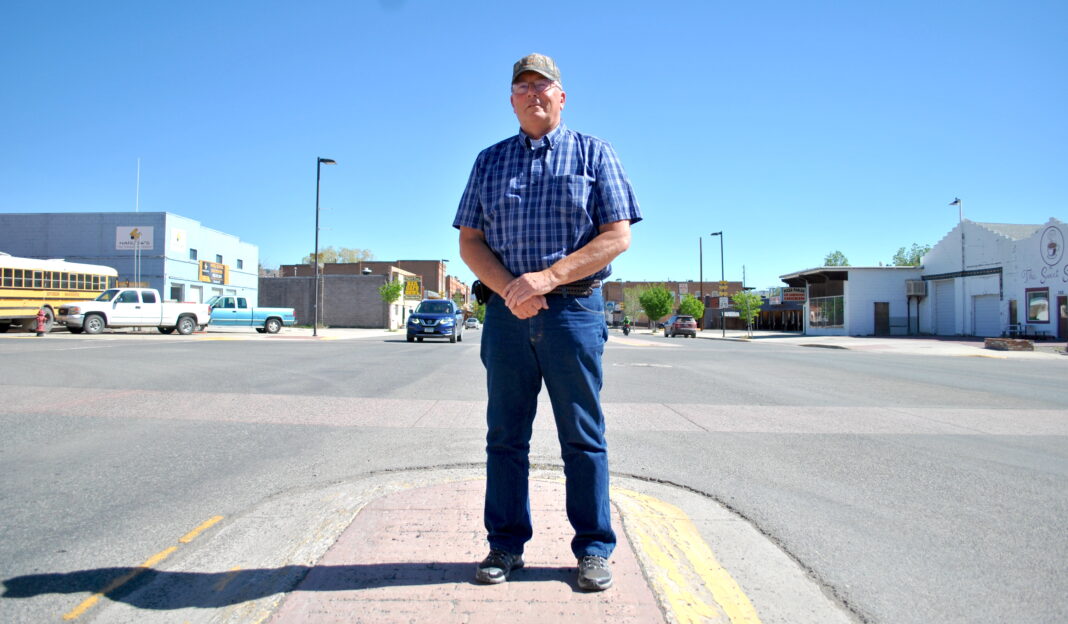
In 2001, Tom Harrington began working part-time at the then relatively new Jefferson Local Development Corporation. Since then, as co-head of the JLDC and an economic and community development agent at Montana State University’s Madison-Jefferson County Extension, he has been at the heart of the county’s effort to remake its economy.
Harrington’s work has reflected the broad scope of the JLDC’s portfolio. He’s been in on plans to redevelop the former Montana Developmental Center campus; the ongoing attempt to create a Western Legacy Center; and the redevelopment of Whitehall’s Borden’s Hotel building. He has advised county and municipal government leaders on economic policy, and he’s consulted to countless small businesses looking to grow.
Harrington is retiring this summer. He spoke with the Monitor about the changes he’s seen in the county, what he’s learned about economic development, and the opportunity ahead. The interview has been edited for clarity and length.
—Keith Hammonds, publisher
You’ve been working on economic development in Jefferson County for 20 years. What has changed in that time?
Jefferson County is in this unique position, located between Lewis & Clark, Gallatin, and Silver Bow [counties]. We’ve always been this little rural area between metro areas. Our workforce has always gone into those neighboring counties, and the economies of those areas have dictated what happens here.
We’ve kind of been discovered in the last few years. People are moving here because you still have affordable housing, and a lot of growth has been the result of that. And 60 percent or 65 percent of the county is public lands, so people come here to enjoy that amenity. People have figured out this is a good place to be. Pipestone is a good example. Twenty years ago, no one had heard of it. But with the evolution of trail riding, motor biking, horseback riding, it’s become a destination. You can’t go up there on weekends now without seeing campers and ATVs everywhere.
How does that translate into economic development?
Right—the challenge has been, how do you capitalize on that? Whitehall sees a lot of traffic from Pipestone, people coming in to buy gas and eat at restaurants. Boulder has an opportunity to be a recreation hub, too: You look at the Elkhorns, Basin and Bernice, and Pipestone, and you have an opportunity for Boulder to take advantage of those day-trippers. We tried to push that a few years ago, but we didn’t get a very positive response. There’s a pretty strong feeling about recreation and what it does to the land, and if you get too many people coming in to recreate, you take away opportunities for people living here.
In terms of the county’s economy, what have been defining moments in the last two decades?
The Montana Developmental Center closure, of course, with the large workforce there, and the impact it’s had in the community. Montana Tunnels was a huge economic driver for many years; it went into closure mode and never really restarted. The other is probably the ebb and flow of the Golden Sunlight mine: They’ve come close to closure there which has an impact not just on the local economy but on the region.
Those critical moments create dislocation and pain—but they also can establish urgency for change.
With the MDC, you had a 100-year relationship with the community of Boulder. The word came out that it was going to close, and it was like going through a grief process. But once you get through that, you start looking at opportunities: It’s not coming back, so where do we go from here? That’s how [the Boulder Transition Advisory Committee] got started: People came together and said, we have an opportunity to change the destiny of the community. You had great public meetings that led to the Boulder Development Fund and the legislative appropriation, and a lot of good projects. Today, Boulder is in a much stronger position as a result of that visioning process. So the MDC closing wasn’t all bad.
We’ve had a very strong core of volunteers who are committed to improving quality of life. They’re the movers and shakers—people who are very busy in their own jobs, but they’re willing to take the time and effort to better their community. There’s Bob Marks—when I first started, he was board president of the JLDC, and he has an uncanny way of going right to the crux of whatever the challenges are. Drew Dawson has been on the board for many years, he’s got good perspective and is well rounded. Scott Mendenhall trained me; he was very astute at economic development.
So, leadership is a key ingredient. People who have vision and foresight to look down the road and ask, what’s worthwhile doing here—and then have the desire to carry it forward. We’re very fortunate to have a proactive County Commission—very forward-thinking and willing to take risks on behalf of the county. It hasn’t always been that way, and I don’t think constituents really grasp that this is a very good commission that really has the county’s interests at heart.
Has your thinking on what works in economic development changed over the years?
If you look back five or 10 years ago, the focus was on job creation. It’s still a mantra today. But especially with COVID, what I’ve seen is that it’s not about creating more jobs. We have plenty of jobs right now. There’s an opportunity to refocus that effort and look at existing businesses that have weathered the storm, and help them expand and grow. It’s a better long-term investment.
Where will the American Rescue Plan Act funding take the county?
It’s one of those once-in-a-lifetime opportunities. And there are two schools of thought: We’ve already seen three iterations from the feds on the ARPA rules, so some people say, we don’t know what’s going on, everything’s changing, we have to wait and see how it plays out.
Well everything changes. In the meantime, if you go to the Montana Association of Counties site, you’ll see 300 or 400 county plans [for ARPA spending], some of them very detailed; people have been working on those for months. My argument is, if you sit back and wait, by the time you figure it out, everyone else will take advantage of it—and you’ll miss opportunities.
So you have to start with a road map, and then adjust.
What should be in the road map?
Broadband [internet] is an example: We have a lot of places that are underserved for broadband, and building that capability is going to bring in economic development. The opportunity to sit down with a strategic plan and say we want good coverage for Boulder, Whitehall and some of the outlying areas, and you not only help the constituency, you also set those communities up for opportunities down the road.
Jefferson County has a hidden asset: We have a lot of people who have moved here and are commuting to Butte, Bozeman and Helena. So how do you retain that workforce? If I’m a business that’s struggling with hiring, [connecting with that workforce] becomes an important competitive question. If I can offer you what you need, you’re probably going to stay here.
To do that, you need adequate housing, you have to have childcare, you have to have good internet. So those are the things you really focus on.
How did you start into this work, anyway?
I was retired out of the military, and living in Whitehall. I had a background in finance and management from Montana State, but I had never put that to use in the Army. So, first, I was recruited for the JLDC board. I helped out with some projects, and the next thing you knew, was working there part-time.
That worked out pretty well…
It’s hard to explain: If you do this work, it isn’t about monetary reward. It’s about the personal satisfaction of helping people be successful. You look at the Borden’s Hotel project, the business parks we’ve done, the small businesses we’ve assisted. The dynamic is, you pull-off a project and you go to the next one. People are happy and excited, and you’ve had a great week.