
I’m keenly aware of the gap between the importance most people place in the news as a pillar of democratic function and their actual belief that journalism is living up to the job. Numerous surveys nationwide show that while citizens think the news should and could help strengthen society, many believe it has failed to do so in practice.
That’s why I attach so much importance to The Monitor’s annual subscriber survey. It’s satisfying, of course, to learn that you still like us—and you mostly do. But what’s really telling is the divide, often nuanced, between what this news organization thinks it’s doing and what our readers actually see.
The top line: 207 subscribers completed the survey, a number that in itself shows strong engagement with the news. Thank you to those who took time to share their thoughts.
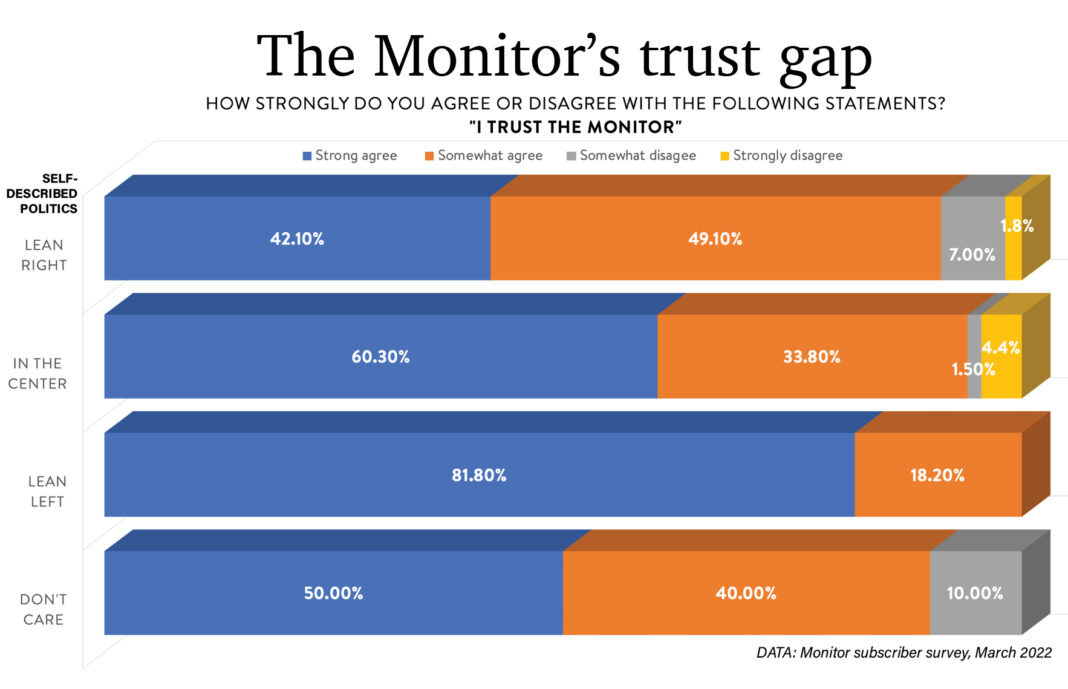
The bottom line: Of those, 94% agree strongly or somewhat that The Monitor tells them what they need to know about what’s happening in our community. Separately—and this is the single question that matters most to me—94% say they trust The Monitor, with about 60% of those agreeing strongly.
But that still leaves about 6% of readers who don’t think we’re telling the story of our community well, and about 44% who only “somewhat” agree that we’re doing so. Some 46% of respondents say we should be doing more coverage of community activities; 43% think we should report more on local government.
Let’s unpack those numbers a bit. This year, for the first time, we asked folks to share their political affiliation, age, and place of residence. We suspected that those questions could help explain some of the differences in the way people view and react to The Monitor.
In fact, political identity was an important fault line. Those who indicated they leaned to the right were more likely to say they only “somewhat” trust The Monitor than those on the left or in the center. That pattern was similar, though not as pronounced, for the question about whether the paper is telling readers what they need to know about the community.
The divide is nuanced. Among readers who self-identified as leaning right, we were as likely to hear that there should be “more in-depth reporting on city government; seems like [your] stories just tell the surface,” as we were: “The Monitor is covering local government in a more thorough manner. That’s what local journalism should be doing—keeping folks informed about community issues and City Council decision-making.”
But the politics-based perceptual gap mirrors a national trend. Americans’ trust in the news has declined generally over the past five years—but that drop has been sharper among Republicans or those leaning right. Last June, according to the Pew Research Center, 66% of Republicans said they had a lot or some trust in the information generated by local news organizations, compared to 84% of Democrats; back in 2016, 79% of Republicans and 85% of Democrats said they had some trust in local news.
Here are some other key findings from the survey:
North vs. South: The Monitor aims to cover a big chunk of Jefferson County, from the Helena city boundary to Basin and the Boulder Valley. We’ve done steadily better at reporting on the northern communities of Montana City, Clancy and Jefferson City, and some folks recognized and applauded that. Others (and not surprisingly, these were all north-county residents) pointed out that, as one said, “the paper is very South End-focused.” To them, the north still feels orphaned—not well covered by media in Helena, and overlooked amid our reporting on Boulder and county government.
So, good news! We have just hired Eliza McLaughlin as a reporter focusing exclusively on the North End. We’ll introduce Eliza properly soon, and we hope that folks in Clancy, Montana City and Jefferson City will quickly spot her at meetings and events in their neighborhoods. If you’d tell Eliza about the issues in your community, give her a shout (eliza@boulder-monitor.com).
Depth vs. Breadth: In the last year, The Monitor has invested increasingly in long-form reporting. Exhibit A was Editor Joshua Murdock’s 4,500-word profile last September of Elkhorn icon John Bonan. We also went deep on affordable housing and child care in Boulder, and we examined the mental health challenges facing ranchers and farmers.
Beyond those special features, we are tending to bring more detail, and more words, to our week-to-week coverage. Part of this is a matter of quality: We believe that journalism provides greater value to the community when it explains not just what happened, but also the context for that news and analysis of why it matters.
Some readers like this, others not so much. “You sometimes have some really long articles that could be condensed,” wrote one reader. But another said: “Excellent in-depth feature stories.”
I think both have it right. The Monitor needs to keep doing long-form stories that reveal deeper truths about our community. But we also need to tell more stories, reflecting the rich breadth of people, institutions and activities that make Jefferson County what it is.
Which stories? Well, you all had plenty of suggestions: The goings-on at County Commission meetings, for one. Previews of events before they happen. Environmental issues. Court proceedings. Ranching. Outdoor recreation. Restaurants. Pretty much anything at the area’s elementary schools.
It’s a long list. This will always be the challenge with a tiny newsroom staff, and with a paper that—as some readers noted—has shrunk over the last two years to (most often) 12 pages from 16. (“Less and less news for more and more money,” complained one.) The latter is a function of advertising, which continues to be soft in the wake of the pandemic. We’re working to build that back up, and to bring you a newspaper with both more and better coverage.
The Views: The Monitor has recruited new opinion columnists—and you’ve noticed. Mostly, you’ve seen and reacted to Jane Lee Hamman, who brings a conservative perspective to her monthly piece. Not surprisingly, folks on the right applauded “more balance” on the Views page; on the left, some decried what one called Jane’s “long rants on Republican talking points.”
I’m pleased that conservatives feel better represented on the Views page. So should progressives, since The Monitor also regularly features James C. Nelson and Jim Smith.
But we don’t view this as a job done. As always, we’re looking for contributors who will reflect the full range of perspective in this community. What’s probably missing most urgently in that regard is opinion from the center: 39% of subscribers said they resided in the political middle.
Indeed, The Monitor as a whole remains very much a work in progress. Some of you noted in your comments that the newspaper and web site have changed a lot over three-plus years, building on the existing, very strong foundation. I’m grateful to those who have supported our team over that time—and, as well, the growing numbers of readers who are new to the party.
As always, you don’t have to wait for the next survey to tell us what you think. If you have an opinion about what The Monitor is doing, or isn’t, or about stories we should be taking on, drop me a note. Operators, as they used to say, are standing by.
Contact Publisher Keith Hammonds at keith@boulder-monitor.com.


