
I really look forward to the results of The Monitor’s annual audience survey — not because I think everyone will love everything we do (um, you don’t) but because I know I’m going to learn a lot about our community: What people think is important, what news they need, and how they feel about their roles as citizens.
Thank you for that. This year, as last, the response to our appeal was startlingly strong: About 40% of subscribers completed the survey – indicating that, like us or not, you care deeply about the news and how it informs civic life.
In many ways, what you told us was consistent with the results a year ago. On the single question that matters most to me, 61% of respondents said they strongly agree with the statement, “I trust The Monitor”; another 31% somewhat agreed. Likewise, 90% agreed that “The Monitor tells me what I need to know about what’s happening in our community.”
I look at those results in two ways. Yes, a 90% approval rate is very strong, by any standard. But for 10% of our audience, we’re essentially failing to deliver on the core of any local newspaper’s mission – providing people with essential information about their community.
So, let’s dig into that tension. Here’s what I’ve taken away:
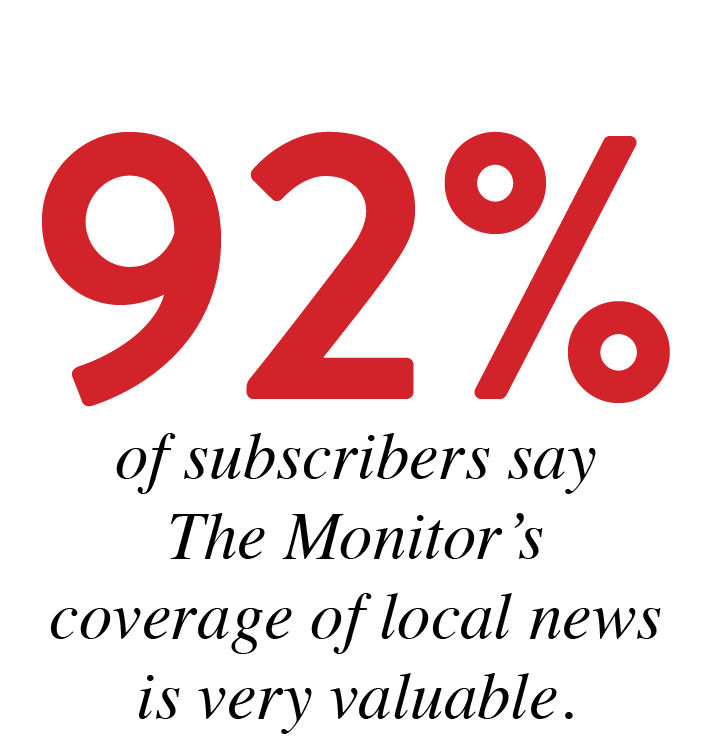
Keep it local: 92% of you told us that The Monitor’s local coverage was very valuable; another 7% said somewhat valuable. But that perception varied quite a bit by subject area: You tended to find our reporting on local economic issues, schools, public safety, and civic engagement more compelling than that of aging, mental health and substance abuse, and the environment.
I think that’s completely fair: We have indeed overweighted our coverage in those areas. We have committed to focusing more this year on mental health and aging — notably with the “Graying Pains” series, on issues facing seniors in rural Montana, that will resume later this year.
Some complained that too much of the paper is given over to stories that have nothing to do with Jefferson County. “I don’t need to read or hear about what the national and world news has brainwashed us,” one subscriber wrote. Another observed: “National news is rather one-sided and not important.”
I’m somewhat mystified by this, since the only national reporting that finds its way into the paper is the occasional “Fixes” column, republished from The New York Times. (For what it’s worth, The Monitor is the only newspaper in the U.S. besides The Times that can run this feature.) But the criticism is noted.
We will continue to regularly publish relevant reporting from Montana Free Press, a news service that, in my opinion, provides mostly excellent coverage of state politics and economics. We believe it’s important that our local coverage be read in the context of what’s happening in the rest of the state.
Focus on government: A significant number of readers, when asked what stories we should pursue that we’re not now, suggested a need for greater attention to government meetings and decision-making. “The Monitor needs to follow in the fine tradition of Jan Anderson’s coverage of the County Commissioners and school board,” wrote one. Another asked: “Is the Monitor still doing coverage of County Commission and school board meetings? Is this a priority?”
The answer is, yes and no. John Blodgett, The Monitor’s editor, spends a lot of time at public meetings — in part because there are just a lot of meetings, but also because these gatherings are, in fact, where much policy is aired and decided on. But we don’t report every week on everything that happens at every meeting. That’s because (with apologies to dedicated local officials) much of the tick-tock proceedings of local government aren’t, per se, very interesting or that relevant to most people. Instead, we try to report immediately on matters of broad urgency and importance – but otherwise, we use those meetings as sources of intelligence and context that can inform our longer-term reporting on local issues.
That said, we’ve considered creating a network of community volunteers who could attend public meetings across the county, helping us document more of this discussion and decision-making. If you’re interested in taking that on, send me a note.
Look north: We’ve worked hard in the last year to do more reporting on the growing communities of Montana City, Clancy, and Jefferson City. Some readers tell us it’s not enough: “More news from Jefferson City, Clancy & Montana City. We are a wider audience than just Boulder.” “I would love to see more coverage of North Jefferson County.” “The paper is useless unless you live in Boulder!”
I agree with the general sense of these comments (though not with the specific of the last). There is a gap between the coverage we aspire to in the northern communities and what we’ve been able to do so far. It remains a strategic priority for The Monitor to expand reporting on those communities – while sustaining our focus on Boulder, the county seat.
This is another area where we could use help: We’re looking for part-time reporters who can help us keep tabs on Jefferson City, Clancy, and Montana City. Give us a call.
Swipe right: A year ago, I acknowledged the dearth of conservative perspective on The Monitor’s “Views” page, and I wrote: “We’ll work to recruit more diverse voices, and we’ll make sure to create a forum that feels fair and safe for all.”
We’re not there yet. While our letters to the editor do reflect a broad range of opinion, our contributed columns do not. I agree with one reader who observed that the “far right and moderate-to-far left is well represented. I would love to see more opinion from the moderate conservative side.”
Multiple respondents criticized, as have others before, our decision to give regular space to Representative Greg DeVries; his columns, one reader wrote, “are divisive and offensive.” While I believe strongly in the importance of exposing citizens to the views of their elected officials, I do think that our experiment in giving unfettered space to legislators did not regularly foster the constructive public discourse we had hoped for. Some adjustment is needed.
So: While I’m very proud of what The Monitor has accomplished in the last year, we have work yet to do.
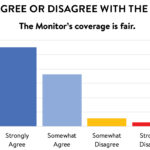
I’m well aware that people see The Monitor through their own filters. Some think it’s too focused on Boulder; others think it’s not focused enough. Some love our coverage of high school sports; others think we do way too much. There’s still disagreement about whether our coverage is politically biased, or not.
I think that, ultimately, that’s a healthy tension, and I’m grateful for it. I’m at least as grateful for the many notes of support that came with your responses, even from those who said there’s significant room for improvement. And I deeply appreciate the time and care that you took to tell us what you think — an investment that tells me, above all, that you believe The Monitor matters.
Contact Keith Hammonds at keith@boulder-monitor.com.