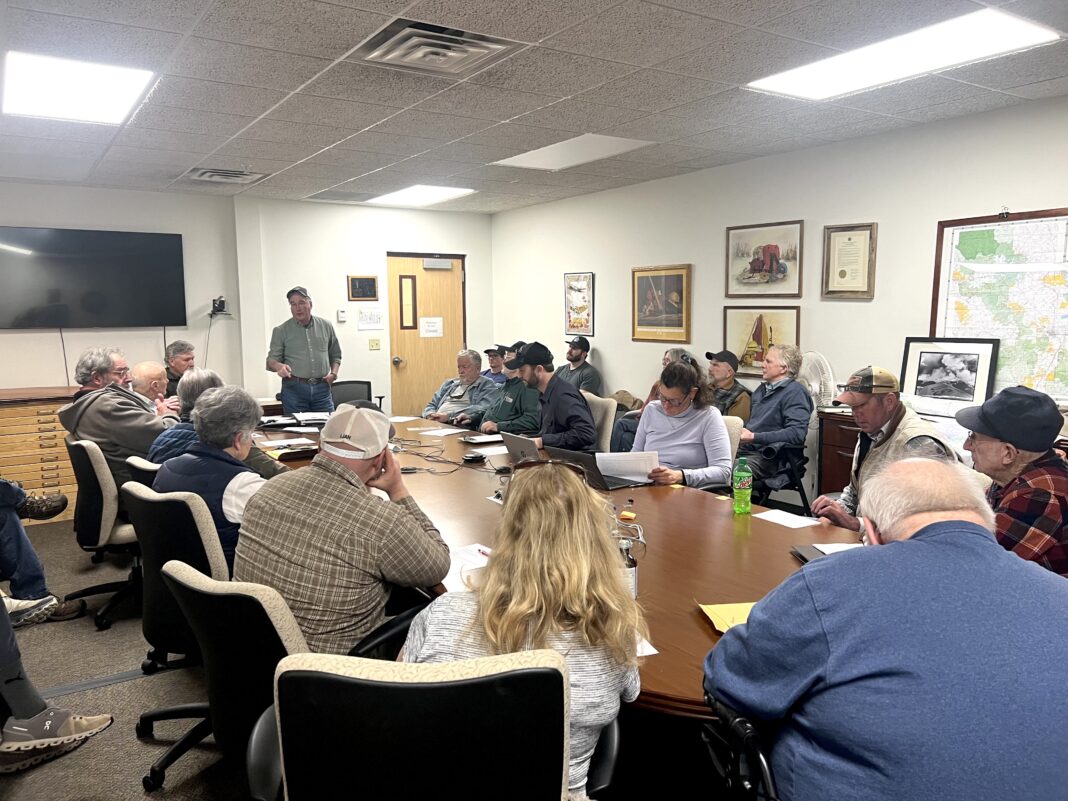
The Elkhorn Working Group, a volunteer organization that assists federal agencies with wildlife and wilderness management in Jefferson County, and the Big Elk Divide Restoration Committee voted on Mar. 11 to draft letters of concern regarding more than 360 probationary U.S. Forest Service workers who were fired in Montana as a part of federal austerity measures.
While those workers were reinstated last week when the federal Merit Systems Protection Board issued a 45-day stay on the termination of probationary employees, members of both groups, gathered at a joint meeting in Helena, said they were deeply concerned about the quality and long-term security of forest and wildlife management in Montana.
“From our point of view, the problem is that, in the sweeping brush stroke of these firings, no one took into consideration how the forest service actually operates, and who is responsible for doing what,” said Elkhorn Working Group member Mike Korn, in an interview with The Monitor. “Nobody in their right mind disagrees with the idea of going through and seeing where there’s waste, and cleaning things up. But this was done terribly. And the fact is that the folks who were canned here are our neighbors and friends, and I hate to see them in the position they’re in.”
Both the Elkhorn Working Group and the Big Elk Divide Restoration Committee intend to send letters of concern to U.S. Senators Steve Daines and Tim Sheehy and U.S. Congressmen Troy Downing and Ryan Zinke. While the Elkhorn group’s letter is still being drafted, Korn says it outlines the potential second and third order impacts of the firings on fire mitigation, wildlife management, timber harvesting, rural communities, and future wilderness projects in Montana.
Korn and other meeting attendees said they were concerned that staffing cuts will directly affect the U.S. Forest Service’s ability to respond to significant fire events, while also placing at risk the agency’s recreation and wilderness research priorities.
Korn says the Elkhorn Working Group hopes to send its letter sometime before the end of March. “We don’t want to send a letter that’s out of sync with what’s actually going on,” he said. “Things are changing every day, so we want to make sure we’re responding to what’s really happening.”
The Helena meeting was attended by retired and active members of the U.S. Forest Service, the U.S. Bureau of Land Management, the U.S. Fish and Wildlife Service, and the Montana State Department of Natural Resources and Conservation. While Forest Service employees attended as a part of their regular coordination with Elkhorn and Big Elk Divide groups, they absented themselves before planning began for drafting the letters of concern.
“I’d ask you not to blame the agencies,” said Bill Avey, a U.S. Forest Service retiree, during the meeting. “Blame the (Trump) administration, because they’re the ones who directed it. And, also, our congressional delegation hasn’t said anything about it. I am not being political, it’s just the hard reality of what we’re seeing. The agencies didn’t ask for this.”