
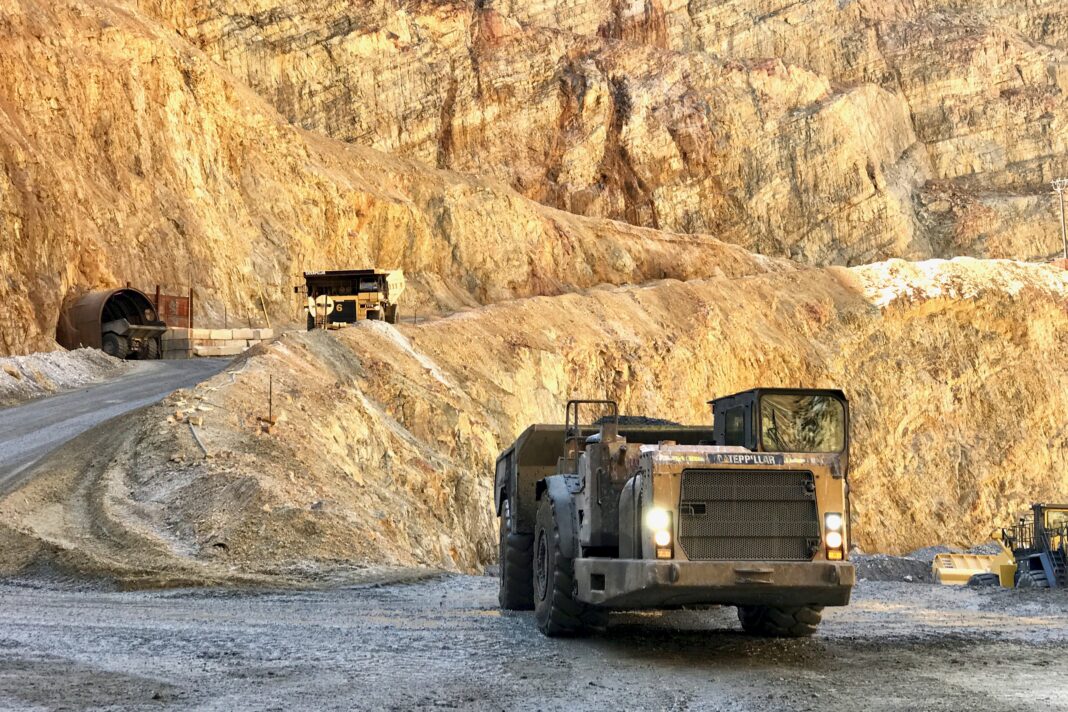
Twenty people gathered around a table in Whitehall’s historic Borden’s Hotel on Thursday, April 25 for the first of what promises to be many talks on how the community might adapt to the end of gold mining at Golden Sunlight mine.
“Following a detailed review of the Golden Sunlight operation, new underground development has ceased, and mining is limited to existing areas only,” states a March 21 news release from Barrick Gold Corporation, the mine’s owner. “A final mill run to process gold ore is currently scheduled for May 2019.”
A few weeks after the announcement, the Butte Standard reported that the company doesn’t expect to reduce its workforce — currently 53 employees, 41 of them contractors — until Sept. 30. The report also states that contractors and subcontractors, numbering 103 at the end of March, have already been leaving.
The ceasing of gold mining was not unexpected. The March 21 statement noted that the mine “has been approaching the end of its operational life in recent years, with the mine’s remaining gold reserves nearly depleted,” and significant layoffs occurred in 2015 when the mine began shifting from open-pit to underground mining.
Absolute closure of the facility is not imminent. Reclamation and related efforts will continue for years, and Barrick Gold Corporation is exploring the feasibility of processing the mine’s tailings for sulfides for use in its gold mining operations in Nevada. However, the company does not appear to expect staffing levels to match previous levels.
The Jefferson Local Development Corporation — whose offices are housed in the former hotel — convened Thursday’s meeting as an extension of its monthly Community Transition Advisory Committee meetings.
The Committee, known as CTAC, was formed before previous slowdowns at the mine and lets various community entities apprise one another on economic and community development matters.
The people at Thursday’s meeting represented a similar cross-section of the community. They included residents, business owners, bankers and Golden Sunlight mine staff.
Tom Harrington, the MSU Extension Agent for Jefferson County who leads the JLDC, told attendees that it was an opportunity to capture thoughts and ideas about the mine’s impact on the local economy and how the community might offset any related losses.
Harrington pointed to the Boulder Transition Advisory Committee, or BTAC, as a good model to follow. JLDC formed BTAC after CTAC to respond to the Montana Developmental Center’s closure, and that body’s efforts have shown that “leadership and vision are probably the two key things” necessary for determining “where we are going from here and what are we gonna do,” he said.
“[MDC’s closure] happened,” Commissioner Leonard Wortman said at Thursday’s meeting. “But in reality we started looking at it not as a negative but as an opportunity, and I think that as the people of this area look at the eventual closure [of the mine] … it opens up opportunities.”
When asked at the meeting about the impact of Barrick deciding to build a tailings processing plant — as well as a water treatment plant — at the facility, Chuck Buus, the mine’s environmental superintendent, said it would be “huge.”
Regarding the processing plant, called a concentrator, Buss said he was “amazed at the traction that it’s getting” within Barrick and guessed that the company might decide whether to proceed with it by Sept. 30.
He said he expected Barrick would build a water treatment plant to deal with mining wastewater “regardless.”
Buus didn’t know how many jobs either could provide, and noted that work such as removing tailings and cleaning the aquifer could take 10 and 20 years, respectively, and backfilling the pit could last 75 years.
No matter how long the mine might provide some jobs, those gathered recognized the need to attract other jobs and amenities to the community to encourage economic development and improve the quality of life for residents old and new.
Alison Richardson, a JLDC employee who lives in Whitehall, said when she thinks about what she needs she thinks about the needs of her young family — childcare, after-school and summer activities and the like.
“How do we attract people to live and work here if we don’t have those things?” she said. “How do we make it attractive for new businesses to come here and families not just to live here, but to work here as well?”
Harrington said at the meeting’s end “these discussions will continue.”