
We’re pleased to be starting what will become a regular column on gardening for The Monitor. We look forward to telling you about the many unique and rare plants that you can grow in our harsh climate and poor, high-alkaline soil. In addition, we’ll be sharing many of our gardening secrets.
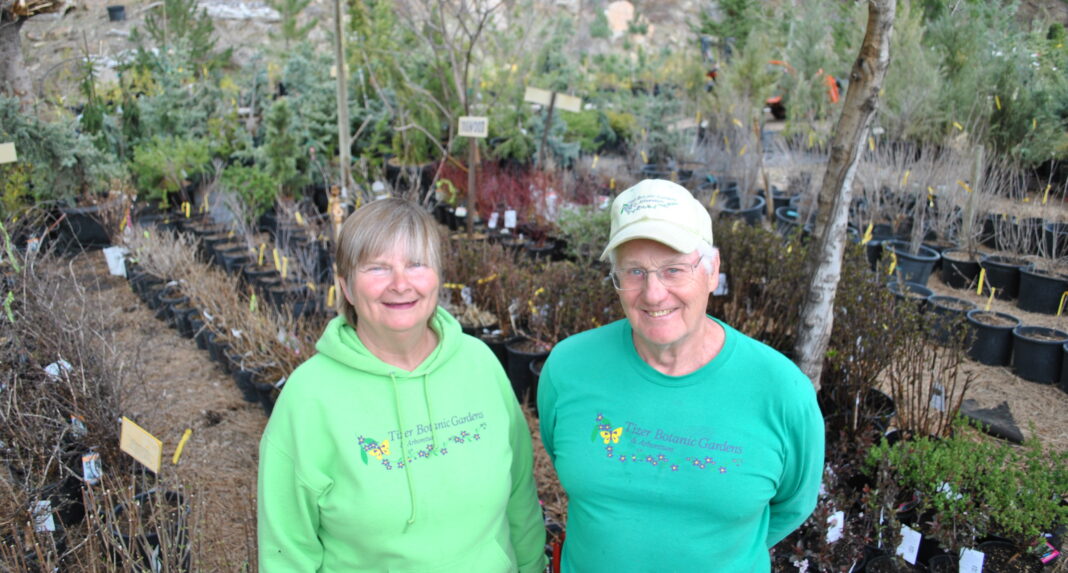
But first, let me take a moment to explain our unique business. My wife, Belva Lotzker, and I started Tizer Botanic Gardens & Arboretum (TBGA) in 1998 near Jefferson City. It began as a small backyard garden that grew to a collection that today has over 1,500 woody plant varieties and more than 1,000 varieties of perennials and other plants.
What is a botanical garden, and what is an arboretum? They are different things with different missions. A botanical garden is an institution holding documented collections of living herbaceous plants for the purpose of scientific research, conservation, display and education. Herbaceous plants are vascular plants, including many perennials, and nearly all annuals and biennials, that have no persistent woody stems above ground. An arboretum is an institution holding documented collections of living woody plants, which include trees, shrubs, roses & most vines such as grapes, clematis, and honeysuckle.
In 2005 TBGA received the designation as a Public Botanical Garden and Arboretum. In 2012 we were designated a “Level One” internationally accredited arboretum status by ArbNet, a partner of the Morton Arboretum’s international Register of Arboreta. Almost all botanical gardens and arboreta in the world are owned, operated and funded by a university or government entity. TBGA is privately owned, operated, and mostly funded by plant sales. We are not aware of another botanic garden or arboreta in the world that also operates a garden center or nursery as their major funding source. In 2018 we became a “Level Two” internationally accredited arboretum. At that time, ArbNet told us that we are one of only three privately owned arboreta in their international accreditation program in the world and they we may have the largest collection of woody plants.
TBGA is also unique in that we we are located at almost 5,000 feet in elevation. Only once in the past 20 years have we seen more than 64 consecutive frost-free days. We average between just 50 and 60 consecutive frost-free summer days. That’s one reason that, about 14 years ago, TBGA became Montana’s only demonstration garden for the Denver Botanic Gardens and Colorado State University’s “Plant Select” drought tolerant program, their northern-most site in the U.S.
Our distinctive location has caused me to think often over the years about the conditions in which plants thrive. The biggest mistake a gardener can make, I believe, is to rely on a plant’s Zone rating. The U.S Department of Agriculture (USDA) established a hardiness zone chart for the entire country. It is based on the average annual extreme minimum temperature over the previous 30 years, not the lowest temperature that has ever occurred or might occur in the future. A hardiness zone is a geographic area defined to encompass a certain range of climatic conditions relevant to plant growth and survival. For example, a plant may be described as “hardy to zone 10”: this means that the plant can withstand a minimum temperature of 30 °F (−1.1 °C) to 40 °F (4.4 °C).
People put too much faith in zone ratings. Some time ago, the USDA added a letter a or b after the zone number, which is supposed to make it more specific as to the temperature span. I believe this is pretty much useless.
That’s because all a USDA zone considers is the lowest temperature a plant can be exposed to and survive. In reality, there are many plants rated zone 1, 2, 3 & 4 that will not grow in those zones due to two other factors that are more important than a zone rated temperature: Atmospheric humidity & soil ph are often much more important than a low temperature. Some plants need one of these two conditions, and some need both in order to do well or even survive.
Most of the Rocky Mountain region lacks both of these attributes. Our atmospheric humidity is very low. And the average soil ph in Montana, according to Montana State University data, ranges between 7.2 & 8.5. That’s very alkaline. Some plants, like blueberries, need 4.5 to 5.5, which is very acidic.
How many plant tags have you ever seen mention anything about soil ph or atmospheric humidity? Almost none. I think this is a disservice to people buying plants.
I can’t even guess how many thousands of times people have told me that they were told by a garden center or friend that they could grow a particular plant because it was in their zone, but the plant then died. The opposite is also sometimes true: We’re growing several Zone 5 & 6-rated plants in our solid Zone 3 area with great success. The best advice before buying a plant is to talk to someone who has been successfully growing it for an extended period of time.
Richard Krott is co-founder and co-owner of Tizer Botanic Gardens & Arboretum.