At one of our local swimming holes on the Prickly Pear, I often lie in the water, feet pointing downstream, with nothing but my nose exposed for oxygen. Higher up in its reach, the Prickly Pear is unsullied and crisp, and in the effervesce of the flow past my ears I imagine it melting off of an early summer snowdrift high in the Elkhorns, down the canyon along Tizer Road collecting smaller streams and gaining power, until it parallels I-15, eventually providing a little relief to my bald and sunburnt melon, then flowing past to Clancy, Helena, and the Missouri River beyond.
Except for maybe somewhere high on our western perimeter, where a tree whose stump arises on the edge of Jefferson County but its branches dangle over the divide, all the water that falls to earth here runs to the Atlantic Ocean. The divide Montanans are most aware of is our Continental one – diverging surface flow to one of two oceans on different shores of our country, as well as delineating the western edge of our county. But divides are near-endlessly scalable when reduced, and it is those smaller catchments – what locals may refer to as “drainages”, that I’d like to explore.
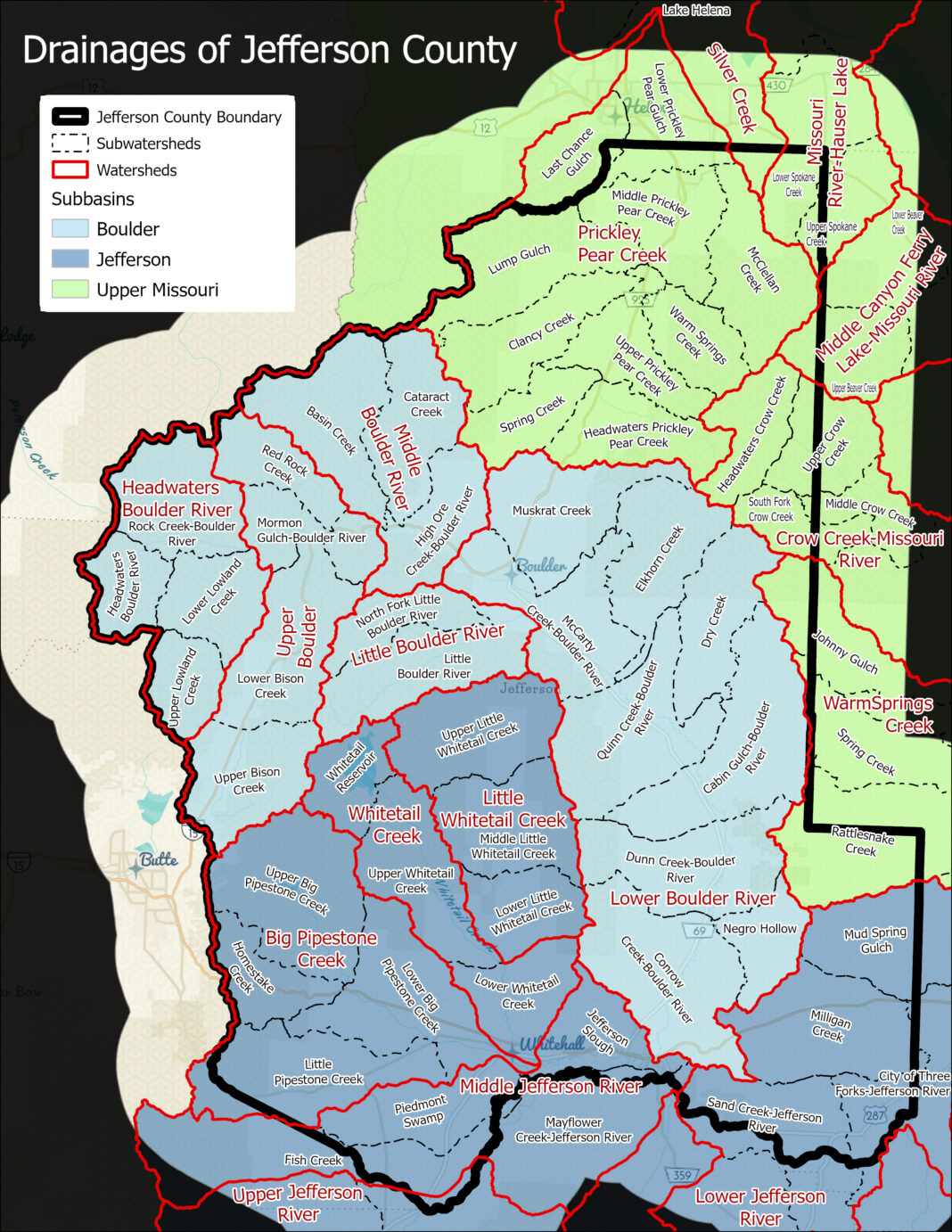
The United States Geological Survey (USGS) has a technical name for those successively smaller drainages, always nested in larger ones, that occur on earth’s topography. The term they use for these are Hydrologic Units. The largest type of hydrologic unit is a Region, followed by a Subregion, which is reduced to a Basin, to a Subbasin, to a Watershed, to a Subwatershed. When it comes to Jefferson County, the largest of those categories entirely contained here is the Boulder River subbasin.