
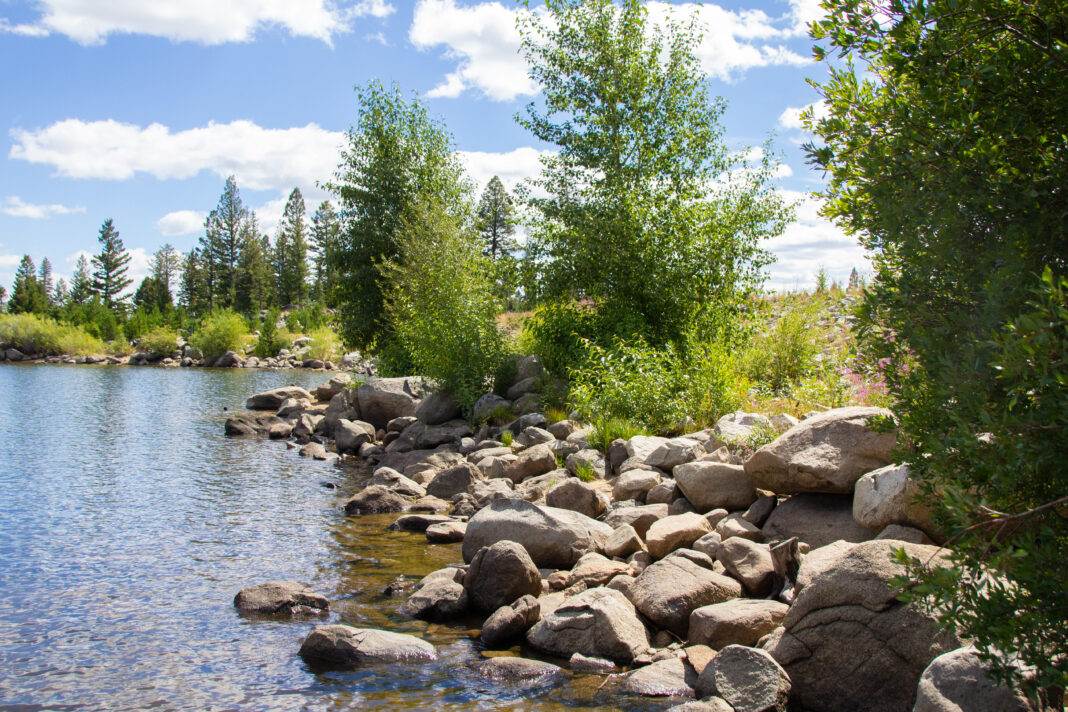
The Helena-Lewis and Clark National Forest Service began making arrangements to replace the Park Lake dam, an embankment constructed in the late 1800s on a 40-acre lake up Lump Gulch, after discovering increased water seepage and erosion in the dam foundation during the site’s annual safety and functionality inspection, according to a Forest Service press release on Aug. 23.
Helena Forest Service District Ranger Kathy Bushnell and District Public Affairs Officer Chiara Cipriano said there is no public safety emergency at this time; however, the agency has made the project a priority and “initiated a process to rehabilitate the dam” to avoid a future emergency.
At the moment the Forest Service does not have a plan of action to replace the dam, but the agency does intend to reduce Park Lake’s water level by six to eight feet in September to alleviate stress on the dam, Cipriano said, adding that the entire project is expected to wrap-up within two years.
“I understand that Park Lake is a favorite place for many, it’s one of mine, too. While this has potential to be disruptive to visitors over the next couple of years, we thank you in advance for your understanding,” Bushnell said in the Aug. 23 press release.
The Forest Service plans to pay for the dam rehabilitation project “through a combination of funding mechanisms within our agency budget,” Cipriano said. Funding will be determined after the agency completes its survey and design of the replacement.
The Forest Service plans to close the road to the lake for the season on Sept. 7, according to Cipriano. In the past, the Forest Service has “shut the gate” to Park Lake between September and October.
While Park Lake attracts many visitors throughout the year for recreational purposes, the lake also serves as an arctic grayling fish hatchery which Montana Fish, Wildlife and Parks uses to restore the species’ population throughout the state.
“We hope to avoid a grayling winterkill this year,” FWP Communication and Education Program Manager Morgan Jacobsen told The Monitor, adding that the lake must remain at a sufficient water level through the colder months.
FWP will not restock the lake with cutthroat trout this fall as it has done in the past, Jacobsen said, but plans to do so following the dam replacement. “The [dual] fishery of stocked cutthroat and naturally reproducing grayling has been relatively stable and successful for a number of years,” he said.
Cipriano said the Forest Service expects water in Park Lake to return to its normal levels following completion of the project.
“All of these impacts are going to be temporary, and we appreciate the grace of the public as we go forward,” Cipriano said.
In addition to having a plentiful fish population, Park Lake provides local emergency crews with access to water in the event of a fire. Cipriano said Park Lake is not the area’s primary source of water for fire suppression, but called it a “bonus” to have. Considering these benefits has led the Forest Service to replace the dam rather than returning the area to its original condition. “Park Lake has ecological, recreational, and historical importance,” reads the release.
Despite there being no emergency, Jefferson County Disaster and Emergency Services Director Doug Dodge said the county has taken steps to prepare for a critical situation, such as dam failure. This includes contacting residents along Lump Gulch Road and near Buffalo Creek.
“We’ve reached out to those residents directly to make sure they are aware of the problem and try to update any contact information changes they may have,” Dodge told The Monitor. “If anyone who lives on Lump Gulch Road hasn’t heard from us, but feel they should have … they should reach out to me at (406) 225-4035.”
Cipriano said the agencies have considered hosting a community meeting to connect with residents. “We’re going to keep folks updated,” she told The Monitor.
Fire Chief Tracy Leibbrandt said the Clancy Volunteer Fire Department has worked closely with Dodge to review, update and modify hazard plans. Failure of the Park Lake dam, Leibbrandt said, is an emergency that the department plans for annually.
Were the dam to break, residents along Lump Gulch Road would face significant flooding, which Cipriano said would then move towards Clancy. Cipriano explained that within 3.5 hours the flood waters would reach the small north county town, adding that the water depths could reach approximately 13 feet traveling down the mountain.
Leibbrandt told The Monitor that the agencies’ biggest concern is the possibility that flooding washes out Lump Gulch Road due to limited evacuation routes in and out of the area.
For nearly 200 years, the dam has held back the waters of Park Lake. In the late 1800s, Chinese immigrants built the dam to provide local placer miners with water. “Gold mining was a big part of Helena’s growth,” Cipriano said.
In 1908, the lake flooded and all the dams were destroyed, except the one positioned at the south end of the lake today. A hundred years later, in 2005, Montana Fish, Wildlife and Parks repaired portions of the dam, later passing the water rights and management of the lake onto the Forest Service.
With Park Lake closing only a week out, visitors carry on as usual kayaking, swimming and fishing in the lake, unbothered by the dam’s situation.
“We don’t want them to worry,” Cipriano said.
For more information, visit the Helena-Lewis and Clark Forest website at www.fs.usda.gov/hlcnf or call the Helena Regional Office at (406) 449-5201.