
The last couple of summers a crucial water-retaining slough at Trudy Dawson’s Boulder Valley ranch has run dry early, forcing her cattle to return from grazing before she’d finished the seasonal hay baling.
“That was awful,” Dawson said on a recent afternoon, recalling watching her herd lap up stale water. “I just knew something’s got to change.”
Jefferson County has been in a drought since the early 2000s, and in each of the last six years has at some point been classified as facing severe drought, according to the National Integrated Drought Information System. In January, the U.S. Department of Agriculture declared the county a primary natural disaster area, enabling ranchers to apply for emergency loans.
Whether the result of an extended dry spell, climate change, increased area demand, some unknown factor or all of the above, Dawson is certain the amount of available water has dropped considerably since her family homesteaded the valley in 1882.
Seeking a regenerative solution, she reached out to Montana Fish, Wildlife and Parks (FWP) to request one of the agency’s top nature-inspired fixes: Beaver dam analogs (BDAs) are simple, man-made structures meant to mimic the function of real beaver dams by slowing water’s passage through streams, reducing erosion and potentially raising the water table.
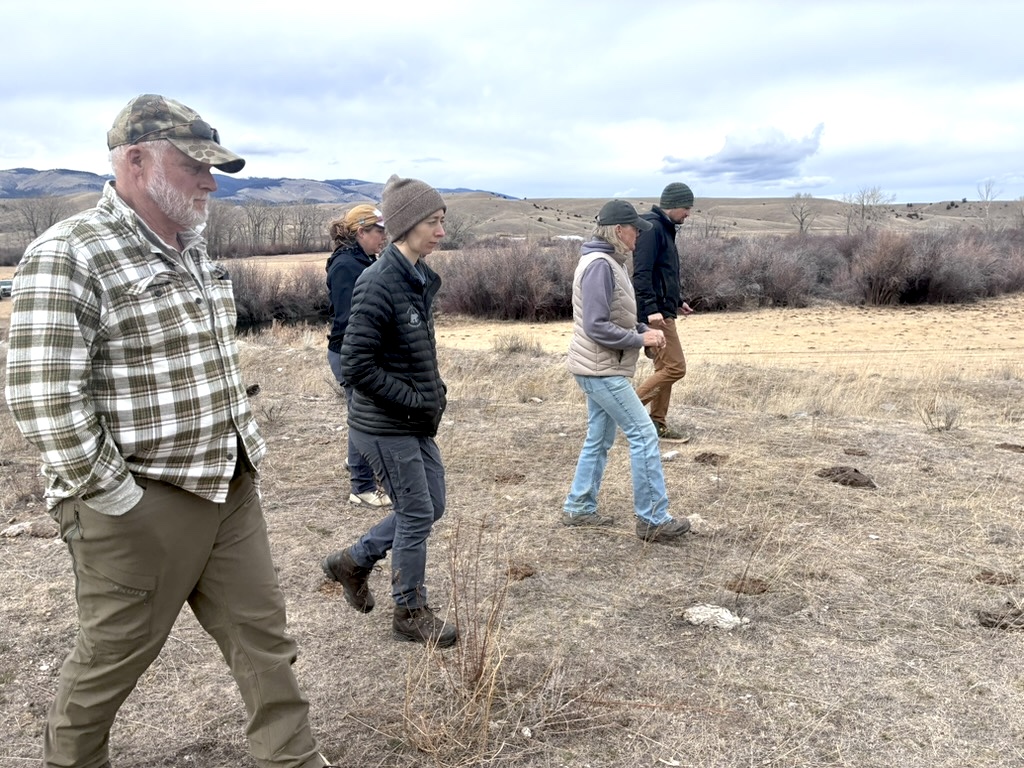
On March 4, two FWP officials and other water and wildlife experts visited Dawson’s ranch, and three others in the Valley, to assess the properties for BDAs. FWP wildlife biologist Torrey Ritter explained that BDAs can reverse incision, which is when water surges through, eroding the bed and carving a deep gulley that keeps the stream from flooding and recharging aquifers.
“That’s kind of one of the biggest signals we look for,” he said. “Are we actually starting to see a balancing out of erosion and deposition along the entire stream section that we’re working on? Alongside that, you’ll start to see native vegetation come in.
These human-made dams rely on much the same materials as nature’s furry engineers: wooden posts pounded upright into a creek bed, with flexible willow branches woven between them and caked with mud and sediment. Some BDAs aim to entice beavers into the area, while others seek mainly environmental benefits.
They’ve become the go-to fix for an array of non-profits, environmental advocates, and state and federal officials, and increasingly popular among ranchers as a cost-effective way to combat reduced water flow. A 2018 article in Science magazine described BDAs as “perhaps the fastest-growing stream restoration technique in the U.S. West.”
After watching the decline of a key stream nearly a decade ago, for instance, Idaho rancher Jay Wilde built 19 BDAs and released five beavers nearby and the next summer the stream stayed wet two months longer, irrigating his grazing meadows, the Science article reported.
Ritter cautioned that the structures are not a regenerative panacea. “The actual process of restoring a stream is very complicated, and it goes way, way beyond just building a BDA,” he said. “You have to do a lot of that work yourself, if there’s not going to be beavers there.”
The data is mixed, with some research finding that BDA impacts tend to fall short of real beaver dams. But a 2021 Wyoming study concluded that, in the short-term, “BDAs can be successfully used as a stream restoration practice to reduce stream bank erosion.”
This underscores the temptation to embrace a quick win. In Ritter’s experience, planning, building and sustainably maintaining an impactful BDA can take 15 years.
“It looks really good in the before and after pictures,” he said. “But again, if the natural processes aren’t fixed to sustain that system, after we stop going in there as humans, it’s all going to be temporary, and it’s not going to lead to a restored system.”
Ritter is unsure of the Boulder Valley’s readiness for beaver reintegration. To help along that process, Dawson plans to deal with a conifer encroachment near her streams and potentially replace them with willows, which make for ideal beaver food.
Dawson is determined to set up BDAs on her property, with or without the help of beavers. Forging ahead on the FWP dam, she’s begun the permitting process and hopes to start building in the next few months. It’s unlikely to immediately fix her dry slough, but over time it could boost the water table and keep her cattle out grazing longer.
“I don’t know if I’m doing the right thing,” said Dawson. “But you can’t keep doing the same thing.”