
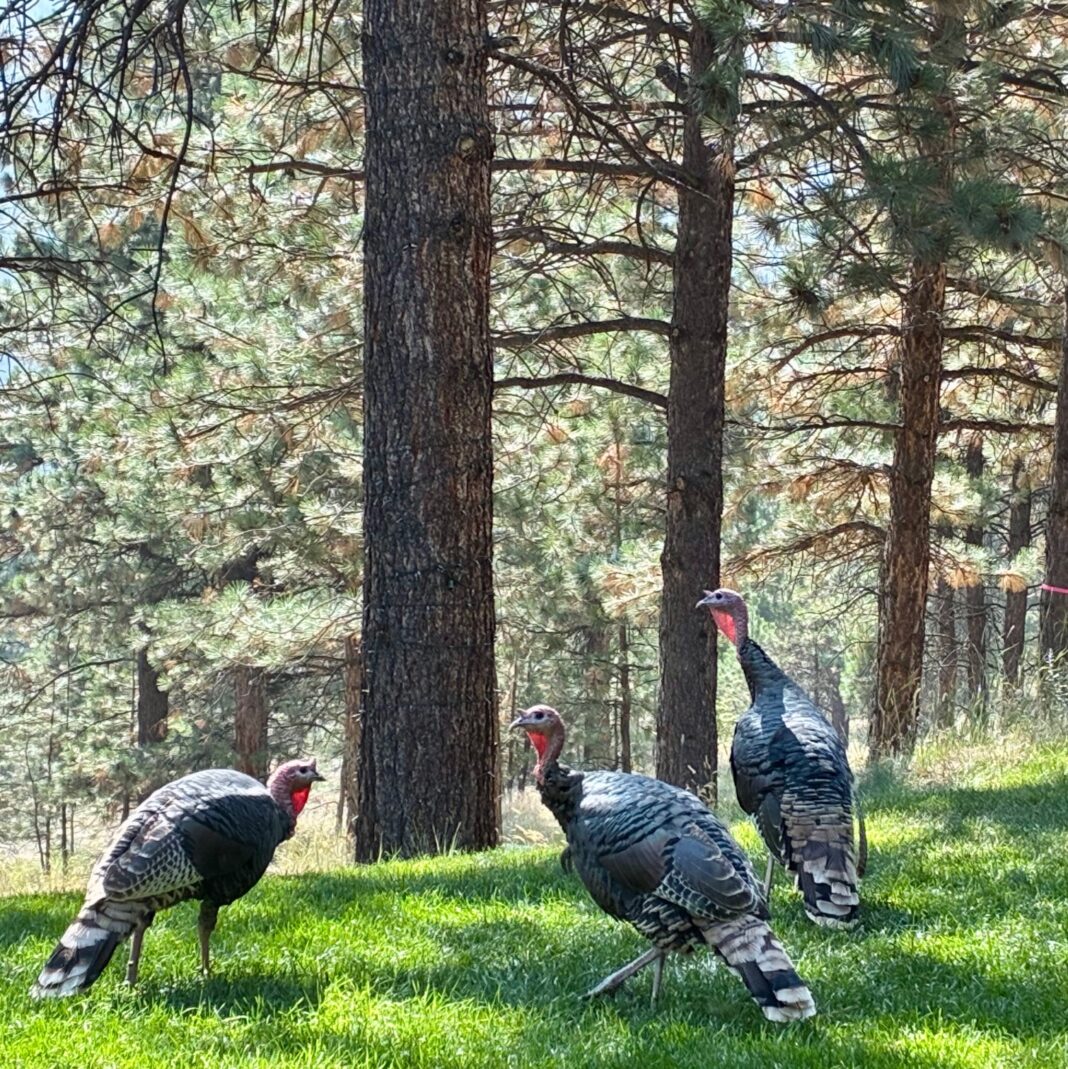
When I first moved into a rural home a few miles outside Helena three decades ago, there were no turkeys in the vicinity. But that’s all changed in the last few years as the turkeys have moved in big-time, colonizing the grassy hills and ponderosa pine forest around our house and beyond.
At first it was just a tom and a hen, then the next spring a half dozen chicks trailed behind them. Now there are many more. They wander up our driveway and hang out on our porch and the roof of our garage. The other day, as I walked through the yard, some two dozen surrounded me, chirping and thoroughly unbothered by any threat I might pose.
Then, suddenly, they all ran off. Wow, I thought, cool. A week later I saw three dozen cruising the hills together.
These are Merriam turkeys, famous for their white tipped feathers. It’s a joy to watch the males spread their tail feathers in a large circular fan behind them and strut down the road, presenting the classic Thanksgiving scene.
Wild turkeys aren’t native here. A few dozen were brought to Montana from their ancestral range of Colorado and Wyoming in the 1950s. They have flourished and there are now perhaps 120,000 across Montana. The return of the wild turkey to much of the state is considered one of the great conservation success stories. The Flathead Valley is home to some eastern turkeys, released there around the same time, but not too many.
When I see a turkey I can’t help but see a dinosaur. The big, gnarly feet, their boldness, the long scaly necks and floppy red wattle, wrinkled caruncle and fleshy snood all evoke an ancient beast.
This is partly because of the bird-like dinos in the film Jurassic Park. But it’s also because, for a book I wrote titled The Wonder of Birds, I interviewed an expert in animal locomotion at the University of Montana flight lab. Birds, he told me, “are the dinosaurs that made it.”
The dinosaur lineage, he said, still inhabits the Earth in the form of the 10,000 or so species of bird. Turkeys – along with emus and ostriches — represent the dinosaur lineage to me more than others. It’s fun to have them around, especially this time of year.
I don’t hunt turkeys, but if they eat stinkbugs and grasshoppers and voles and a variety of other pests, I welcome them to the neighborhood. Not that I have any say in the matter.
Jim Robbins is a longtime freelance journalist in Helena. The Wonder of Birds was a winner of the 2017 Montana Book Award.