
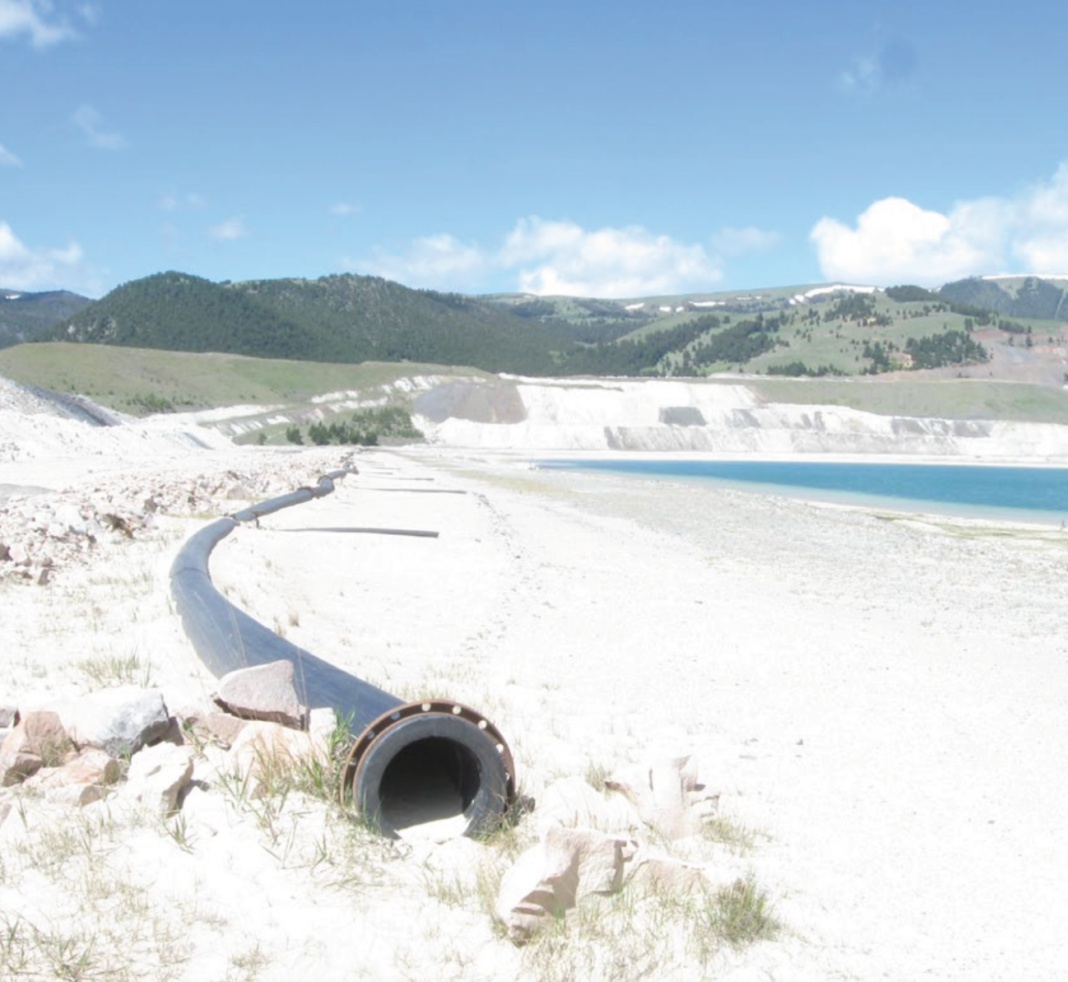
The prospects for Montana Tunnels Mining and its long-dormant mine outside Jefferson City may have become both clearer and more complicated in recent weeks.
On May 28, a federal judge denied a Jefferson County motion requesting that he reverse his previous dismissal of the Montana Tunnels bankruptcy case, effectively ending a legal marathon that had plodded along for over two years.
And earlier in May, Gov. Greg Gianforte signed a new law empowering the Department of Environmental Quality (DEQ) to seize by eminent domain, then transfer, mining properties in cases like that of Montana Tunnels, where an operating permit has been suspended.
Together, the two actions shed light on the possible legal and financial pathways that could lead to the sale of the Montana Tunnels Mine, which though inactive since 2008 still contains an estimated $1.4 billion of minable ore. They also could point the way to a long overdue clean-up of the mining site and surrounding areas.
The bankruptcy decision was not completely unexpected. Judge Benjamin P. Hursh had signaled his impatience with the logic presented by the County and by DEQ, which had argued in court that they and other creditors would be better served by converting Montana Tunnels’ Chapter 11 bankruptcy case to a Chapter 7 liquidation rather than the dismissal Hursh issued last July.
Montana Tunnels owes the County $3.1 million in back Metal Mining Taxes and DEQ $17 million for the cost of repairing environmental damage from the mine.
In December, Hursh gave the battling parties an opportunity to work things out, encouraging them to enter into a settlement conference with a judicial mediator. But those talks were abandoned in March. And in his harshly worded, occasionally entertaining decision last week, Hursh observed that the County’s petition “evidences a fundamental misunderstanding of this Court’s underlying decision.”
The case had been dismissed, he noted, on very simple grounds: Montana Tunnels’ bankruptcy plan explicitly required dismissal unless the company made certain payments by a deadline — which it very much failed to do.
Jefferson County Treasurer Terri Kunz was not surprised by Hursh’s ruling. “But I am disappointed,” she told The Monitor. “I don’t think the judge knows the whole story.”
Montana Tunnels may now transfer the mine to Goldfields Funding Partners, an affiliate company created in 2021 to pay the County $5.1 million in property taxes on the mine. The County and DEQ worry that transferring the mine to Goldfields — a move Montana Tunnels agreed not to pursue until the resolution of its bankruptcy case — could make it more difficult for creditors to collect on their debts.
DEQ lawyers said during a Dec. 11 hearing that, if the Montana Tunnels case were dismissed, DEQ would hire a company this spring to begin restoring the area around the mine site. That would be a more aggressive timeline for clean-up activities than required by state law, which gives DEQ five years in cases like this to start reclamation.
It’s not clear whether DEQ will now stick to that timetable; a department spokesperson said only, “DEQ continues to evaluate all its options.” Meanwhile, the governor’s approval of House Bill 717 presents a new option: DEQ can ask a district court to grant it immediate possession of Montana Tunnels’ property, then resell the mine to a new operator.
Mooney Group, a Florida-based company that owns the Barretts Minerals talc mine in Dillon, has indicated its interest in buying the mine near Jefferson City. The DEQ spokesperson did not say whether the agency had begun work on a request for eminent domain. But Kunz said she had discussed with DEQ the county’s possible organizing of the required public input meeting.
The new law is not a quick fix. Its sponsor, John Fitzpatrick (R-Anaconda), has noted that eminent domain proceedings can take a long time. Sources in the mining industry have speculated that DEQ could instead use the threat of a property seizure as a lever to pressure Montana Tunnels, and other companies in similar situations, to sell without legal action.