
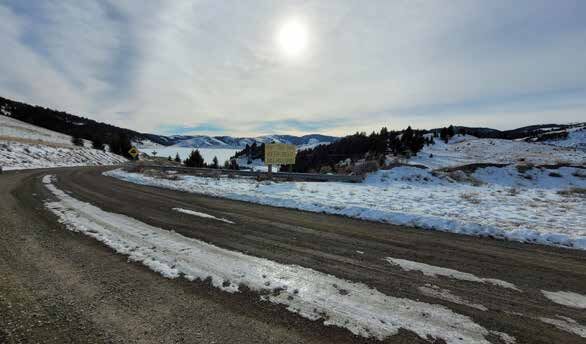
The Montana Tunnels Mining bankruptcy saga may be nearing the end.
Maybe.
Following Montana Tunnels’ failure to meet several hurdles set out by its Chapter 11 bankruptcy plan, acting U.S. Trustee Gregory M. Garvin moved last month for the company’s case to be dismissed or converted to a Chapter 7 liquidation, according to papers filed with the U.S Bankruptcy Court in Butte.
Montana Tunnels (MTMI) responded on Feb. 20, objecting to the motion and suggesting a modified plan that would reschedule its payments to the state Department of Environmental Quality (DEQ) and its creditors — including Jefferson County, which is owed $3.1 million in back taxes and fees.
The bankruptcy court has set a hearing for April 10 to consider the objection.
The latest back and forth could signal resolution of a bankruptcy proceeding that has proved long and, perhaps predictably, rocky. MTMI and its creditors agreed last October to a plan of reorganization for the mining operation, which owns a long-dormant mine outside Jefferson County. That plan hinged primarily on the company’s full payment of a $40.96 million bonding mandated by DEQ to ensure that the costs of future environmental liabilities are met.
Montana Tunnels made its first $1.5 million payment against the bonding by Nov. 30, but it failed to make the next $1.5 million payment, due Dec. 31. With that, DEQ acted on Jan. 22 to force the forfeiture of the bond, starting a process that could lead to the mine’s sale to another owner.
In its motion to dismiss or convert the bankruptcy case, the U.S. Trustee noted that MTMI also had failed to pay statutory quarterly fees for the fourth quarter, and to file monthly operating reports for the months of October through December. It also has yet to make the first two monthly payments of $78.248.13 each due Jefferson County, according to Treasurer Terri Kunz.
A dismissal of the Chapter 11 proceeding would essentially return MTMI to square one, allowing its creditors to pursue the amount owed them immediately. In a joinder to the U.S. Trustee’s motion, however, the DEQ observed that since MTMI can’t engage in mining operations without the required bonding in place, “the best interest of creditors…may well be better served by conversion of MTMI’s Chapter 11 case to a case under Chapter 7 of the Bankruptcy Code.”
Chapter 7 allows a trustee to sell a bankrupt company’s assets to a financially sound buyer “which could post the requisite bonds and resume mining operations in an economically and environmentally responsible manner,” DEQ wrote.
In its response, Montana Tunnels acknowledged its failure to pay the DEQ bonding. It wrote that its corporate affiliate Montana Goldfields had entered into a binding letter of intent with Dignity Gold on Oct. 4 for funding of $32 million through the advanced sale of gold from the Golden Dream Mine of another affiliate, Elkhorn Goldfields.
Montana Tunnels said that the agreement was subsequently assigned by Dignity Gold to another company, Becker8 Gold LLC. On Oct. 23, it said, Elkhorn Goldfields entered into an agreement with Becker 8 Gold for a promissory note of $4.5 million, which included an advance of $2.1 million.
Becker8 Gold failed to make its December payments under the agreement, leading to MTMI’s inability to pay the DEQ bonding, it said. Because Becker8 “has violated their prior agreements, have no exclusivity, and are in default,” MTMI said it “is working to have a back-up plan in place.”
The company wrote that it was preparing a modified plan of reorganization, that would extend the original deadline for full payment of the DEQ bonding to March 31 — an odd statement, since March 31 was, in fact, the original deadline. It also proposed to make initial payments to creditors by April 4.
Under the modified plan, it said, “if MTMI fails to make the March 31, 2024 deadline, it will agree to a sale of the Montana Tunnels to an operator acceptable to the DEQ.”
James A. Patten, an attorney for MTMI, did not respond to a request to discuss the latest court proceedings. A spokesperson for the U.S. Trustee told The Monitor his office would not comment beyond the filing.
Kunz said the county would prefer dismissal or liquidation — providing a path to what would likely be a quicker resolution of Tunnels’ debt — to MTMI’s modified plan. “I have no interest in modifying the [payment] schedule,” she wrote.
Indeed, Montana Tunnels’ journey in Jefferson County has been torturous. The Jefferson City mine, which once produced gold, silver, zinc and lead, has not operated since 2008. MTMI took control the following year — and has regularly claimed in the years since its intention to reopen and even expand the operation.
The plan to salvage the company from bankruptcy has always appeared tenuous, dependent on the company’s ability to either secure new loans or restart the mine’s operations, or both, to pay creditors. MTMI Chairman Patrick Imeson said in October that he hoped to launch operations at two small mines, Golden Green and Diamond Hill, this spring. Doing so, he said, could create confidence for an initial public offering of stock, or note or bond financing, that would support the reopening of the much larger Montana Tunnels mine.
In the meantime, the property itself has degraded, according to DEQ and Earthworks, an environmental advocacy group that in 2018 conducted a review of the site with Trout Unlimited Montana.
That report noted that testing in 1987 had found elevated cyanide levels in groundwater monitoring, and that a 2008 environmental impact study determined that groundwater quality “have exceeded secondary maximum contaminant levels (SMCL) for sulfate and manganese and increased in concentrations over time. Average concentrations of cadmium and zinc were also above water quality standards.”
And in 2020, an environmental assessment prepared by DEQ’s Hard Rock Mining Bureau recommended constructing a new, half-mile channel for Clancy Creek, moving it away from the mine’s failing pit wall and out of the plastic pipe that has contained the waterway since 2013.