
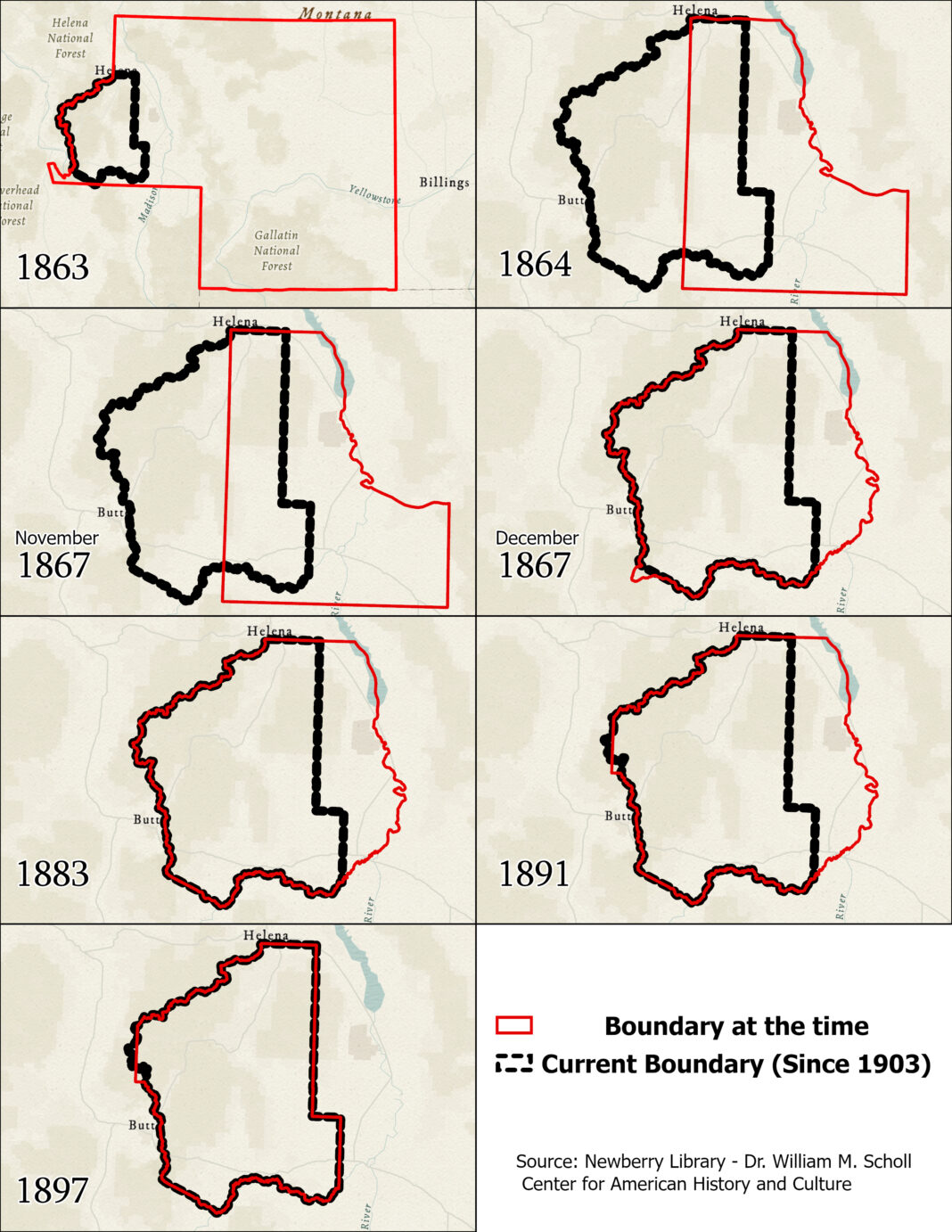
Back when Honest Abe was president of the United States, during Idaho Territory’s first session of 1863, the county we call home was first constituted. Like anything born 158 years ago that is still around, it looks different than it did then. It’s seen a thing or two. Jefferson County is a place that has changed hands between territories and watched one become a state. It’s given and taken, and in its time has been defined by mountain ranges and section lines.
One of the chief purposes of a county is to provide those within it a form of accessible government. Since its creation, Jefferson County’s borderlines have changes 7 times. It’s a land with a memory of many frontiers. In following the revisions and adjustments of our county, we might find that exploring how something got somewhere can be as interesting as seeing where it is.
In 1863, the administrative boundaries of Jefferson County were fabricated as a chunk of Idaho Territory. Our western boundary was similar to the one we have today, but our eastern boundary was 165 miles away from the Continental Divide, past modern day Columbus and only 25 miles from Billings. The county was big north-south too – stretching from the current Wyoming border to 138 miles north and containing all of the Big Belts, Crazies, and Beartooth ranges – over 2,200 square miles.
That was short-lived though, and a year later, in 1864, Jefferson County was recreated in Montana Territory. It was the Elkhorns and the Boulder Valley and not much else. Today’s county seat wasn’t even in the county.
Three years after that, in November of 1867, the 4th Montana Territorial Legislature changed the county boundary ever so slightly. The 19-mile line that delineated our northern border was a bit wavy, and they straightened it out, exchanging a bit of land with Edgerton County, which today is Lewis and Clark County.
Only a month later, the Territorial Legislature more than doubled Jefferson County in size. They pushed our western boundary to the Continental Divide, and our eastern boundary to the Missouri River. All of the Elkhorns were ours.
16 years later, in 1883, Montana Territory adjusted our boundary slightly once again. A small peninsula in the southwestern corner of our county that followed Fish Creek up toward its source was removed and given to Silver Bow County, and a bearing clipping it off clean and making a straight line to the head of Little Pipestone Creek was established.
A while after that, in 1891, no longer a part of Montana Territory but rather, the State of Montana, we exchanged a small chunk of our western edge with Deer Lodge County, and instead of following the Continental Divide, a ten-mile section of our western fringe was a straight shot north.
Six years later, in 1897, we gave up the banks of the Missouri River and half of the Elkhorns to the creation of Broadwater County, establishing the eastern boundary we see today. What a gift. Have they ever thanked us?
In 1903, the Jefferson County boundaries we see today were finalized. That adjustment that had been made in 1891 must have been a bad idea, because they reversed it. Through the creation of Powell County, we exchanged land with Deer Lodge and Powell Counties, and returned our western periphery to the Continental Divide.
For the last century, though our interior has evolved drastically, our perimeters have been fixed and unchanging, and it would probably be safe to say this time of peace on our dividing lines will persist. That said, if Broadwater County ever wants to give us Radersburg, or the western shores of Canyon Ferry, we should take them up on it. They owe us anyway.