
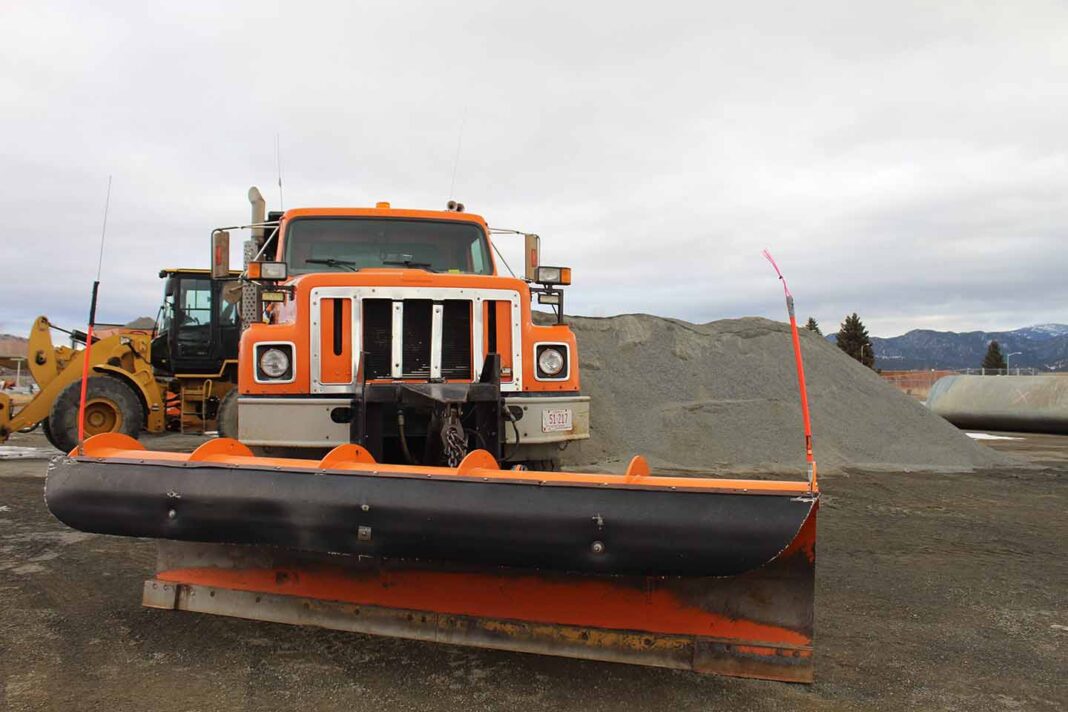
It happens every time it snows.
Someone will push the excess snow from clearing their driveway across a Jefferson County maintained road.
The excess snow results in berms and snow banks and that causes accidents, as well as issues for the road crew that is trying to keep the thoroughfare clear, said Roads Supervisor Michael “Bear” Taylor.
That’s just one recurring problem encountered by the Road Department, whose job it is to keep much of the county’s 875 miles of maintained roads plowed each year.
And with winter having officially begun on Monday, it’s likely that snow plows will soon be a common sight on those roads in the coming months — with different roads being handled by different agencies and having varying priorities.
The state maintained roads — namely I-15 and Montana 69, to include Main Street and Centennial Avenue in Boulder, and the frontage roads — are plowed by the Montana Department of Transportation.
The City of Boulder takes care of the roads within its city limits, while the remaining roads, which are prioritized by the amount and type of usage they receive, are plowed and sanded by Jefferson County.
The county Road Department has a snow removal policy to help residents understand when their road may or may not be plowed.
Top priority during and following a storm are roads that also serve as school bus routes, such as Depot Hill Road in Boulder, said Taylor.
Other high priority roads include Upper and Lower Valley roads and Muskrat Lane in Boulder, a portion of Lowlands Road in Elk Park and Cedar Hills Road, Piedmont, Parrot Castle and Mulligan Canyon in Whitehall. In the northern end, the high priority roads are McClellan Creek, Corbin, Jackson Creek, Lump Gulch and Clancy Creek roads.
The county also plows Elkhorn Road, as well as Basin Creek Road and Boulder Valley Road in Bernice.
Next on the list are major subdivision collectors and most of those are in the northern end of the county, said Taylor.
There are numerous subdivisions in the northern part of the county that are responsible for clearing their own roads, he said.
Third priority goes to residential and other local roads that carry a moderate to low traffic volume. Last on the list are cul-de-sacs or dead end roads that have very low traffic volume.
The four levels of prioritization are accompanied by four phases of action during and following a snow event. The county will only plow dirt roads when there is at least three inches of snow because any less can cause damage, said Taylor. Hard surface county roads can be plowed with less, but not with less than an inch for the same reason.
Besides, plows are not “a squeegee,” he said.
Taylor said his department gets a good amount of calls from folks at all hours expecting the plows to be out there, but it’s not financially feasible.
“We don’t have the manpower to chase every snowflake,” he said.
Phase I calls for opening all priority 1-3 roads, in that order. A severe storm may delay response time for priority 3 roads because opening major arterials requires multiple lanes to be plowed in each direction.
Phase II includes plowing and sanding problem roads with steep inclines, curves, bridges or overpasses, widening any priority 1-3 roads if necessary and repeat plowing of all streets as snow continues to accumulate.
Phase III calls for removing packed snow and ice on priority 1-3 roads, and plowing of priority 4 streets as resources become available, and that could be several days after the storm has ended.
Phase IV is when the storm is over and plows continue widening to improve travel.
Taylor, who used to plow for the Montana Department of Transportation, said the state is required to keep the roads open 24/7, but that doesn’t apply to the county.
The county plows during regular working hours and are generally on the road at about 6 a.m. unless it’s a major snow event. The goal is to get the roads cleared before the school buses start running, said Taylor.
There must be at least three inches of snow on a majority of the road, or severe ice conditions before operators will be called out after hours or on weekends.
The county Road Department uses three to four plows in the Montana City area and two to three each in the Boulder and Whitehall areas. The department spends about $15,000 a year on sanding material and $4,000 on salt. What goes on the roads is a mix of about 90% sand, for traction, and 10% salt to keep the sand from freezing.
The sand is used for traction and special attention is given to roads posing specific safety concerns, such as schools, bridges and overpasses, turn lanes, curves, heavy traffic areas, among others.
In addition to folks pushing their driveway snow onto county roads, another problem is speed, said Taylor.
Some people do not drive to the conditions and the Road Department cannot keep the roads perfect during a snow event, said Taylor. Taylor advises those living on lower priority roads to plan ahead because they may not be able to get out for a day or two.
As for pushing driveway snow into a roadway, well, that is considered encroachment into a county right-of-way, said Taylor.
There are ways to issue fines for offenders, but the county would rather folks be responsible, said Taylor.
Plowing isn’t difficult, “just pushing snow,” and Taylor said his crew is good at their jobs.
But many motorists fail to give the plow drivers the right of way nor do they slow down and allow the plow room to maneuver. For Taylor, it shows a lack of respect and if the public provided more cooperation, they could do a better job.
“It’s our office, it’s where we work … everyone wants respect in their own office,” he said.