
Once every five years or so, state, county and municipal officials across Montana imagine the worst that can happen — and then consider how they might prepare for that.
The result is a Hazard Mitigation Plan, a comprehensive document intended to help communities reduce or eliminate long-term risk to people and property from natural disasters or other hazardous events. It is arguably the most conservative document in the state: If something could go wrong, this plan probably has accounted for it.
The draft 2023 Western Montana Region Hazard Mitigation Plan, one of three produced for regions statewide, was published in early October. It includes a 284-page regional plan and 18 separate “annexes” for each of the participating counties. Jefferson County’s annex alone runs to 57 pages.
That represents a lot of work and no small expense, says Doug Dodge, head of the county’s Office of Emergency Management. But it’s also a critical resource — first, because it’s sound policy to identify and assess potential risks, but also because a hazard mitigation plan is required for certain grants made by the Federal Emergency Management Agency (FEMA). Even though chances are low that Jefferson County or its municipalities, Boulder and Whitehall, could qualify for a FEMA grant, Dodge said, the plan is still a worthwhile “insurance policy.”
The heart of the Jefferson County annex is a 57-item compendium of action items — a “wish list,” as Dodge says. “That is the living part [of the document], something we add to over time.”
The plan and its action items are formulated with a long view. Its authors understand both that the risks they identify will persist and that addressing them all immediately would be impossible. “The list can be overwhelming,” Dodge says. “Even one of these projects can be daunting from a management perspective. So you have to bite off pieces.”
For example, flooding is a significant hazard for areas in Whitehall along Whitehall Creek, Big Pipestone Creek, and Jefferson Slough. Nine of the 57 action items address that risk in some way — from installing new culverts and upgrading roads for run-off management to clearing debris from stream channels to evaluating the feasibility of a new flood channel. Improvements have been made, but Dodge notes that some potential actions have been in the plan for years. A new flood plain map in the works may help the county better target its flood prevention efforts.
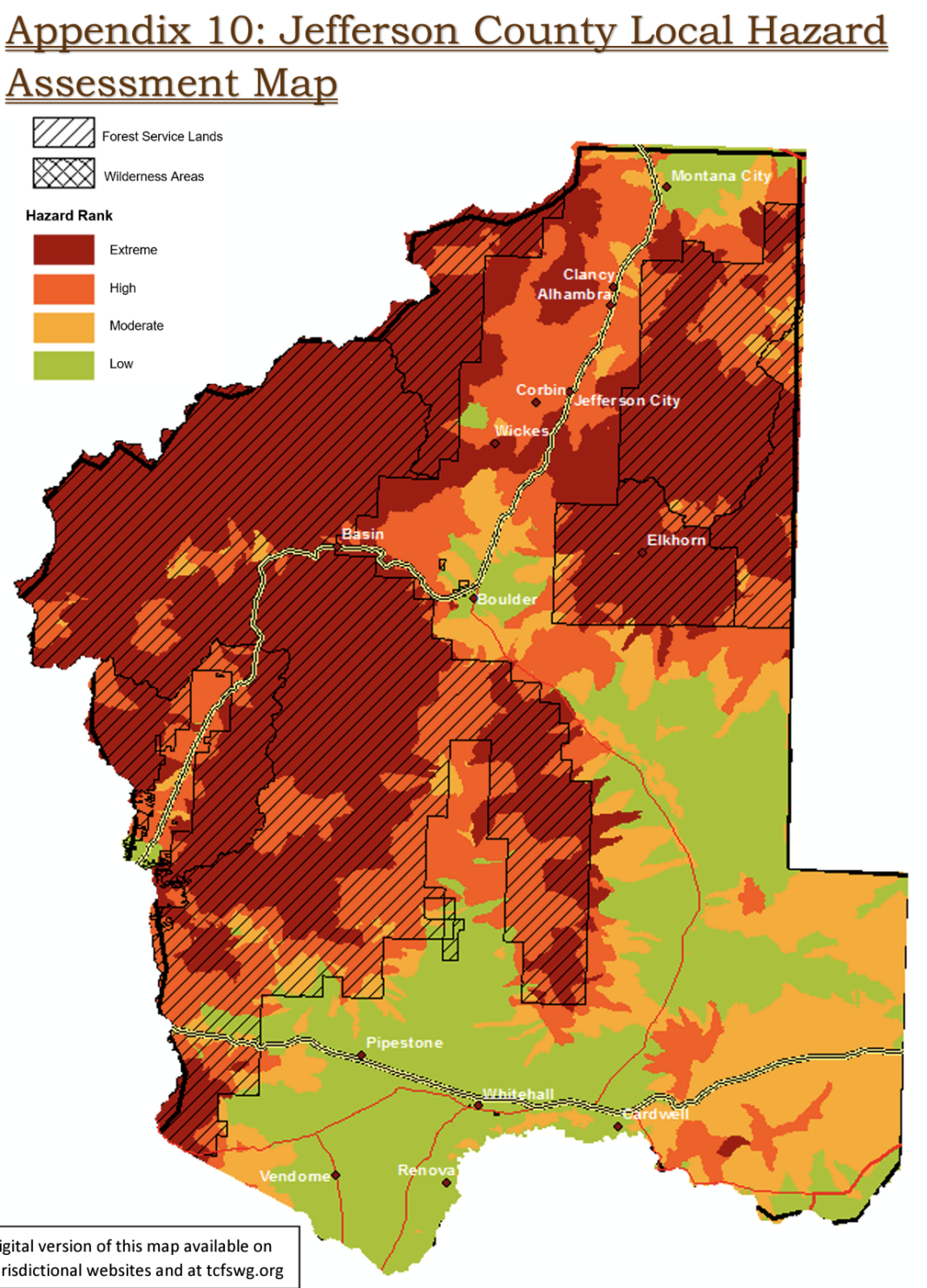
Fourteen of the action items address wildfire. “Jefferson County ranked wildfire as a high significance hazard,” the plan notes; large portions of the county, especially in forested sections in the county’s north and west, are designated as extreme hazards. Jefferson County has had 598 wildfire calls for service since 2017, according to the plan — most notably, the Haystack Fire, which burned 24,011 acres near Boulder in 2021. “Events similar to the size and scale of these fires are very likely to occur again, especially in the event of a dry summer,” it notes.
Action items proposed in the plan include fuel mitigation around historic sites, near Basin and other vulnerable communities, and on evacuation routes and power lines. The plan also includes outreach to citizens on wildfire mitigation techniques and pressing for subdivision regulations that require vegetation management plans.
Four action items are new to this year’s plan. One would pre-wire certain critical locations such as shelters, fire stations and community centers) for generators that would ensure continuity of essential services in the event of a power outage. A related item would investigate either shared generators or rentals that would make generators accessible to those critical locations in an emergency.
Dodge also envisions purchasing an incident management trailer that could serve as a mobile communications and planning center for hazards that emerge in remote areas.
A fourth action item would enhance highway safety to reduce transportation accidents on high-risk roadways like Interstate 90 at Homestake Pass and Interstate 15 on Boulder Hill and the Basin Curves. That could include wildlife crossings, Dodge says, or far less costly approaches like more and better signage.
The Hazard Mitigation Plan is available at https://virtual.woodplc.com/VirtualSpace/143511. The period for public comment closes on Nov. 5.