
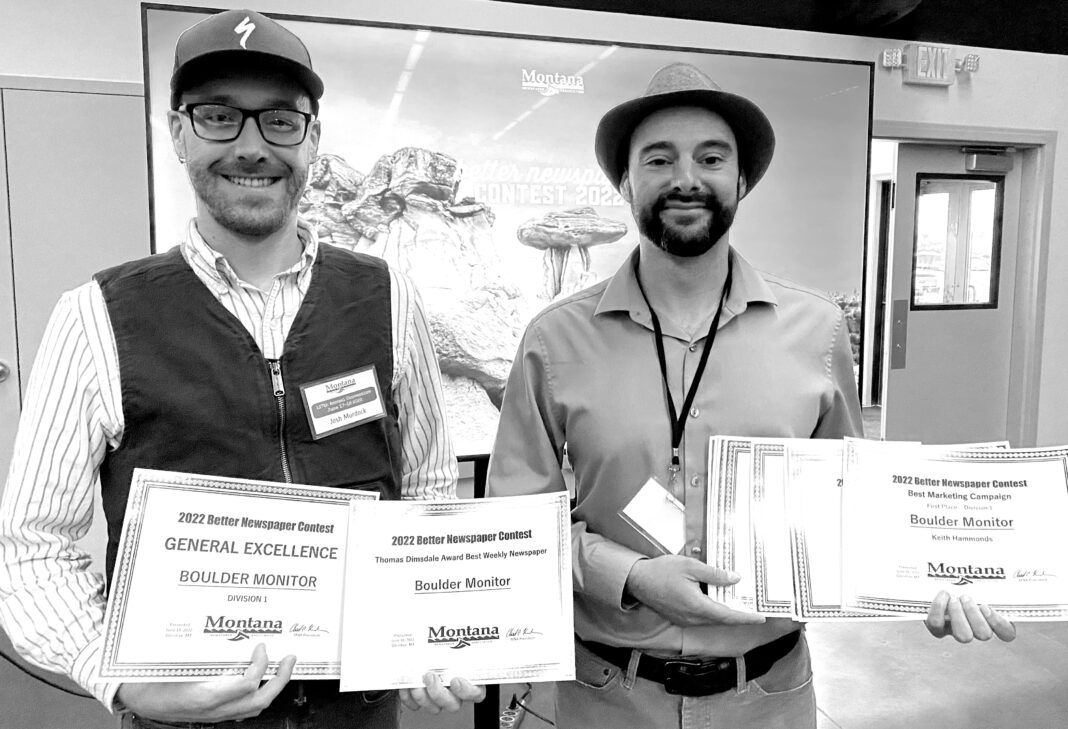
Last June, at the Montana Newspaper Association’s annual convention in Glendive, The Boulder Monitor received the Thomas Dimsdale Award, given each year to the state’s best weekly newspaper.
We were, of course, honored and gratified. The award recognized a lot of great work by our team in 2021, like Joshua Murdock’s in-the-trenches coverage of the Haystack Fire and Aleka Kroitzsh’s probing series on mental illness among ranchers and farmers.
And don’t get me wrong: Awards like this, which mostly celebrate great individual stories, photos, and designs, are terrific. The plaques look nice on our wall, and I’ll be happy if we can keep taking home bling.
But I can’t help thinking they miss the point.
Because really, community newspapers like The Monitor are about the long haul. Most of what we do isn’t splashy; it’s not geared to win awards. Week after week (and day after day on our website, boulder-monitor.com), we steadily chronicle the goings-on of Jefferson County. We explain not just what’s happening, but how and why it happened – and what it means to you.
At our best, as our motto at the top of each paper says, we serve the future of the people and institutions that make up this community, telling them what they need to know to make this a better place to live, work, and play.
That requires, first of all, that we show up: The Monitor goes to meetings – many, many meetings. We do so in the name of transparency, ensuring that citizens know what they should about the functioning of government and civic entities. And even when there’s not much to report from those meetings, attending helps advance our understanding of what are often complicated and nuanced issues.
Our coverage of the Basin Water and Sewer District Board (which also won an MNA award) is a case in point. In February, 2021, then-editor Diana McFarland reported on the board’s agreement to a request for an independent audit of its financials. Over the next few months, she and other Monitor staffers chronicled the escalation of tension between the board and a group of Basin residents: a recall petition; the board’s resignation; the search for new members; and a new board’s halting first steps.
Two years later, we’re still going to Basin Water and Sewer meetings, almost every month. It’s a small group in a tiny community – but what happens at those meetings matters.
It’s not just meetings. We show up at fairs, community days, school events, rodeos, parades, and bake sales. Fires, highway accidents, and court hearings. Football games, basketball games, cross country meets, tennis matches.
Over time, as we show up, we build trusted relationships. And we come to understand which stories are most urgent and relevant to people trying to navigate an uncertain future. Like housing, of course. And child care. Mental health. Access to health care and services for the aging. And a panoply of questions connected to growth and economic development.
Much has been written and said about the existential threat to local news. That threat is indeed real: In many communities, newspapers are cutting staff or shutting down altogether. Maps of media reach reveal that more and more counties in America are becoming “news deserts,” lacking any local news at all.
To me, the antidote to news deserts is straightforward. First, journalists have to do their job: We have to show up, understand what’s most important to our audience, and provide accurate and authoritative coverage that matters. Week after week, day after day.
And also: People have to value the news. Staying informed about what happens in our government, community and society is central to good citizenship. And if people value the news, they should pay for it.
So, the marker of a successful newspaper isn’t about awards, but about audience. Simply put: A good paper should attract and engage more paying customers.
On that score, The Monitor is inarguably making progress. In the last two and a half years, our total paid circulation has increased by nearly 50%. I’m grateful to the increasing number of people who are supporting our work.
Tellingly, that audience has changed over time. The number of readers in Clancy, Montana City, and Jefferson City now significantly outnumber those in Boulder. At the same time, and not surprisingly, our readers increasingly have shifted to digital products, which now account for over 30% of our total audience.
For us, the implications are clear. The Monitor will continue to invest in coverage of the North County, in addition to that of Boulder; our reporter Eliza McLaughlin has become a familiar and welcome face in those communities. And more and more, we’ll put news on our website as it emerges, rather than waiting for the weekly print issue; The Monitor is moving toward a continuous news cycle.
Our other strategic priorities remain the same. We will invest in solutions-focused coverage of important issues, explaining not just what’s wrong in our community but how people, government, and other entities are responding – and assessing whether those responses have been effective, or not.
And we will continue to broaden the range of perspective in our pages. I’m pleased that the Views page reflects a spectrum of opinion that is truer to the diversity of our county; thanks to our regular columnists – Mechele Anderson, Jon Goff, Jane Lee Hamman, Bret Lian, James C. Nelson, and Jim Smith — for making that happen.
While on the topic of gratitude: The Monitor has a wonderful team. I’m so privileged to work with our editor, Charlie Denison, our office manager, Patricia Lewis, our reporter Eliza, and our sales representative, Alisa Smith. My wife, Jackie Dyer, keeps our finances in order, with the assistance of our son Conor.
I’m also grateful to John Blodgett, Diana McFarland, and Joshua Murdock, who helped build the foundation for what The Monitor has become, and to Candace Hecker, whose contributions are celebrated on the following page.
And to The Monitor’s subscribers and advertisers: Thank you for your continued investment in our work. More than any plaque, your support tells us we’re doing something right.
Keith Hammonds is The Monitor’s publisher.