
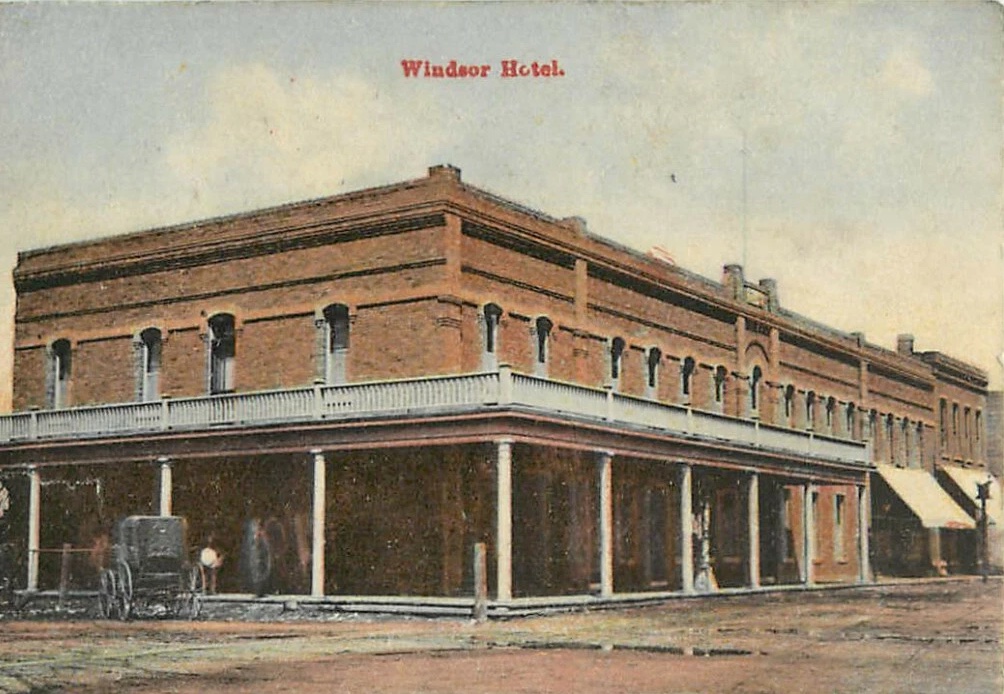
Excerpted from Boulder: Its Friends and Neighbors, written by Boulder’s only female mayor, Olive Hagadone, and originally published serially in The Monitor in 1985-86.
Hiram Cook was born May 7, 1817, in Norwich, New York, and educated in New York and Ohio, later moving to Michigan, where he engaged in farming. On Oct. 30, 1838, he married Mary E. Vining, the daughter of Rev. R. W. And Lydia Vining of Genesee County, Michigan.
The Civil War was in its second year when Hiram became Captain of Company H 25th Regiment of Michigan Infantry. He later resigned from the military because of ill health and the family moved to Montgomery County, Missouri. Probably influenced by their son, Vining, who was operating a ranch at Horse Prairie near Bannack, Captain and Mrs. Cook, with their family, headed west, landing in Helena, then on to Little Boulder, as postmaster.
When he was unable to obtain land for the post office, he acquired land one half mile west of the old town and built a building, the Boulder Hotel, which also housed the post office. The hotel later became the Windsor. The oldest continuous business in Boulder, The Windsor was built in 1876, the first building in the new town.
In about 1883, the building was acquired by A. C. Quaintance, and John Barta became manager. Barta had been born in Bohemia about 1830 and settled in Helena in 1869 working in a hotel there and later at the old camp of Vesta and at the Legal Tender mine at Clancy. He married Benettie Nagues of Butte in 1881 and became manager of the Windsor in 1883, in partnership with James J. Bonner, but this partnership was dissolved in 1890.
Barta continued the operation of the bar and the hotel was run by John Nagues. The Bartas left Boulder in 1893 to run a hotel in Duluth, Minnesota. Boulder was becoming the distribution center for the mining industry with several freighting companies headquartering here. The Windsor became the stopping place for mining developers from all over the East.
The traveling public was pushing the facilities far beyond capacity. Between December 1, 1886 and March 7, 1887, a period of a little over three months, 1368 guests registered at the Windsor.
Quaintance completely remodeled the building and extended the verandah to 10 feet to cover the plank sidewalk. He also built a huge barn, 36×60, 18 feet high with a 20×60 shed, with room for 75 horses, buggies, tack and hay to feed them.
The McGowan brothers built the bar addition from stone. The first fire struck in 1889, only two years after the stable was built, destroying the stable, 6 horses, 4 sets of double harnesses, 2 sets of single harnesses, 5 buggies, and a bus, several tons of hay and several thousand pounds of grain. A good description of the traveling conditions of the day is related by Sam Robertson in the April 17, 1890, Sentinel:
“Last Saturday morning the guests at the Windsor were awakened by the cries of fire, and there was for a time serious doubt as to whether the building could be saved from the forked flames or not. It appears that the house was very crowded with strangers, as the traveling public seems to prefer the Windsor to any other place in the city. And on this occasion, Friday night, Pat Scullion took quarters with Johnny Quinn in a double bed. There was a single bed also in the room occupied by ‘Snyder,’ the Elkhorn Knight. They all retired at about the same time – 12 o’clock – but Snyder was a little slower than the rest. Pat said to him to get into bed and he would blow the light out. Snyder remarked that he would attend to that matter himself, and Pat and Johnny jumped into bed, and were soon in the embrace of Morpheus.
“At about 3:30 in the morning Pat was awakened by the smoke, and jumping out of bed, pulled John with him. The whole room was in flames. Snyder was also ruthlessly dragged to the door. looking as though he had just tackled a wild cat – bareheaded, barefooted, barebacked – well, he did not have clothes enough on him to wad a single barreled shotgun. Others were running hither and thither in their night clothes, while John, giving a regular Cheyenne yell, broke for high ground, entirely bewildered.
“Pat went to work, got two buckets of water, dashed them on the flaming walls, then taking up a quilt. commenced to do battle in earnest, dressed in a pair of drawers and shirt collar.
“At this juncture, the prince among Boulder firemen, Pat McGowan, appeared upon the scene, and just in time, too, as things were getting pretty warm. The two Pats went at it like beavers. The room was completely emptied in a moment, notwithstanding the fact that it was all ablaze. The paper on the four walls was burning, but the men were equal to the emergency, and soon the masters of the situation. The damage will be about $200 to Mr. Barta.
“There were other losers besides the landlord: John Quinn lost his coat, vest and hat. Pat Scullon was badly burned about the face. His nose has entirely peeled off, and looks like a Missouri carrot. Snyder had his hair burned nearly off, his back blistered, and really scorched all over. The boys say Pat McGowan is deserving of lots of credit in saving the building.”
The Windsor continued to be the favorite stop-over throughout the boom years of Boulder. In 1890, a special attraction was installed, an Edison phonograph, which customers could enjoy at 10 cents a tune. In 1904, Jan. 2, fire broke out in the oil room of the Windsor shortly before 1 a.m., and in a few minutes the alarm was given which called the department and citizens from their beds to fight the biggest and most threatening fire that ever visited Boulder.
The fire consumed the hotel, which was a two-story frame building; the saloon, which was a stone addition to the south; and the Weber building adjoining on the north, and several outbuildings. The Maxfield block was saved by pouring water down the side from the roof which kept the second story cool, and the second story being of thick brick was proof against fire.
Across the street on the east were the post office, Knowles’s meat market and Pfaff ‘s store, which were one story frame buildings, and these were badly scorched but kept from igniting by the copious use of water. The old Grand Central Hotel and Graves Mercantile Company were brick and the bank, of stone, were opposite of the fire, but not damaged, excepting the windows which were shattered by the heat all along the block.
Ed Ryan of the Valley grabbed his clothes, got out through the window and slid down a post to the street. Editor Cornish made his exit through a window also, with his trunk. Ben Hindes escaped with only a few of his outside clothes. Ferd Wolpert saved enough of his barber’s outfit to continue business.
The ‘help,” in hotel parlance, fared badly at the Windsor fire, Mrs. Peltier, Miss Annie Johnson and Miss Annie Peterson were compelled to leave clothes, jewelry, etc., in their rooms behind them. They retreated from the burning building without clothes enough to dust a $3 fiddle. They had to rush out in the cold with their lower extremities as bare as a duck’s bill — no stockings, nor scarcely anything else.
The hotel and saloon building, belonging to A. C. Quaintance, were insured for $6,500. Tim Hayes, the lessee, carried $1,500 on the saloon, but failed to renew insurance on hotel furnishings for that year. He said his losses amounted to about $7,000.
In February, 1904, Quaintance let the contract to Fiske Brothers of Helena for the construction of a new hotel on the site of the Windsor. The building was to be of stone and brick, two stories, with 38 rooms upstairs and the general arrangement on the first floor about the same as before.
The contract price was $8,210, and adding material made the cost about $12.000. The verandah, which was such a pleasant place for the hotel patrons to sit on a summer evening and provided protection for the plank sidewalk below, was also replaced.
The outside appearance of the hotel remains very much the same as it did eighty years ago, with the exception of the balcony, which was removed in 1935.
The Windsor dining room was the scene of many business meetings and banquets, with entertainments often furnished by students from the Deaf, Dumb and Blind school who provided musical numbers and skits. Always there was a midnight supper available during intermission at the dances. A favorite political speaker was Jeanette Rankin, both as a campaigner for Women’s Suffrage and later in her own candidacy for State Representative.
With the coming of trains, automobiles, and better roads, the habits of the traveling public changed considerably. No longer were the small town hotels bustling stage stations where bone weary travelers could rest for a while from the beating they had taken over the rough mountain roads, have a meal, a hot cup of coffee, or something stronger.
In 1914, Alex V. Gibson, former sheriff, sold the hotel to H.K. (Kirk) Hundley, of Cascade. These next years must have been rather lean ones. Prohibition had closed the bar, making the operation dependent on the success of the dining room and resident guests. He sold the hotel to George W. Hanchild in 1921.
Jim and Margaret McGowan operated the hotel from 1928 to 1930, followed by ex-sheriff John Mountjoy, who leased it to Louis Schiavon and Leslie Harris for a short time. When the bill to legalize the sale of liquor, sponsored by Rep. Jaffrey of Jefferson County was passed by the legislature, effective April 4, 1937, the Windsor received its liquor license on April 10, 1937.
At this time, Ella (Quinn) Mosher, whose daughter Bette married A. M. “Bugs’’ Buckles, owned the hotel and the dining room was kept busy providing the good dinners that many local people still talk about. This was the last time the dining room was operated very successfully.