
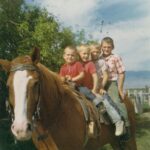
Sherry Cartwright Zipperian measures only five feet and two inches tall; however, the bend in her back, caused by the weight of time, seems to decrease her true height. Cresting the top of her head is thin, white hair just long enough to cover her ears. Her wrinkled skin creases when she smiles, and when she tells a story, her hazel eyes light up and survey the space in front of her as if she’s watching a memory unfold.
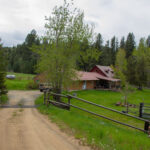
She unravels these stories from her historic home on what can only be described as a 1,680-acre slice of heaven, tucked behind not one, but four cattle guards just over four miles north of Jefferson City. While wilderness conceals her home from the commotion of civilization, Sherry is eager to share the stories of her life accomplishments and adventures to those willing to take a moment, and “sit for a spell.”
Telling these stories is what Sherry does best.
Throughout her life, Sherry has worked in a multitude of industries. She’s been a wall paper hanger, the owner of a tire store and an upholstery business, a cowgirl, a writer, and a deputy-sheriff. Her first adventure began on Dec. 22, 1937, when she was born with only one hand.
On Dec. 6, 2021, at 84 years old, Sherry added another occupation to her already extensive resume: novelist. Under the name S. C. Zipp, she co-authored “Map of Bones,” the first book in her Montana mysteries series, and hopes to publish the second book, “Trail of Dust,” this September.
Woven into the details of her books are elements of her own adventures. “I have had a very colorful life, despite being born with one hand. I never let that limit me,” she said in an Feb. 22 media release.
***
Sherry Zipperian–born a Cartwright–grew up on a cattle ranch in the Canton area, just outside of Townsend. From a young age, she was determined to do the same things as people with two hands could do. Her father encouraged her to develop this determination before she had even started school.
In the time before Sherry would enter kindergarten, he taught her to tie her shoes with one hand, worrying that she would be the only student who couldn’t do it themselves; however, the opposite was true. “Turned out I was the only one in the class that could,” she said. “Recesses I spent most of my time tying everybody else’s shoes. And I think some of them untied them just so they could get me to tie them up.”
Having one hand has never stopped Sherry from doing something, referring to it as her “pusher.” Despite her condition, she has done more with one hand than most people have with two. “People would say … ‘Awe I feel sorry for you, because you can’t do this.’ So, I’d go home and I’d learn how to do it,” Sherry said.
One of the first things Sherry learned to do was write. At 8 years old, she enjoyed writing letters to her grandmother; however, her school teacher mother required that the letters have perfect spelling and grammar before she could mail them out.
While Sherry will tell you she never got around to pursuing her passion of writing, the truth is, she found various means of incorporating it into her life.
In her adult years, Sherry Zipperian made a point to chronicle her life events in the form of short stories. “Anything I know about my family is what I remember, and I didn’t want that to happen to my kids,” she said. Some of the short stories were published in the Townsend newspaper. Each of the stories Sherry has written are neatly compiled into binders and stored on the shelves in her living room, along with many other photos and mementos.
Sherry wrote for more than just her family. In 2009, she had an article titled “The Voice of the Good Shepherd,” published in the Ensign, a magazine produced by The Church of Jesus Christ of Latter-day Saints. She also helped write an article about home hemodialysis for the January-February 2017 edition of the Nephrology Nursing Journal.
When piecing together the pages of their memoir, many struggle to think of interesting things to write; the same is not true for Sherry. Her many occupations and lifetime of adventures has provided her with an endless bounty of stories to tell.
Sherry’s most recent writing project, “Map of Bones,” draws inspiration from her time as a Broadwater County deputy sheriff. In the book’s acknowledgements, Sherry thanks former Sheriff Barthule, saying that without him, she “would have had nothing to write this book about.”
***
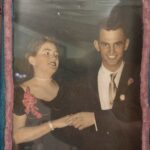
John Zipperian moved to Townsend from Butte in the eighth grade. When he met Sherry, she was only in seventh grade. The two hung out in similar friend groups, but had never viewed each other romantically.
That changed the summer before Sherry’s senior year of high school when John was driving a group of his friends–coincidentally all “steady” couples–around town in his father’s Hudson car. Although the vehicle was clearly full, Sherry approached the door asking if there was any room for her. To her surprise, John scooted over enough to share the driver’s seat.
The group went for a drive, eventually parking out in the country. Once at their destination, one of the couples challenged the rest of the vehicle’s passengers to a kissing contest. “I looked at John, and John looked at me, and we thought, ‘maybe we better.’ And it turned into quite the kiss,” Sherry said. After winning the contest, the two “never looked at anybody else again.”
In 1955, John proposed the night of Sherry’s graduation ceremony where she would speak as the class’s valedictorian. While the ordeal added to her nerves, she said “yes,” and they were married that fall.
While the two dated, John’s father took part in discussions with missionaries from The Church of Jesus Christ of Latter-day Saints. At the conclusion of each discussion, John would pick Sherry up and park to tell her about everything he had listened in on.
Four months after their marriage, John and Sherry were baptized into the church. Sherry calls this the “best decision we ever made.”
Within the first three years of marriage, Sherry and John gave birth to three sons: Kenny, Mark and Dan. In 1961, their fourth son Gary was born.
The four Zipperian boys have followed in their mother’s footsteps achieving great things. Gary, father of Jefferson County rodeo star Drew Zipperian, found fame in the saddle first. Gary has been featured in the Missoulian, the Billings Gazette and many other news sources for steer wrestling. Several of the boys even helped open and operate Zipp’s Tire Shop in Townsend with their parents.
Kenny passed away in 2014 due to complications from his lifelong battle with diabetes. He passed surrounded by his family in a Denver hospice facility. “As much as we hated to let him go, as a family we felt blessed we were given three wonderful, spiritually rich days in such an awesome environment to say our goodbyes,” Sherry said. “It was as if we were privileged to go halfway with him. Heavenly Father went to great lengths and pulled a lot of strings to provide that marvelous, comforting experience.
John would follow Kenny, passing away in November 2018 after 63 years of marriage to Sherry. “I still expect him to come out of the bedroom and ask me what I’m doing,” she said.
***
In 1980, Sherry started working as a dispatcher for the Broadwater County Sheriff’s Department. “Women were not deputy sheriffs in Montana in 1982,” Sherry recalls in one of her stories. When Sheriff Rick Barthule asked her to become a deputy sheriff, “many thought maybe he had slipped a cog,” the story goes on to say. Despite the lack of women in law enforcement at this time, Sherry only had one question: “Will I get paid the same as the guys?”
John fully supported the decision.
As part of the training for her new position, Sherry had to attend the Montana Law Enforcement Academy. In the narrative detailing her time at the academy, Sherry explained that the instructors believed there was no way a five-foot-two-inch woman with one hand could pass the course. Barthule never doubted her abilities and told the instructors to “just wait and see—give her a day or two.” It only took a day for Sherry to outperform her classmates in field stripping and target practice.
Despite the lack of confidence her instructors had in her, Sherry received the Jimmy Kaaro Memorial Award for achieving the highest academic record during her time at the academy.
Sherry continued to face opposition as a female deputy in Broadwater County. One specific encounter included a stubborn business man, a judge and a speeding ticket–and no, this isn’t the start to a bad joke.
While at Zipp’s Tires one day, a truck whizzed past, continuing down Main Street into Helena. Sherry rushed to her government-issued vehicle and pulled the truck over. As she approached, the man in the driver’s seat asked, “Do you know who I am?” In response to the irritated driver’s complaint, Sherry said she didn’t really care who he was. He had been speeding.
The motorist identified himself as the CEO of Harrington Bottling and made it known his feelings on a woman writing him a ticket. Outraged by the situation, the man demanded to take the ticket to the judge and Sherry accompanied him. The enraged driver left the courthouse that day with a “healthy fine.”
During her five years as a deputy sheriff, Sherry encountered many interesting situations, including the day she describes as “a really bad day at the Sheriff’s office.” On this particular day, two men had drowned at the Toston Dam, the local doctor made a fuss about where the EMT’s had placed the bodies in the hospital and the postmaster had climbed to the top of water tower with a high-powered rifle intending to shoot people. “Being a deputy was just so exciting, I loved it,” she said.
Despite having worked five years as a deputy sheriff, Sherry only had to draw her gun once. For weeks, a group of union miners from Butte had gathered outside the Cominco Continental Lime Plant just outside of Townsend. In addition to their picketing, every few days the protestors drove down the gravel road to the plant, dumping barrels full of nails. This caused what Sherry refers to as “Broadwater County’s flat tire epidemic.”
After three weeks of protesting, Undersheriff Ron Gollehon grew tired of the “incessant stream of tire complaints” being left for dispatch. Ready to do something, Gollehon rushed to his vehicle, stopping only to ask Sherry if she wanted to come, too. “Sensing a potential adventure, I hastily trailed him and climbed into his patrol car,” Sherry wrote in a story detailing the events.
Gollehon drove the state-issued vehicle 30 feet from the unruly rioters, opened the door and told Sherry to cover him. Still unsure of what was about to take place, she unlatched her holster and stepped out of the vehicle.
While Sherry kept a close eye on the miners, Gollehon retrieved his shotgun from the back of the vehicle–causing Sherry to draw her gun–loudly racked the shells into the barrel and calmly proclaimed, “‘Bout time you went home.” The group disbanded and never returned.
On the drive home, Sherry described the conversation as “predictably sparse,” noting that the only thing Gollehon said was, “Maybe there won’t be flats now.”
***
“Map of Bones” tells the fictional story of a former Seattle detective and her journey to solve the largest murder case Keystone County had ever seen. The book proves that not only does Sherry do everything, but she does it well.
At this time, the book has a 4.8-star rating on Amazon and a slew of positive comments: “This may be a work of fiction, but it feels real.” “Throughout it all the raw beauty of Montana and the people who live there comes out and paint a picture worth reading and smiling about.”
Leah Howery, a fan of the book and one of Sherry’s close friends, had one positive thing to say about the story. When Sherry mentioned that she thought the second book could be better than the first, Howery told her, “It can’t be.”
The Montana Mysteries series takes place in the same location with all of the same characters–Well, almost. But you’ll just have to read the books learn more.