
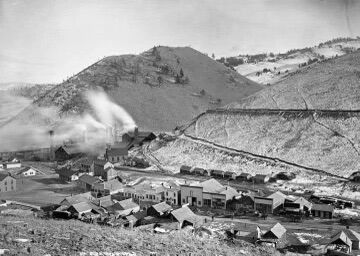
As time passes, many historical towns have silently been erased from the map. Despite drastically decreasing in population since its “boom” days, Wickes still remains on the map. However, it’s role in Jefferson County happenings has diminished.
Like the other historical towns in North County, Wickes originated from a nearby mining claim: the Alta lode.
Raemarie Bruce, substitute director at the Jefferson County Museum, said that although the Alta lode was discovered in 1869, the town wasn’t settled until 1877.
In 1895, it was reported that the Alta mine had been in operation for 20 years, after being discovered by “a party by the name of Williams.”
In 1887, the Helena Mining and Reduction Company built the town’s first smelter. The mining company was also responsible for bringing the railroad to the town several years earlier.
By 1889, the smelter was abandoned and moved to East Helena to process other prospects.
According to Bruce, the Altla lode was the most productive silver-lead mine in the area, generating 150 to 200 tons of ore per day; plenty of ore to draw miners to Wickes.
A Sept. 1895 edition of the Wickes Pioneer — an entity which will be explained shortly hereafter — lists a W. W. Wickes as the person for whom the town was named.
However, Reverend T. A. Wickes is generally associated with the naming of the town, according to a Heritage Center document summarizing the town’s history. However, his uncle William Wickes — likely the W. W. Wickes listed in the paper — was a major stockholder in the Alta Mining Company.
The Wickes family has played a rich role in American history.
William Wickes was a direct descendant of Thomas Wickes, a promoter of the Massachusetts Colony in 1635. His grandfather, also named Thomas Wickes, served as a major during the Revolutionary War, and his father General Van Wyck Wickes served in the war of 1812.
William Wickes has also had a significant impact on homes around the world, with his creation of the forced air refridgerator. He came up with the idea after watching rations spoil while en route during the Civil War.
“Mr. Wickes stands out perhaps most prominently in the history of the mining town of Wickes, Montana,” reads the Heritage Center document.
Another prominent character in town was Johannah Kuhlcke, who earned an unique title.
When Kuhlcke and her husband arrived in Wickes, “she found herself the only woman in a bustling mining town that consisted of not much more than boarding houses for the miners, livery stables and blacksmith shops, with a scattering of saloons,” according to the Heritage Center.
By the 1880s, Wickes was booming and drew in businesses of all kinds, including a potential roller rink, according to an June 1885 edition of the Jefferson County Enterprise.
In August of 1895, Wickes received its very own newspaper. The publisher of the paper, Robert G. Bailey, had previously operated the Hartford Pioneer several miles to the north.
The front page of the first edition featured several syndicated articles relaying stories from Europe and back east. A special section also informed readers about the wonders of the animal kingdom.
“A species of recently discovered South African earthworm is 6 feet 5 inches long and of the diamer of a 2 inch rope,” read the front page.
While the Alta lode was responsible for the wealth of the town, it was also the cause of many injuries.
The Wickes Pioneer’s first paper reported three persons injured at the Alta that week: “John Roppats received a severe injury at the Alta a few days ago. In falling, a large nail was forced into the right ankle joint. He is resting easily, but will be unable to walk for some time.”
“Nels Sala was struck in the face by falling rock, at the Alta, a short time since, resulting in an absess about the nasal bone. He will return to work soon.”
“Martin Cummings has his knee badly injured at the Alta, Wednesday evening, from an explosion. It will be some time before he is able to walk.”
Cummings was later crushed by a falling slab and paralyzed, according to an Oct. 5, 1895 column in the Pioneer. Over two years later, Cummings received $12,000 after suing the mining company for negligence.
Throughout its publication, a slew of other injuries were reported, including more head wounds from falling rocks, a piece of steel wedged in someone’s eye and fingers nearly being severed.
In 1896, the silver panic shook the Wickes area, and the mine closed, Bruce said. The newspaper shut its doors shortly thereafter.
Both Pioneers were short lived, and Bailey cited a lack of local support for the demise of both papers.
“If the people of Wickes want the Pioneer to remain here, then they will have to support it in more decent shape than they have [done] for the past few months — else we are prepared to shut down at once,” wrote Bailey. And they did.
Following the final edition of the Wickes Pioneer, Bailey opened yet another paper near Missoula, according to the Lump City Miner. The Rock Creek Record published for at least a year, and at some point, changed ownership.
In the 1900s, north Jefferson County towns were plagued with fires, and Wickes was not excluded.
The fire of 1901 destroyed the entire business portion of Wickes, according to the Heritage Center document. This fire also burned the Kuhlke’s home and killed Johannah Kuhlcke’s husband.
Although the fire destroyed the post office, all the mail was saved.
Even though this fire burnt most the town, the true calamity for Wickes came in 1902.
“Fire broke out in the business part of Wickes and in a few minutes, the [Northern Pacific] depot, the old hospital building, post office, Herman Freyler’s store and Reilly Brothers stables were burned to the ground,” read the Heritage Center document. “In 1909, a new townsite was laid out along the Great Northern tracks on a 6–acre tract of land owned by Mulligan and Teskey of Boulder. The old Corbin railroad station was moved to the Wickes townsite. A school was built and operated until the 1930’s and it had a post office, but it never again regained the importance and excitement of the old Wickes of the 1880s.”
In December of 1925, The Boulder Monitor reported that eight students were still enrolled at the Wickes school, and for two consecutive months the institution had received 100% attendance. At this time, the sixth grade was creating health posters and the third-graders had filled bean bags with coffee grounds.
Mike DeMers and his family have lived in Wickes their entire lives, along with two other families he said.
The DeMers family name first appeared in Jefferson County newspapers in the early 1900s. The name has since gained prominence throughout the county.
Mike and his daughter Brandi DeMers remember a time when Wickes still buzzed with activity.
In her childhood years, Brandi DeMers remembered making the nearly five mile walk from Wickes to T’ings Bar in Jefferson City for shirley temples.
In the 1970s, a “typical hippy,” according to Mike DeMers, named Randy Mossmoved into the area and began encouraging his friends to join him. A commune was eventually formed and a large wooden gazebo for music festivals was erected. The gazebo also hosted a DeMers family wedding.
Other locals weren’t fond of their new neighbors either. Ellen Rae Thiel, a volunteer at the Heritage Center, sais the Wickes music festivals were often chaotic.
“I don’t know anyone that went there that did not come back with a story of fightings and sometimes shooting,” Thiel said.
When the Department of Environmental Quality reclaimed Wickes and the former mining claims, the town’s five smokestacks and gazebo were demolished.
Today, several DeMers still reside in Finn Gulch — located east of the Wickes townsite and named after the Finlander family. As for the rest of Wickes, the properties have changed ownership, are currently for sale or are occupied by renters.
The only remaining structures from Wickes’ early days are a barn which has been converted to a rental property and the old Dailey house.