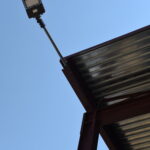
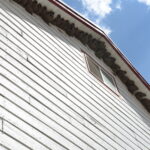
Let’s reckon with the bad news first: New metal soffits did not, as had been intended, prevent barn swallows from nesting under the eaves of the old granary building at the Jefferson County fairgrounds.
Instead, nature being nature, the swallows returned this year with a vengeance, building hundreds upon hundreds of mud nests under the roof. “They told me it would work,” says County Events Director Bruce Binkowski. “Apparently, it didn’t.”
Fortunately, the birds are expected to have moved on, and their nests removed, by the time the Jefferson County Fair & Rodeo opens on Aug. 22. And fairgoers will encounter a host of improvements to the fairgrounds, some modest, others striking.
The fairgrounds property — officially, the Jefferson County Recreation Park — is a century-plus-long work in progress. It was purchased by what was then called the Montana School for the Deaf and Dumb in 1907. Over the decades that followed, buildings were added to support a working ranch. When the ranching operation shut down in 1971, however, those buildings fell into disrepair until 1981, when the county began leasing the parcel from the state.
In the decades since, both before and after the county acquired the property outright in 2005, a steady stream of clean-up, upgrading, demolition and reconstruction, much of it volunteer-led, have preserved and advanced the grounds. In the past few years, with an annual budget of $100,000, that work has accelerated — to sustain the annual fair and rodeo, and also to attract more revenue-generating activities such as weddings and reunions.
“This is the crown jewel of the county in terms of events,” Binkowski says. “We’ve really made an effort to upgrade and keep the place a first-class operation.”
Which is why, on a recent visit, a worker was seen clambering atop the granary roof — above the remaining swallows — looking for wobbly screws. Heat and cold and wind loosen the screws over time; over recent weeks, across the grounds’ multiple metal roofs, perhaps thousands have been tightened.
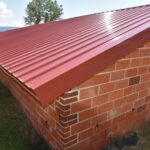
Toward the south end of the campus, there’s a new roof on the 205-foot long onetime chicken coop, built nearly a century ago and now used for storage. There’s also a new line from the bathrooms and the caretaker’s trailer to the septic tank, and fresh epoxy on the floors of the bathroom in the old boiler building and the fair office in the original milking parlor.
It’s not all glamorous, but every detail of every upgrade appears to thrill Marilyn McCauley. She has served on the Fair and Rodeo Board since its inception in 1983, and the fairgrounds’ history and infrastructure are her passions. “Nobody knows those grounds better than her,” Binkowski says.
Take the red horse barn. “We did a lot of work this year,” on the two-story structure, built in 1914, McCauley says. “We hadn’t done much since the early ‘80s.” The barn will host exhibits, a puppet show and, as always, the baked goods auction on fair weekend — but it’s also becoming an increasingly popular event venue.
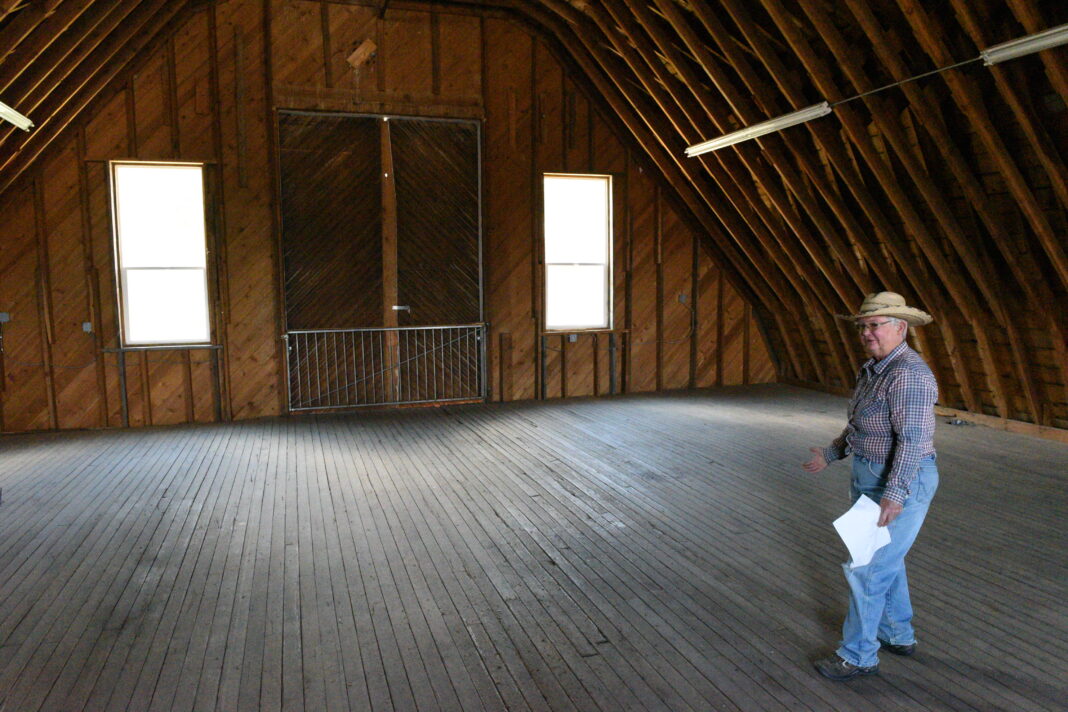
So in the last year, the county has replaced four support beams that had previously been removed, and upgraded the food service area that was once a harness room for horse teams. Upstairs, workers cleaned the floor, put a steel safety gate across the loft door and installed big new windows. “It had been pretty dark up here,” McCauley says.
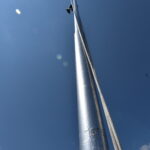
The main flagpole has been painted silver, and it sports a light to illuminate the flags. (Actually, McCauley explains, this light is the third; the first was damaged when the pole was taken down for painting, and a second broken when wedding revelers tried to climb the pole.)
The carousel — built locally in 1958, restored by community members in 1995, and finally enclosed in 2015 — has a newly refinished wooden deck and sweeps (the overhead spokes). They literally gleam.
And finally, there are the rodeo arena lights. A year ago, spectators at Saturday evening’s NRA rodeo had to squint through the gloaming to catch the final competitors — and the last bull rider couldn’t see much, either, says Jefferson County Rodeo Association President Brady Nordahl; as the event wound down, the only light came from floods on the announcer’s stand.
Nordahl and others at the JCRA had been working since at least 2016 to find a lighting solution. They had salvaged post lights from the old East Helena arena. But with electrician Annette Smith, they settled instead on six LED lamps girding the oval – providing more lighting, Nordahl says, and still within budget. They cost about $15,000, of which the JCRA contributed $5,000 and the Fair Board $2,500; the rest was paid for with funds from the county’s American Rescue Plan Act (ARPA) grant.