
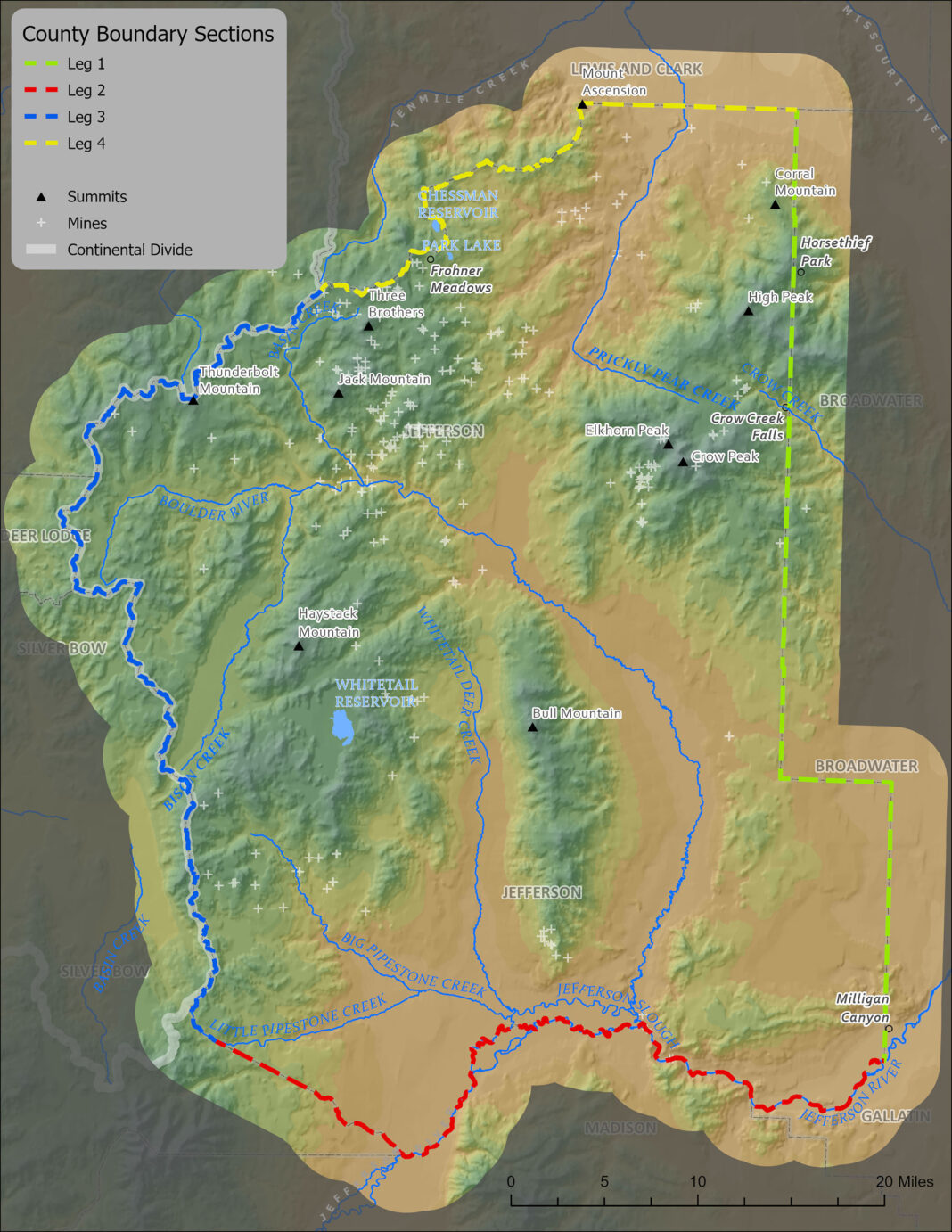
A county and its boundaries are a human construct. Sometimes they are based on Earth’s features, like a divide between watersheds or a river, and other times they are based on our imaginary partitions – such as townships or the lines of the graticule. Ultimately, county boundaries are jurisdictional in nature and define the rights, responsibilities, and interests on the land.
Since 1863, when the boundaries of Jefferson County were created by Idaho Territory, to our most recent change in 1903, when we exchanged a small area with Powell County on our western border, Jefferson County’s boundary has changed seven times. It seems to largely be fixed now, so feeling energized and willing, if we were to travel the border of our county in a loop, it would be a 216 mile excursion. Dividing our trip into four legs, let’s start in the northeast corner and travel clockwise, and hopefully it will be worth the time.
Leg one of our journey starts a half mile north of Highway 12, where a single imaginary point touches Jefferson County, Lewis and Clark County, and Broadwater County in the middle of a wheat field. Here we walk south in a straight line where two townships meet, huffing as we ascend the eastern flank of Corral Mountain. Outside of a minor zig or zag, we would walk south for 36 miles through the heart of the nation’s only Wildlife Management Unit. We skim Horsethief Park in the northern portion of the range and may be able to peer into Crow Creek Falls in the southern Elkhorns. Transitioning from timbered high country to the draws of sage and juniper, eventually we bisect the limestone features of Milligan Canyon and hit the Jefferson River, where we soak our blistered feet.
On the second leg of our Journey, we follow the Jefferson River upstream for nearly 30 miles. We wouldn’t swim against the current, but maybe we would take canoes up the stream, just like Captain Clark and his expedition did in the summer of 1805. At the time they called the Jefferson River the Southwest Fork of the Missouri, and where it flows into the Jefferson from the north, they named the Boulder River, Fields Creek, in honor of Reubin Fields, one of the expedition’s finest hunters. This would be a wonderful part of the trip. There’d be fishing and hunting and if we were traveling it in the fall, beautiful colors as the cottonwoods turned. At the point where we finally abut Silver Bow County, we leave the Jefferson River and travel up toward Fish Creek, where it takes a hard vector northwest, until we finish this leg on the banks of Little Pipestone Creek.
By now, a few of us are sick of walking or paddling, so maybe a plane would be preferable. Soaring above leg 3 of our outing takes us up Little Pipestone Creek to the Continental Divide, which we will trace until we leave it for the last leg of our trip. The continental divide of Jefferson County’s western edge is a microcosm of the Boulder Mountains and much of Jefferson County – Elk, bears, meadows, rounded granite summits, and more dead lodgepole than all the rest combined. It’s beautiful and lonely and as valuable as anywhere else. At Thunderbolt Mountain, we will ascend to the highest point on our journey – 8,597 ft above sea level. At the end of this portion of the borderline, we cut east on a hill above the headwaters of Basin Creek, and begin our final push.
At the start of our fourth leg, now more than ever, we are in mining country. As we head northeast we pass above prospects like the Paupers Dream, the Porphyry, the May Lillie, and the Gould Diggings – most now defunct. Cutting north, we pass through wetter country and headwaters – Frohner Meadows, Park Lake, and Chessman Reservoir all within sight. Eventually we are on ridges separating Helena from Clancy-country, and will take those all the way to the top of our last summit – Mount Ascension. At this point we turn due east, gliding for 11.5 miles over the south hills and their hiking trails and growing subdivisions to close the loop in the center of a wheat field. Good trip.
We’ve made an attempt to explore the boundaries of our home, but remember that a newspaper article on geography is just superficial analysis. As it pertains to the edges of Jefferson County, we haven’t even come close to the edges of our knowledge, and it is worth our time to keep exploring the frontiers of our love for all those things within and outside of it.