
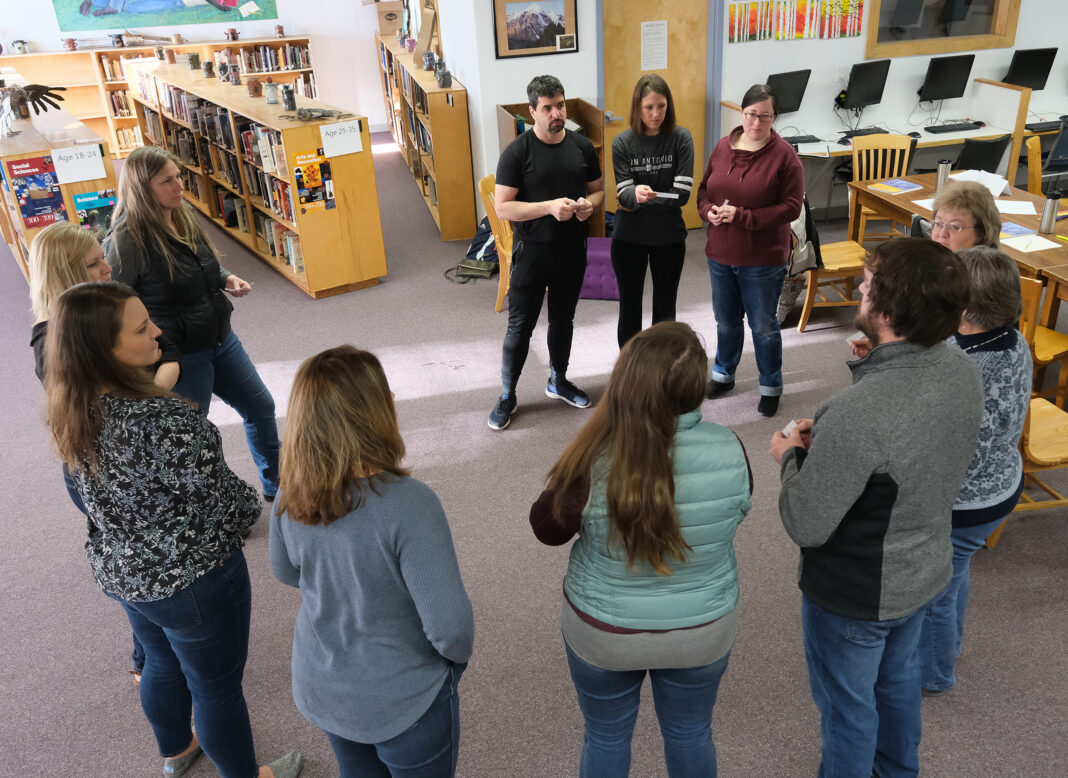


Jefferson High School, one of eight high schools nationwide chosen to participate in a Teen Mental Health First Aid pilot program, kicked things off last Friday with teacher and staff training.
Youth Dynamics, which provides mental health services to children and families in Boulder and elsewhere in Montana, has joined Jefferson High to assist with the study, which superintendent Tim Norbeck has called “a real good opportunity for a rural school” in a state with the highest suicide rate in the country.
The first of its kind developed for high school students in the U.S., the pilot program is run by the National Council for Behavioral Health and Lady Gaga’s Born This Way Foundation and will be evaluated by researchers from Johns Hopkins University.
Teen Mental Health First Aid training was designed to teach high school students about mental illnesses and addictions and how to identify and respond to such problems should they arise among their peers, a news release states.
Last Friday’s training, which lasted about eight hours, was run by two instructors from the Montana Hospital Association and administered to nine teachers and staff members. Sarah Layng, the school’s librarian and the person chosen to manage the pilot locally, was among them.
“The training was thorough and informative,” she said by email. “The hands-on activities and examples were very real and discussion was based on true examples putting much into perspective.”
Instructors Natascha Robinson and Shani Rich led the group in a variety of activities that included filling out a questionnaire about opinions concerning mental health and discussing the importance of diminishing the stigma surrounding mental health.
“Changing our language and how we view mental health is something that really stood out to me,” Layng wrote. “We need to make this a topic in which people are more comfortable talking about and aren’t embarrassed by.”
In their training presentations, Robinson and Rich likened mental health first aid to physical first aid in that it prepares people top provide help until professionals can intervene.
“We’re not treating [anyone],” Robinson told the group. “This is simply a first aid course. If you walked in [here] not knowing how to diagnose, you will walk out not knowing how to diagnose.”
The value of mental health health first aid for teens or adults, she noted, is that the sooner someone gets help, the more likely treatment and recovery is possible.
A second training will be held April 12 for teachers and staff who couldn’t attend last week’s session. Meanwhile, students will be introduced to the program on April 4.
Students in grades 10 through 12 “will be broken into three groups with each group being taught by a different instructor,” Layng wrote. “Students will learn what mental health problems or challenges are, and also the implication of what substance use has on a person. They will also be able to take away what a healthy mind looks like, the impact of our thoughts and feelings, and what the spectrum between being healthy physically and mentally versus having an illness might look like.”
Three students will also be taught how to train their peers in Mental Health First Aid. According to Youth Dynamic spokesperson Katie Gerten, those peer-to-peer trainings “will be a part of [students’] routine school day with their regular classroom teachers available for additional support.”
The training will be made available to the public following analysis of the pilot study, the news release states.
Mental Health First Aid is a program created in Australia in 2001 by a nurse and a mental health literacy professor. Since establishing its own Mental Health First Aid USA program, the National Council for Behavioral Health has trained more than 1.5 million people nationwide how to identify, understand and respond to signs of mental health and substance use challenges and crises, according to a description Rosenbaum provided.
To create the Teen Mental Health First Aid program, the National Council adapted the Australian model for American high schoolers.