
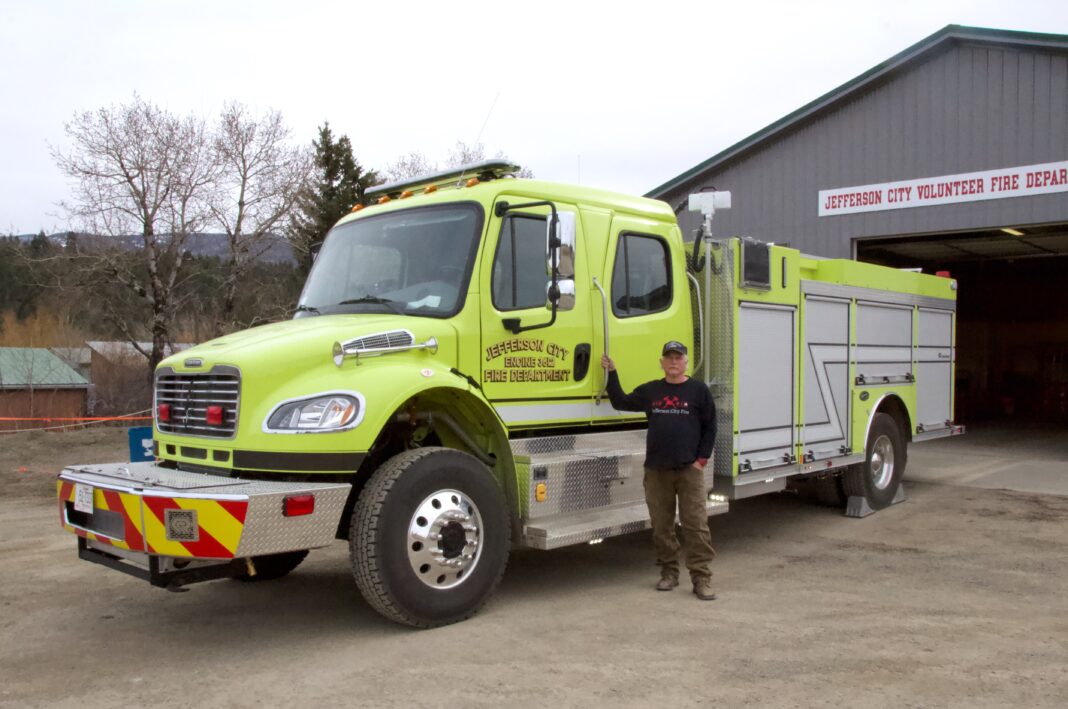


The Jefferson City Volunteer Fire Department will make significant improvements to its fire hall and equipment after receiving some surprise funding that flowed to the agency after nearby Montana Tunnels gold mine paid millions in overdue property taxes. The department also recently received a brand-new fire engine—a first for the agency.
The department is funded primarily by property taxes, and the sudden lump-sum payment of funds that should have gone to the department all along has helped put the department on stronger financial footing. The owner of the Montana Tunnels mine paid $5.1 million in overdue property taxes just days before a Dec. 2, 2021, deadline, preventing Jefferson County from seizing the mine through a tax deed.
“We didn’t get as much as school districts, but for us it was more than five years worth of normal tax revenue at one time,” Dave Cooper, president of the Jefferson City Rural Volunteer Fire District board, said. Chief Keith Wear referred to the money received from the mine’s back taxes as a “gift” and explained that the department doesn’t plan on spending it all at once. Instead, the agency plans on using the money to prepare for the department’s needs over the next 10 years, he said.
“We don’t want to take that lump sum tax money and spend it on operations and have nothing to show for it,” Cooper said.
The first thing the department plans to do is expand its fire hall. According to Wear, the primary need for expansion is because the department’s new fire engine, purchased with department savings, barely fits inside the current structure. The truck is the first piece of brand-new equipment the department has purchased in its 70-year history.
To accommodate the larger vehicle, Wear said, the department plans on extending the existing fire hall 20 feet to the west, effectively adding another vehicle bay to the building. Wear expects the expansion project to finish within the year. The addition will feature garage doors on both ends, allowing firefighters to pull the fire truck through rather than backing it into a stall. Wear explained that firefighters can easily be injured backing a truck into a building, and having the ability to pull through will significantly improve the station’s overall safety.
“I think my biggest job being a chief is safety,” Wear said.
The department finished constructing the current Jefferson City Fire Hall nearly 20 years ago, according to Wear.
“This building here, we’ve used it well but now we’re to a point where it’s not feasible,” he said. “That’s why we’re adding onto that bay.”
Wear also said the department has already started searching for another location for later expansions.
“I think that this department is definitely going in the right direction,” he said. “We’re setting this department up for the future.”
Purchasing the new engine had been in the works for several years: While the department ordered the customized firetruck three years ago, it didn’t arrive at the station until the end of February. They had only expected to wait 13 months. The extended delay resulted from the production slowdowns caused by the coronavirus pandemic. A pandemic-related computer chip shortage further delayed the truck’s arrival.
Purchasing the new fire engine was a big step for the station’s future, Wear and Cooper said. The truck can seat up to five firefighters—more than their previous engine. The new truck is also much quieter than the older models, which Wear and Cooper agreed would facilitate better on-scene communication. The department has yet to take their new engine on a call because the firefighters are still learning to use it.
“We have a lot of skill with putting out fires, but we don’t have a lot of skills with the new electronics,” Wear said. “But we’re getting there.”
The new engine has several features—such as cruise control, air conditioning and a heating system—that are commonplace on modern passenger vehicles but are a new luxury for the Jefferson City Volunteer Fire Department because previous engines lacked such amenities.
“If you came to the station late, you would be sitting in the back [of the engine], especially if it’s below zero,” Wear said. “And you were a popsicle before you got to Ting’s [bar].”
The new truck will also cut down on water usage—and challenging water gathering the department grapples with—by utilizing a mixture of water and fire-retardant foam, rather than just water, to extinguish fires. Obtaining quality water to fill trucks has been a problem in Jefferson City: The department previously pulled water from local creeks, but that left sand deposits in the bottom of truck tanks.
“We got a major water issue,” Wear said.
To ensure they have enough water to put out a fire without also taking on sediment, the department now stores water in tanks in the basement of the historic schoolhouse-turned-community-center located on the fire hall property. Even with seven 1,200 gallon water tanks, Wear and Cooper said, the combined 8,400 gallons is only a drop in the bucket compared to what the department needs. The tanks can only fill the department’s tender—a water hauling truck—twice before the storage tanks themselves must be replenished.
The department is looking for an alternative water solution, but in the meantime the new engine will help cut back on water usage: Because the engine mixes water with a fire retardant foam solution, the department expects to use 40% less water than before.
The foam mixture not only conserves water, but it also allows the department to extinguish fires in the rapidly growing amount of electric vehicles on the road—fires that are difficult to extinguish with water alone because burning batteries can repel water. There were fewer than 300,000 electric vehicles registered in the U.S. in 2016, according to a Pew Research Center study. Only four years later, the number had grown to nearly 1.8 million.
“We’re taking a lot of new training right now,” Wear said, regarding electric vehicles. The training includes understanding which wires on a vehicle firefighters can cut without getting electrocuted.
Wear and Cooper hope to get plenty of use out of the truck in the next 10 years. Before purchasing the new fire engine, the department had only ever bought used equipment from other fire departments. The pair recognized that the department has survived because of the generosity of their fellow firefighters and other departments, and they want to use their fortunate situation to “pay it forward” to another small-town department in Montana by donating the current fire engine.
“We’re trying to give it to another fire department somewhere in the state that needs it,” Wear said.
Also in furtherance of safety, Wear said, the department plans to use some remaining tax revenue funds to update old equipment and purchase necessary appliances, such as a washer and dryer, for the fire gall. While a washer and dryer aren’t directly critical to firefighting, Wear and Cooper explained that the department needs these devices to support its personnel. When firefighters respond to a house or car fire, they said, they often return covered in carcinogenic soot. With a washer and dryer, the firefighters can wash their clothing at the station before returning home to their families. According to Wear, adding the appliances to the firehouse will reduce the likelihood of firefighters developing cancer later in life.
“I want my guys to feel good, safe, and I want them to go home at night.” he said.
The department also plans to update older firefighting equipment, including its breathing apparatus systems. The current system provides 25 minutes of oxygen to each firefighter—even less for those who are breathing quickly.
“You really got about 10 [minutes], because you got 10 in and 10 out,” Cooper said.
Additionally, when the current tanks run out of oxygen, the department must order new full ones. The new system, which should arrive by the end of April, provides firefighters with closer to 40 minutes worth of oxygen and includes a compressor system to refill the tanks at the fire hall. Cooper said the new oxygen system will be safer for firefighters and reduce the fire department’s costs. The new system is also more compact, which will provide the department with more room in their station.
The department plans to sell its old oxygen tanks to help offset the costs of the new system.
Taken together, the new equipment and fire hall expansion mark a new era for a decades-old department used to humble facilities. When the department first organized, they held their meetings at the bar and operated out of the old schoolhouse basement. Today they use the restored community center for their bi-monthly meetings and have an actual fire hall.
“This department has come a long way,” Wear said.
The department also uses the community center to host events such as their annual easter egg hunt. Wear hopes to someday register the 111-year-old schoolhouse as a historic building; however, the department must tear down its newer attached garage first, he said.
With funding boosted for the next few years and a temporary schoolhouse water storage solution in use, the department has another problem: finding and keeping volunteers.
“Over 70% of the firefighters in Montana are volunteers,” Cooper said. “And it’s getting harder and harder to find volunteers.”
Currently, the Jefferson City Volunteer Fire Department has 16 volunteers. Cooper explained that while young firefighters are quick to join, some are also quick to leave when they decide to go to college, get married or pursue another career. Because of high turnover among young volunteers, the task of putting out fires in Jefferson City falls mostly to the older volunteers.
“Volunteers are a special people,” Wear said.