
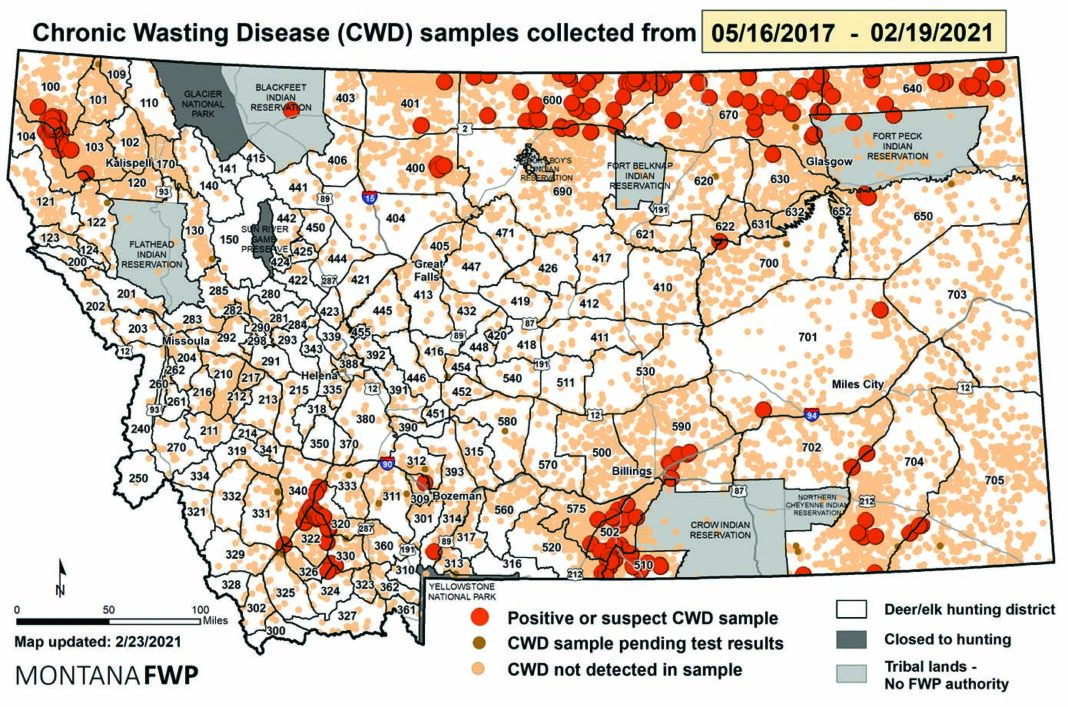
SHERIDAN – More than 300 samples were collected for chronic wasting disease testing during a recent CWD management hunt for white-tailed deer in southwest Montana.
The highest prevalence of the disease during this hunt was detected in Madison County.
The hunt, which lasted from Dec. 15 through Feb. 15, was implemented to reduce densities of white-tailed deer in areas with relatively high CWD prevalence and other places nearby where CWD prevalence is expected to increase in the coming years.
“While CWD has not yet been detected within a cervid (deer, elk, and moose) population in Jefferson County, it will continue to be a challenge into the foreseeable future for both the management and hunting of deer, elk, and moose throughout Montana. How big of a challenge will depend on whether CWD can be managed at a low prevalence within the populations where it currently exists and whether the spread of the disease can be minimized. Hunters will continue to be the primary tool for monitoring and managing CWD spread in these populations,” said Bill Dawson, FWP game warden for Jefferson County in an email.
CWD is a contagious neurological disease that infects deer, elk and moose. It is always fatal, and there is no known cure. It was first found among wild cervids in Montana in 2017 and was first detected among white-tailed deer in the Ruby Valley in 2019.
Continued testing of deer harvested during the management hunt further improved biologists’ understanding of CWD distribution and prevalence in all or portions of nine hunting districts in southwest Montana.
During the management hunt, FWP received 318 samples for CWD testing. So far, 305 of them have received a result, and 52 have tested suspect or positive for CWD.
Hunting District 322, which is located in Madison County, and where CWD prevalence was believed to be especially high, produced 211 samples during the management hunt, and 51 of the samples — 25 percent — were suspect or positive for CWD. CWD was also detected during the management hunt in one sample from Hunting District 326.
When combined with samples taken during previous general hunting seasons, FWP staff have observed CWD prevalence rates of 3 percent in Hunting District 320, and 13 percent in hunting districts 324 and 326, which include Madison and Beaverhead counties. CWD has not been detected in hunting districts 325, 329, 330, 331 and 340. Montana’s CWD management plan aims to keep prevalence below 5 percent.
Montana’s annual deer harvest survey and population trend surveys, once completed this spring, will provide information on how much the management hunt helped reduce white-tailed deer densities in this area, where thousands of white-tailed deer are counted each year. Those portions of white-tailed deer infected with CWD are contiguous with white-tailed deer and moose throughout the Ruby, Jefferson, Beaverhead and Big Hole valleys. They are seasonally connected to migratory populations of elk, moose and mule deer.
Without population reductions, CWD prevalence is expected to increase substantially in the coming years.
One of the best prevention measures hunters can take against the spread of CWD, is to provide for proper carcass disposal,” said Dawson, and offered the following guidelines.
All carcass parts, such as brain, eyes, spleen, lymph glands, and spinal cord material, should be bagged and disposed of in a landfill or may be left at the kill site. Dumping carcasses is illegal, unethical and can spread diseases, including chronic wasting disease. This new requirement applies to all deer, elk, and moose carcasses wherever in the state they are harvested by hunters or as vehicle-killed salvage.
FWP staff thanks hunters for participating in the hunt, seeking landowner permission to hunt on private land and submitting samples for CWD testing. FWP staff would also like to thank landowners for allowing hunter access and facilitating deer harvest and sample collection on their land over several months.
Biologists will continue working with hunters and landowners in the coming seasons to further understand CWD prevalence and distribution in many areas. Hunter and landowner participation, proper carcass disposal and minimizing prolonged concentrations of deer will all continue to play a critical role in managing CWD.
For more information about CWD in Montana, visit fwp.mt.gov/conservation/chronic-wasting-disease.