
Plans guiding the possible redevelopment of the former Montana Developmental Center’s South Campus are due out later this month, following more than a year of development and almost as much time taking public feedback and making revisions.
A master plan and preliminary architectural report, which could be available in draft form as early as this week on planmdc.com, will offer a roadmap for possible redevelopment of the South Campus. After multiple rounds of revisions based on public comment over eight months, commercial development along state Highway 69 is included in the plans; a diverse array of proposed development on state-owned land around the fairground and airport will have much less emphasis; and historic South Campus buildings could be retained or razed. The public will have two weeks to comment on the drafts before the documents are hammered into their final versions.
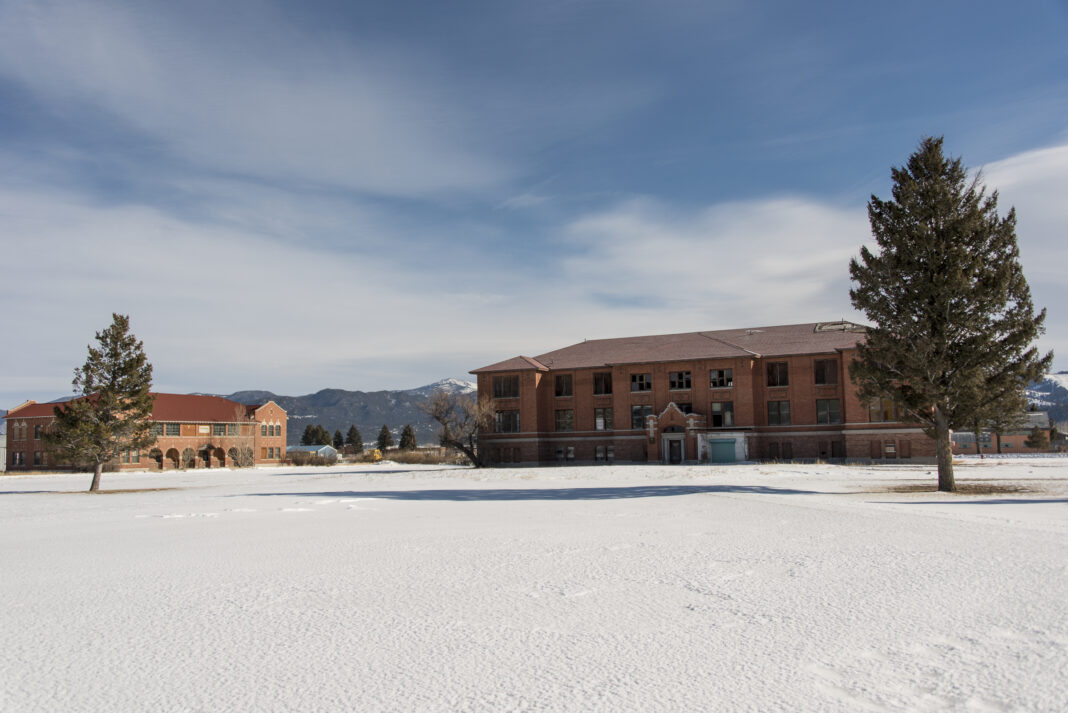
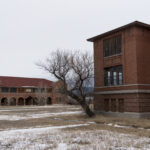
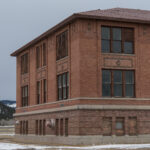
On the South Campus, the documents will detail options for either preserving and reusing, or demolishing, historical buildings five and nine—two large, red, brick buildings at the center of the campus that have been vacant for decades, according to Jessica Holdren, a project manager with FourFront Design, who explained the forthcoming drafts at a Boulder City Council meeting on Feb. 22. Plans for both options, removal or renovation, show commercial buildings with parking areas along state Highway 69 where a roughly X-shaped building—building six—currently sits vacant just to the north of a similar building that houses Youth Dynamics.
In a shift from previous iterations of the plans—which were presented in conceptual form at public events beginning in June—Holdren said that the drafts focus far less on possible development on land currently owned by the state Department of Corrections between the fairground and airport south of Boulder. Jefferson County had eyed the land for possible housing, commercial, light industrial and open space development—if the state would give it up.
“That agency might have a use for that land after all,” she said, meaning that it was unlikely the state would relinquish the property. Plus, she said, many residents in the area said they simply didn’t want development there, and the prospect of neighborhoods and business parks replacing pastures was “kind of surprising.”
The parcels in question are south of the fairground and state Highway 69, north and east of the county landfill, and north and west of the airport. Whitetail Road and Little Boulder Road run through the parcels. Concepts for the land, which totals about 706 acres, included a mixture of residential or affordable housing area, light industrial and commercial area, renewable energy, and open space, as well as connectivity to possible future Bureau of Land Management trails nearby.
The documents will recommend the county continue dialog with the state about the property, she said, but the master plan and preliminary architectural report will primarily focus on the South Campus, which has already played host to buildings for more than a century.
In a phone call on Feb. 23, Eric Seidensticker, executive director of the Jefferson Local Development Corporation, said that the plans called for the demolition, remediation and redevelopment of building six regardless of the fate of the larger, older buildings. It’s not yet clear what kind of commercial development might replace building six, and previous concepts for the South Campus included possibilities for a variety of commercial activity.
“We’re currently negotiating with a commercial developer,” he said. “They would do the demo and the knock-out of the building and we would transfer the building.”
The JLDC, Headwaters Resource Conservation and Development, and the state Department of Environmental Quality pooled funds to develop the plans, and hired consultants from FourFront Design, SMA Architects, DJ&A Engineering, and Headwaters Economics in January 2021. Seidensticker told The Monitor over the summer that the JLDC began working on the project when it received a $25,000 planning grant from the state Department of Commerce. The plan was originally focused on the North Campus, he said last week, but the focused shifted to the South Campus and state land farther south when the state Department of Justice announced plans last spring to relocate the Montana Highway Patrol to the North Campus.
On the South Campus, the JLDC currently owns buildings six and eight. Building eight, a V-shaped building to the southeast of Youth Dynamics’ main building, is currently rented to and used by Youth Dynamics for use as two group homes, and the JLDC is in the process of selling it to the organization.
“We’re just rounding third, heading home. All of the project is to help support YDI with stabilizing their existing footprint in Boulder,” Seidensticker said, declining to name a sale price before the transaction was finalized. “They’re committed to being in Boulder. The larger project is that they will essentially have that section of the campus to have their new residential group homes. It all kind of fits within that master plan piece.”
Youth Dynamics announced in October that it hoped to raise $2 million to renovate or replace its group homes in Boulder.
To renovate or replace is the primary question for buildings five and nine, both currently owned by Jefferson County. Neither option is cheap, but it’s particularly expensive to renovate the buildings.
“It’s rather expensive to do anything with the buildings, whether it’s demolish them or preserve them,” Holdren told the council last week. At a public forum on Nov. 18, she said that “I think it’s really clear that there is no clear answer.”
Building five, a former dormitory built in 1923 and designed by the same firm as Helena’s Civic Center, has been vacant for more than 40 years, according to a report from SMA. The structure was built well, “has an open plan to support almost any building program” and received a new roof in 2011. Building nine, formally named Griffin Hall, was completed in 1912 and was the original building of the Montana State Training School, according to SMA. The report said that Griffin Hall was damaged by fire in 1964 and that subsequent repairs resulted in the abandonment of the fourth floor. Presenters at the November forum also noted damage from a deteriorating roof and pigeons that live in the building. Both buildings contain asbestos and lead-based paint, and would require abatement of both if the buildings were demolished or renovated.
Reports presented at the forum determined that demolishing both buildings could cost up to $1.87 million; demolishing only building nine could cost up to $1.25 million, and demolishing only building five could cost up to $631,758.
But renovating the buildings was projected to cost far more.
Rehabbing both buildings into usable condition was projected to cost as much as $21.22 million, the report stated; renovating only Griffin Hall could cost as much as $14.76 million and building five could cost up to $7 million.
Renovation costs were so high that, according to a budgeting exercise from Highland Economics, sale prices and rental rates for a variety of units that could be developed in the buildings would have to be significantly higher than comparable properties’ market rates for a developer to recoup the cost of renovation, making the units far pricier than anything else nearby. The economics were even worse for a developer hoping to turn a profit.
The report also noted the option of doing nothing and stated that, “in that case, the building conditions would remain as they are now, continuing to deteriorate to the point that renovation would no longer be an option, making demolition inevitable.”
However, Holdren told the council that public comments showed that preserving the buildings “is something that the community, a lot of people, wanted to see happen.”
Either way, there’s a broader plan: The alternative that included preserving the buildings also featured affordable housing—”small lots with multi-density options” including single family, townhomes and four-plexes—and a recreation complex; the alternative that included demolition of the buildings featured “more of a centralized recreation facility” and more homes and townhomes, she said.
Holdren and Seidensticker have both stressed throughout the process that the documents do not constitute imminent development plans. Rather, the documents, once finalized toward the end of March, will simply offer the county and the JLDC a detailed roadmap for the future of the lands, Seidensticker said last week, arguing that “changes are on the horizon on the South Campus in general.”
“We’re already at that short term of acknowledging that there’s going to be change coming to the campus,” he said, explaining that the master plan and preliminary architecture report will offer a long-term plan. “It’s all going to come down to decisions made by the partners in the area.”