
A public meeting concerning the proposed Western Legacy Center in Boulder grew heated Thursday as residents sought answers to a long list of questions, ranging from cost to the ability of the city’s infrastructure to support such a project.
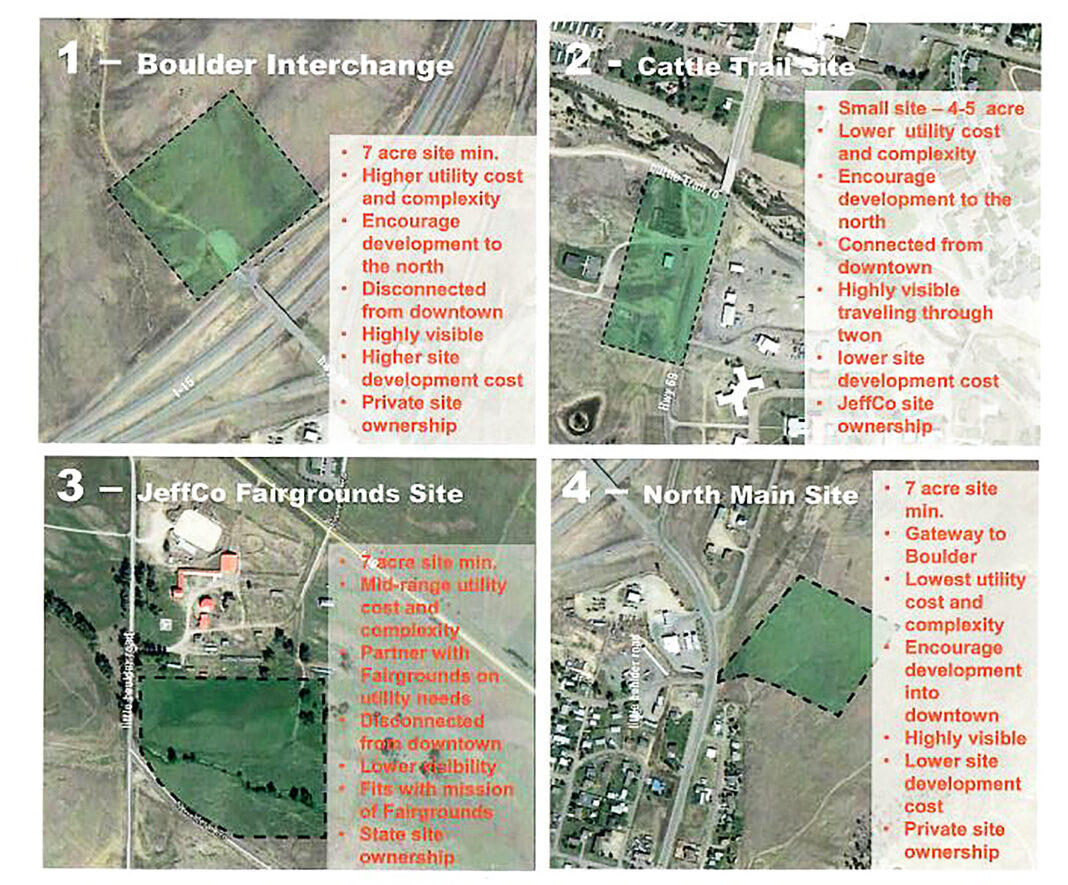
The public meeting was held to gather opinions on four selected sites — at the Boulder I-15 interchange, at North Main Street across from Town Pump, at the Jefferson County Fairgrounds and a site near Cattle Drive Road. The thirty-plus who attended the meeting, in person and via Zoom, were asked to provide their thoughts on the four sites.
The next step is to conduct a feasibility study to determine the project’s viability, as well as a preliminary architectural and engineering report with a conceptual design of the facility, said Ben Tintinger, principal architect with Mosaic Architecture, one of five entities assessing the concept.
The other “team” members include Jefferson County, the Jefferson Local Development Corporation, Great West Engineering and John Rogers Consulting.
The Jefferson County Commissioners had allocated $50,000 to conduct those reports, as well as the site selection process, according to Tom Harrington, project coordinator with the Jefferson Local Development Corporation.
The proposed Western Legacy Center has been proposed by the Jefferson County Commissioners as a way to boost economic development and capture some of the five million motorists that travel past Boulder and through Jefferson County each year along I-15. The center would celebrate western culture, particularly that of cowboys and cowgirls, and include a retail center that could draw on work created by Montana, and ideally Jefferson County, residents.
The meeting was led by Tintinger and Jefferson County Commission Chairman Leonard Wortman.
After being peppered with questions by residents about the feasibility of such a project, Wortman appeared exasperated.
The center was conceived to help Boulder, said Wortman, noting that the last several years has brought an onslaught of job loss due to the closing of the Golden Sunlight Mine in Whitehall and the Montana Development Center in Boulder.
“This area of Boulder has a high rate of poverty. Now it’s more important than ever to bring something here … if somebody doesn’t do something, this area will dry up,” he said, and at one point veered off into the difficulties faced by small businesses due to the recent shutdowns caused by COVID-19 and stay-at-home orders from Gov. Steve Bullock.
Residents, however, were concerned with the cost, as well as whether or not such a facility would be successful.
Tintinger noted that the building itself, in general, would cost about $250 to $300 per square foot, and for a proposed 20,000 square foot building, that could run about $6 million. Add parking and other add-ons and that could go up to $8 million, he said.
Paying for the facility’s construction would require the county to issue a bond, and that would need to go to voters in November — if this project moves forward, said Wortman. No cost estimate was provided.
Jefferson County resident Bob Marks noted that the building was the cheapest part of the project — after it’s built there are the operating costs.
“Operating never quits,” he said.
Ed McCauley wanted to know why a site in Whitehall wasn’t considered, given its proximity to I-90. That highway caters more to American drivers, he said. I-15 runs north-south, from the Canadian to Mexican borders.
Wortman said Whitehall had been a possibility after Golden Sunlight closed, but since the company has found a buyer for its tailings, it lost interest in divesting its land to the county for this project.
If this is going to be on the backs of the county taxpayer, it needs to be where it makes money, said Ed McCauley.
Wortman said the plan is for the center to be self-sufficient, and mentioned possible grant options to cover some of the operating costs.
“Everything we do is a risk,” he said, adding the county will own the building. However, if money is borrowed to build the facility and it fails, it will be left to the taxpayer to pay back, said Wortman.
One entity that has been discussed as a possible partner in the project is Montana Pro Rodeo Hall and Wall of Fame, for which Wortman serves as a director.
Quentin McCauley asked if the City of Boulder’s infrastructure, namely water and sewer, could handle the additional load — especially if this brings in more development.
In his presentation, Tintinger said this project could include an outdoor music venue and arena, as well as attract more businesses, such as a brewery or cidery. No estimate was given on the amount of traffic auxiliary businesses would generate.
Quentin McCauley was concerned that more development of that nature would erode the existing western legacy and agricultural base of the county.
Wortman said that while ranchers are not dependent upon who comes through their doors, small local businesses are, and this is designed to help increase their foot traffic.
Justin McCauley asked why other possible sites had been discarded and why were only four being considered.
Tintinger said other sites were not evaluated and discarded in a formal, documented way, but that he could backtrack and come up with a document giving those reasons, if so desired.
Others at the meeting said they were worried this would cause their taxes to go up, or that it would fail to bring in enough visitors to make it viable. Wortman and Tintinger were also asked if the North Main Street site was also the former location of the city dump.
Wortman said the former dump was further away, but did not offer any additional information on location.
Boulder City Clerk Ellen Harne said she was unaware of the boundaries of the former landfill.
Quentin McCauley said it wasn’t that everyone in the room was against the project, they just wanted it to be right.
The presentation also listed the pros and cons of each of the four selected sites, with criteria being the size of the site, access and traffic, whether it was a good fit for the neighboring properties, whether the site provided a strong public presence and access to existing infrastructure. Six to eight acres would represent the ideal size, said Tintinger.
•Site 1, located west of the Boulder I-15 interchange, was the most expensive when it came to installing utilities, at an estimated $720,000, plus the property was privately owned. The utilities would be run under the interstate and Ranch Road would be relocated. Pros included being highly visible from the highway and its potential for new development. Wortman said a portion of that land could be donated to the county.
•Site 2, located next to Cattle Trail Road, while owned by Jefferson County, would likely require the Bull Mountain Fire Department building to be moved. The cost to put in utilities was estimated at about $259,000. The site is also considered highly visible, as it sits along Highway 69 and is accessible by foot from downtown Boulder.
•Site 3, next to the Jefferson County Fairgrounds, would need to be purchased or traded with state land. The cost to install utilities is estimated at $353,000 and it has been rated lower for parking. In its favor, it is a flat piece of land located next to the fairgrounds and also accessible from downtown.
•Site 4, located off North Main Street, is privately owned, but has the lowest infrastructure costs, estimated at $109,000. As with Site 1, a portion of the land could be donated, as it is the same landowner, Skytop Ranch, said Wortman. The available size is yet to be determined, but Tintinger did not elaborate. The site, however, is highly visible from I-15 and is walkable from downtown Boulder. It could also act as a catalyst for more development in the downtown area.
Wortman said the City of Boulder indicated that its utility infrastructure could handle the increased load.
Once the comments are collected and a site is chosen, the team will proceed with its feasibility study, which will include what the building will look like, what will go in it, where it will be located and what it will cost, said Tintinger.
A building can’t be designed without a building site, he said.
Wortman said on Monday that the county wants to have the PA&ER completed sometime this summer. In order to put a bond issue on the November ballot, the county would need all the information by late August, said Wortman.