
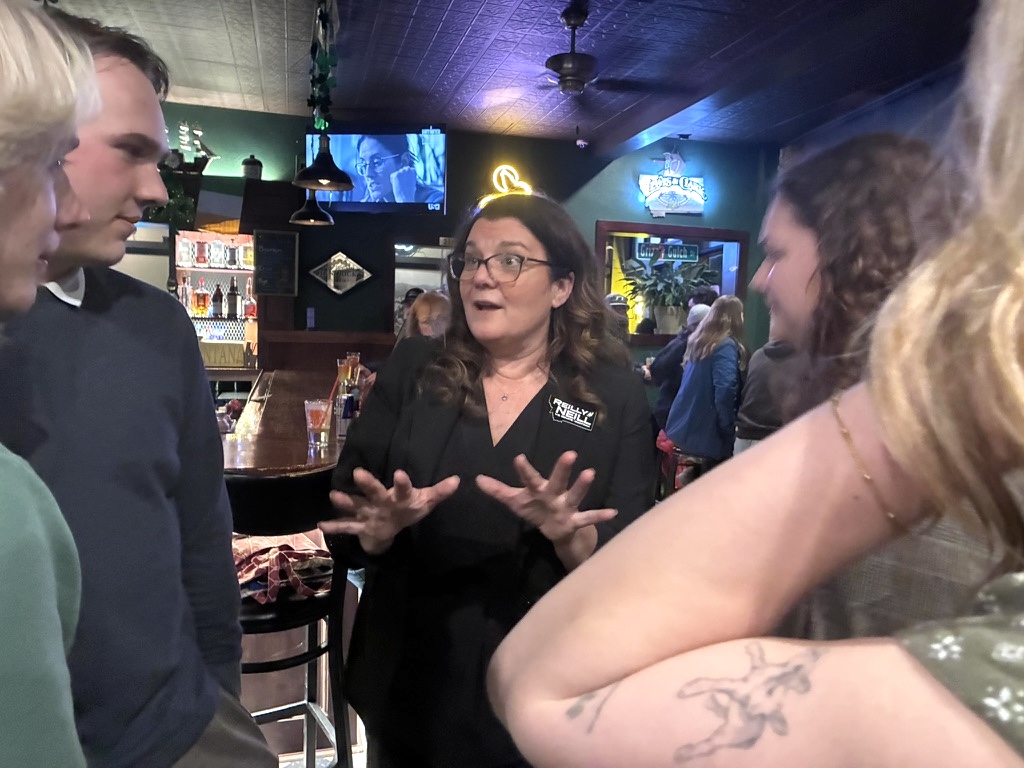
Early campaign support seems strong for Democratic U.S. Senate candidate Reilly Neill, with attendees at her March 6 event in Helena expressing enthusiasm for her people-first approach.
Neill’s platform focuses on funding public schools, supporting ranchers and farmers, protecting public lands, and creating universal healthcare, according to her website. Yet what appears to stand out is her commitment to listening to and serving all Montanans, as shown by her pledge to refuse funds from political action committees and run a truly grassroots campaign.
When Ashley Fischer, co-founder of the Helena volunteer support group Walking Giant, learned of that commitment, “I was like, ‘Oh hell yeah,” she said at last Friday’s event.
Cari Olson, an organizer with the nonprofit One Montana, felt much the same. “I’ve got a girl crush,” she said. “I think she’s going to win.”
The 52-year-old Neill’s origins are modest and locally-focused. Raised in a working-class home, she ran a community newspaper in Park County for more than a decade.
“My career has been in public service and community service,” said Neill, who has lived near Livingston with her husband and son since the early 2000s. “I hear a lot of Democrats say…‘You have to play the dirty game if the other people are playing dirty.’ And I don’t agree with that, and I think most Montanans don’t either.”
Her political record suggests she has a point. She represented Montana’s House District 62 from 2013-2015, losing her reelection bid to Republican Debra Lamm. In 2019, Neill briefly ran for the governor’s office before dropping out in the lead-up to the 2020 primary.
“Having this history shows us where she’ll go,” said Montana State University student and College Democrats of Montana member Blake Lindermann, who believes Neill’s legislative experience could help her navigate Washington politics.
The Gold & Western Bar on Helena’s Last Chance Gulch is often packed on a Friday night, but the crowd at Neill’s event felt different. Groups of activists and political organizers milled about in suits and ties, eagerly waiting to speak to the candidate – who delivered no address, but simply engaged in conversation. Regular patron traffic made an exact count difficult, but well over 50 people turned out explicitly for Neill.
“We need someone honest like Reilly to send to D.C.,” said Qasim Abdul-Baki. A public defender running to represent House District 80, he’s been following Neill’s career since she ran a write-in campaign for House District 62 in 2024.
Standing by the door, Jay Long, the College Dems’ vice chair, called Neill the “most vocal, most determined candidate”. He recalled the Montana of his youth, a fiercely independent purple-tinged state. “Our hope this year is to get back to the Montana we all grew up with,” he said.
Neill hopes to be the candidate who does just that. “The whole crux of my campaign is getting people engaged in politics, getting people engaged with their representatives,” Neill said. “They’re elected by Montanans to serve our needs.”
Before and since launching her campaign, Neill has focused on traveling the state, attending town halls, chatting up locals, and hosting round tables in more than 40 counties. One thing she learned is that, regardless of party, Montanans can easily find common ground.
Support for public lands, opposition to data centers (Neill seeks greater transparency in data center construction), and the desire for better healthcare options tend to cut across party lines. “They’re incredibly progressive,” Neill said of Montana voters, “but they’re conservative.”
On Tuesday, after the Trump Administration renewed its call to eliminate most mail-in voting, Neill released a statement denouncing the move, explaining that mail-in voting is essential for many Montanans.
“Many voters live far from a courthouse or polling location,” she said. “Ranchers, small business owners, and working families rely on absentee ballots because they allow people to vote when the day finally slows down.”
Speaking of rural voters, Neill hopes to pass a farm bill that delivers crop insurance reform for smaller Montana agricultural producers. Under the current system, she said, large operations take advantage of massive taxpayer-funded subsidies while small ranches and farms are left to struggle. “They can’t afford to take out that kind of crop insurance,” Neill said. “It’s a disparity.”
Seeking support from the state’s old guard, Neill received an endorsement from former two-term Democratic Montana Governor Brian Schweitzer earlier this year.
“We can’t predict what’s going to happen,” Paige Frunkes of the College Democrats said at the Gold Bar event. “But I’m really excited about her campaign.”
Neill faces tough competition in the June 2 primary. The Democratic field for the Senate seat is crowded: Helena resident Alani Bankhead, Hays resident Micheal Black Wolf, former Navy SEAL Micheal Hummert, and Missoula’s Christphoer Kehoe, along with Neill.
The election cycle has already seen some surprises, with Sen. Steve Daines announcing his retirement minutes before the deadline and backing former U.S. Attorney Kurt Alme, who was quickly endorsed by President Trump. The last-minute shift has shaken up the race.
In another twist, former U.S. Sen. Jon Tester decided to back former University of Montana President Seth Bodnar, running as an independent. The longtime Democrat reportedly sent a text message in January in which he called the Democratic label campaign “poison” and predicted Neill would lose badly in the primary, according to the Montana Free Press.
“How dare they put up Seth?” Olson said at Neill’s Helena event.
Her outrage over Bodnar stems from a 2021 sex discrimination lawsuit filed by 17 University of Montana women staffers who accuse him of perpetuating a culture of wage, promotion, and opportunity gaps for women, according to Montana Kaiman.
The suit was settled out of court in 2024. And Bodnar’s campaign has gotten off to a fast start, raising more money in a few days than all the Democratic candidates combined, according to a press release from his campaign.
A bipartisan poll, taken by American Pulse in mid-February, before Daines dropped out, showed Neill with 25% of prospective voter support, Bodnar with 16%, and Daines at a hefty 52%.
Several attendees at the March 6 event saw Tester’s and Daines’ behavior as part of a broader pattern of disrespect that they hope Neill’s embrace of all views and voices can end. “It’s important for people to know that I plan on being a representative,” she said, “and that job requires communicating with the people of Montana.”
When a group of students approached later in the evening, Neill quickly pivoted to face them. After a round of introductions, she gave them her full attention: “Tell me your concerns.”