
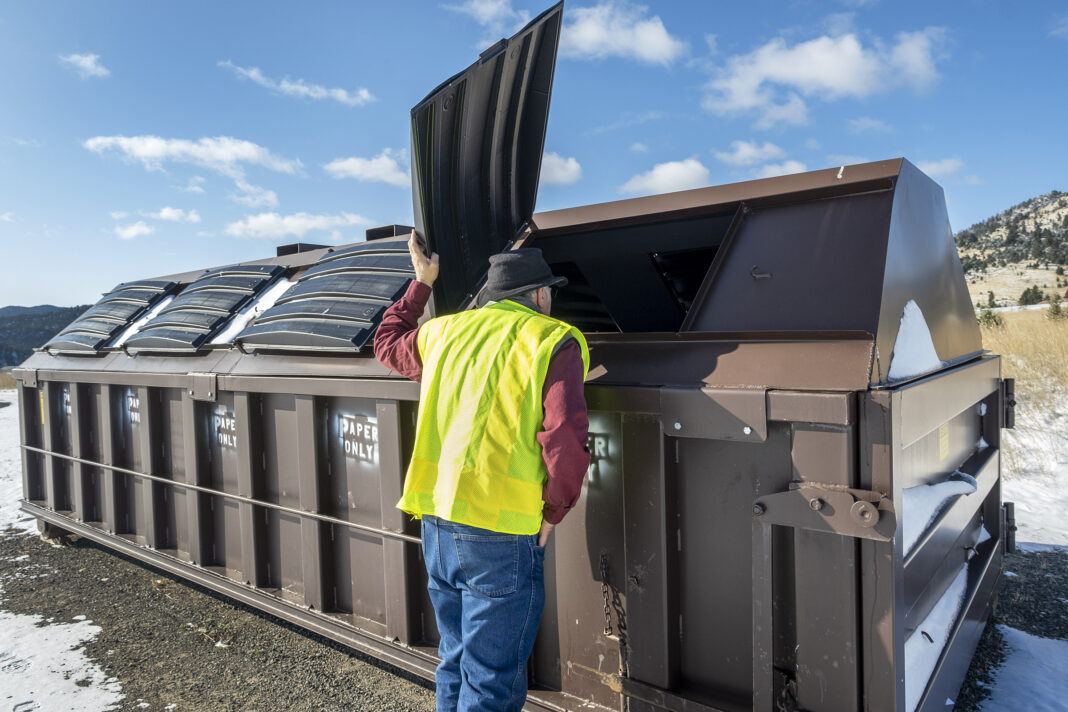
At Boulder’s solid waste collection site, Brian Hohn eyes the recycling bins wondering if the social good associated with all this cardboard and paper can contravene the laws of economics.
Jefferson County’s Solid Waste Manager knows that in today’s market, recycling, once a free and feel-good habit, is no longer without cost. In September the county began paying $35 a ton to recycle paper and $20 a ton to recycle cardboard. This month, the fee to recycle cardboard is up to $30 a ton.
“Any higher,” Hohn says, “and the cost isn’t worth it.”
By comparison, the county pays $29 a ton to transport regular waste to the landfill at Tri-County Disposal.
If it costs more to recycle waste than to bury it, what is the practice worth?
That’s what Hohn wants to know.
With the recycling center located conveniently next to the landfill, the transport costs of diverting waste versus disposing of it do not weigh heavily on Hohn. It’s the tipping fees, the price charged to dispose of a quantity of waste at a processing facility, that have snagged his concern. By his estimation the new fee for paper could cost the county $125 annually. Cardboard – generated by the county at about 8 tons per month on average, or $240 a month with the new fee – could really nudge up the cost of recycling.
“You can collect anything,” says Hohn, “but if you don’t have a marketable commodity, you’re taking it to the landfill.”
Until about eighteen months ago, Jefferson County earned money recycling mixed paper and cardboard, all those glossy flyers, credit card incentives, and Amazon shipping boxes that in recent years had morphed unnoticed by the average consumer, along with other recyclable materials, from mundane waste into bonafide market commodities.
But in January 2018, shock waves sent the global recycling market cartwheeling into a tight corner. China, once the largest buyer and processor of recyclable material from the U.S. and most other countries, banned the import of 24 types of solid waste and imposed more rigorous standards on others. Excessive contamination from the careless sorting habits of consumers – peanut butter still in unwashed jars, plastic wrap snarled through the office paper – was gumming up China’s mill machinery, overwhelming underpaid sorters, and fouling the environment. Chinese processing facilities, reeling with the overflow, struggled to continue processing the volume of tainted material. Faster than the world could respond, much of its recyclable commodities were being shipped overseas only to be dumped in rivers, buried in landfills, sold in illegal markets, incinerated. In a conclusive move to clean up house, China drew a line. An exacting one.
In the meantime, here at home, the pipes have backed up. Supply is through the roof and demand continues to languish as American recycling mills are inundated with shiploads of tonnage that have lost their prime destination. Decades of dependence on China for processing curbed the development of domestic infrastructure. Without enough mills to handle the deluge of material, the U.S. market is saturated with towering stacks of compressed bales degrading in warehouses and waste-management yards across the country. In rural areas like Jefferson County, the nearest mills are hundreds of miles away.
“China got tired of taking our garbage,” says Hohn, “and our small rural communities are paying for it.”
Jefferson County trucks its recyclable material to Helena Recycling, a private company that mainly provides curbside pick-up for residential and commercial properties in the Helena area but also collects cardboard, mixed paper, and aluminum from Jefferson County. While a carefree flick of the wrist can sail a sheaf of junk mail into the recycling bin, it’s an increasingly costlier heft for a company to bale and haul behemoth binloads across state borders when oversupplied processors are beginning to turn away material. Helena Recycling owner John Hilton hauls material to the closest facilities available to him: paper over 300 miles to a mill in Spokane, cardboard almost 700 miles to a mill in Port Townsend.
“Some recycling companies are landfilling their material,” says Hilton. “We haven’t landfilled anything yet. Thank God.”
With fast-diminishing destinations one alternative to burying our recyclable commodities with the rest of our waste, is to raise rates.
“We held on as long as possible before we had to start charging,” Hilton says. “We’re always trying to find new mills, but they’re far away. Everyone’s pretty much scrambling.”
Of the broader future of the global industry, he adds, “I don’t think it will ever be the same.”
Between contamination and commodity, diversion and disposal, how do we restore profitability to the practice of recycling? Beyond the stagnating stacks of our once marketable waste, there is light. Both Hilton and Hohn underscore current endeavors to expand American processing capability by investing in domestic mill infrastructure, including new mills to process material as well as existing mills that are adding production capacity or converting technology to handle additional streams or produce different end products. Even Chinese companies are getting in on it.
“Then all our recycling stays in the U.S.,” says Hilton. “We’re not shipping it overseas anymore. It will be better for everybody.”
Until then, his hope is pooling behind the mantra of “When in doubt, throw it out.”
“If you’re not sure that it’s recyclable, throw it out, because the contamination is ruining our recycling.”
Education, he feels, is the answer. Teach people how to sort their waste.
In his office in Boulder, Hohn sings a similar tune, worrying what might happen if we let slide the recycling habits, insufficient though they may be by market standards, that we have managed to assimilate into our lives. “The key to making recycling work in a small community,” he says, “is to get the customer to do the sorting. Each time we touch it, it costs money.”
As previous Solid Waste Manager for Broadwater County for seven years and a current board member of Recycle Montana, Hohn’s experience guides his concession that if recycling is to gain ground right now, it’s going to cost more.
The only funding for the county’s Solid Waste Department, he explains, comes from an annual $129.69 unit assessment on county residents’ tax statements.
“My job,” Hohn says, “is to be the best steward of that money.”
It’s a responsibility he takes seriously, juggling county and cost, material and market, environment and education. Each facet has its value. What he strives to understand, asking for feedback in the face of rising tipping fees, is the value of recycling to his customers. He invites them to email their thoughts to bhohn@jeffersoncounty-mt.gov.