
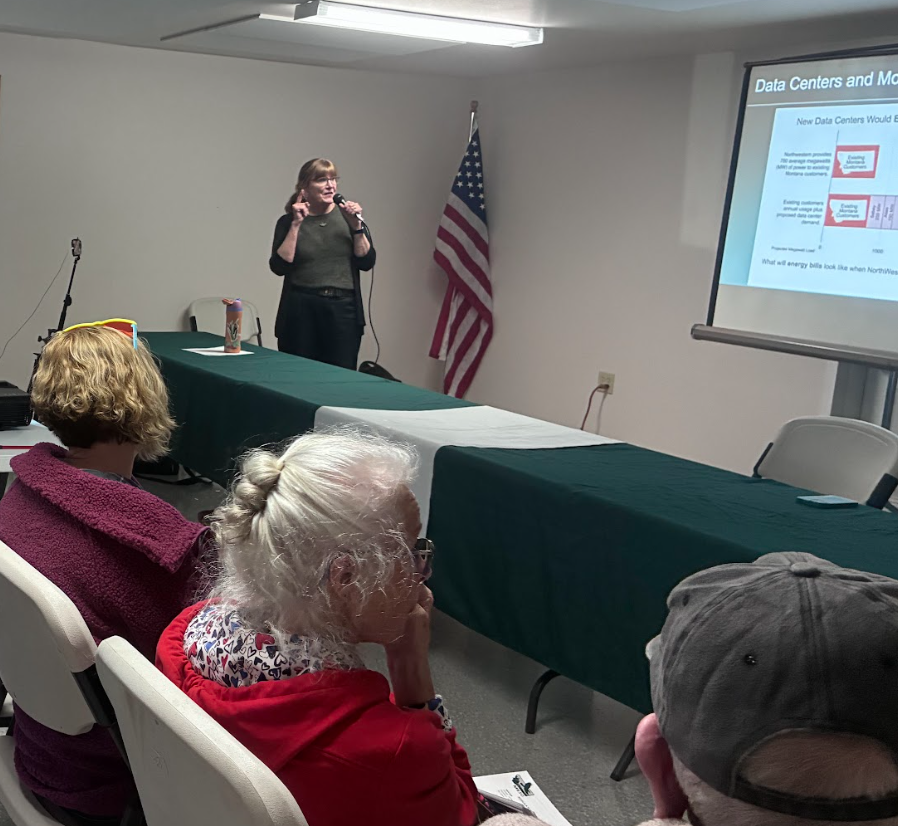
Nearly 60 locals turned out for an animated AI data center event in Boulder last Friday, engaging speakers on legal, environmental, and cost concerns, opening up broader discussions and vowing to demand accountability from their representatives.
“It’s a valuable conversation,” said Barbara Chillcott, Western Environmental Law Center (WELC) attorney, touching on the evening’s hot-button topic. “Where do we want our fresh water to go, and for what purpose?”
Residents’ concerns about the impact of data centers have spiked in recent weeks, following The Monitor’s report on a proposed 500-megawatt gas plant meant to support a government-linked, county-based AI data center.
Such concerns seem merited. Large AI data centers use up to five million gallons of water per day, or about the same as a small town, according to the Lincoln Institute of Land Policy. With the federal government declaring Jefferson County a drought disaster area in February, water had already been top of mind for many.
During the post-presentation Q&A at the Jefferson County Fairgrounds event, attendees mentioned the limited water resources, the abnormally dry winter, and the county’s position in a closed basin, in which all water rights have been allocated. Some expressed fears of out-of-state companies misusing local resources.
“I don’t want anyone messing with our land and water,” said Boulder resident Nancy Roe.
Chillcott explained that data centers would likely apply for water rights as new industrial users, which would play out in one of three ways. They’ll either buy existing water rights from current right holders (a lengthy process involving Department of Natural Resources Conservation oversight), get a geothermal permit exemption (unlikely, according to Chillcott), or, most likely, transfer an existing water right, such as from agricultural use to industrial.
Municipalities and water marketers across Montana have already changed the purpose of their water rights, for instance from agricultural or industrial use, to make them available for purchase, according to Chillcott. “They’re just waiting for the right buyer to come and buy these water rates for millions of dollars,” she said on Friday.
Any ranchers or others tempted to make a big water rights sale, multiple attendees argued, should keep in mind the likely resulting impact on area water resources. “You can’t drink money,” said Whitehall resident Katie Smith.
Echoing several others, Smith vowed to write her representatives to request strict data center regulations. “I want communication from local and state politicians,” she said.
Many data center critics have expressed a similar wish. In early March, in fact, a coalition of advocacy groups, including the Butte Watchdogs for Social and Environmental Justice, challenged a Montana Public Service Commission protective order enabling Northwestern Energy to shield information about planned data centers from public view.
The coalition’s main concern is that AI data centers’ exaggerated power use will drive up electricity rates – a concern shared by Anne Hedges, Montana Environmental Information Center (MEIC) executive director, who spoke at Friday’s event.
“Residential customers are paying a far greater share of utility costs than commercial data centers,” she warned. “We are seeing this all over the country, where the residential customers, us, are getting the short end of the stick.”
U.S. Congressman Troy Downing, whose district includes Jefferson County, appears to share this view. “These developments must not drive up costs for rate payers or threaten the viability of the resources Montanans know and love,” he told The Monitor this week.
If they were to make no negative impacts, data centers could create jobs and boost local economies, Downing explained, adding that locals should help shape such projects. “Community engagement should play a central role in developments like data centers,” he said.
That explains the thinking of Boulder artist Mary Eder, who organized the March 27 event and spoke after Hedges, who emphasized the importance of transparency, urging the audience to press for government regulation and data center accountability.
“I believe we are in charge of this, and if we all sit back and let this happen, that’s our fault,” Hedges said. “We should not sit back and let this happen.”
During the nearly two-hour event, audience members tutted their approval or muttered in disagreement as speakers made points about water usage, potential jobs, and more. Several expressed appreciation for the insights provided by Eder and others.
“They gave us information and they gave us tools,” said Roe. “We need to have regulations in place before it all happens.”
After the event, Boulder resident Tammy Burk, who along with Roe planned to contact state officials, appreciated seeing folks from across the political spectrum in attendance. “I want more uniting,” she said.
Hedges, who also noted the bipartisan nature of the issues, pointed out that data centers are not inherently negative. Yet without governmental accountability, even at the county level, communities are vulnerable.
“We need the facts on the table,” Hedges told The Monitor, calling for county zoning to mitigate data center impacts and for communities to reach agreements with data center developers to create an emergency fund to cover accidents, incidents or emerging issues.
Ultimately, each county is likely to decide how to proceed, guided by community input. “Regulations can make sure we do this on our terms,” Hedges said. “It’s up to us.”