
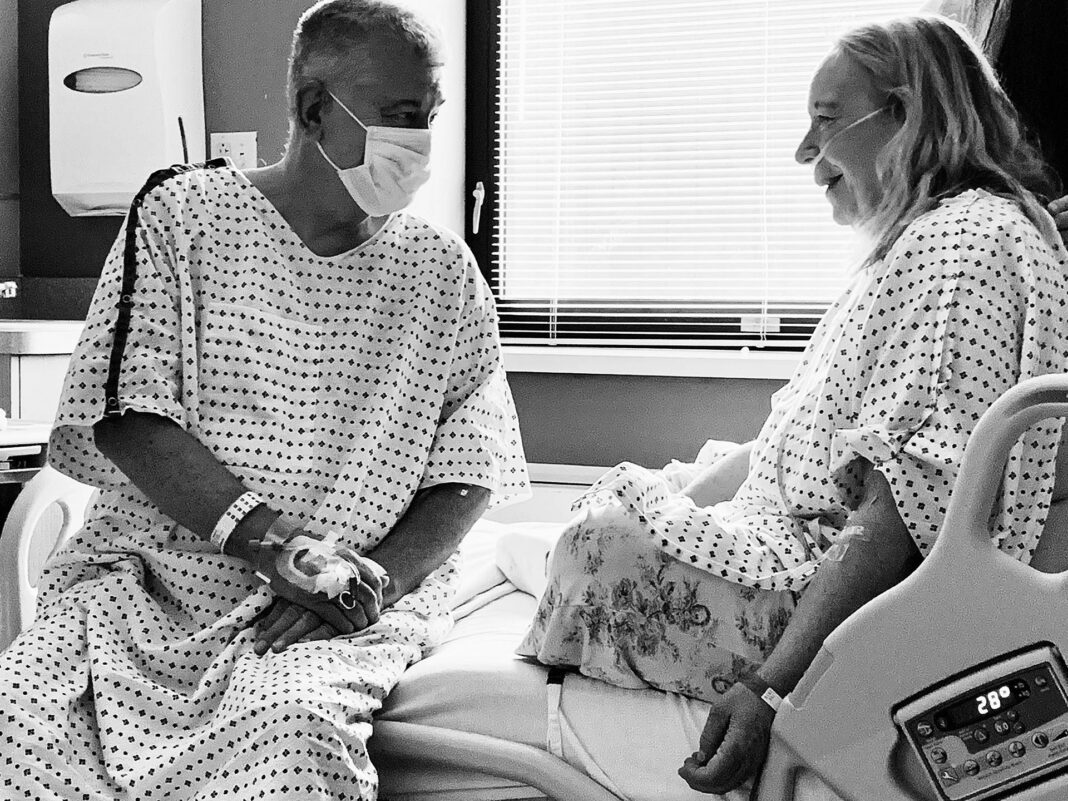
February was a blur. My parents and I caught Influenza A after attending an event together. It left me pretty much unscathed, save for feeling extra run down and uncomfortable for a few days. But my parents got sick. Really sick. Call-an-ambulance-at-four-in-the-morning-because-you-cannot-catch-your-breath sick. Diagnosed with respiratory distress, both were hospitalized in adjoining rooms. There they celebrated their twentieth wedding anniversary on Feb. 5.
Dad came home after a few days, Mom a few days after that. After Mom was home for about a week, however, I found myself following an ambulance over the hill from Whitehall to St. James in Butte for the third time. She stayed for two weeks. I visited her every day, much of which she does not remember.
In February, I got used to wearing a mask and gloves. There was a big sign on Mom’s hospital room door warning everyone to put one on before entering. It felt odd at first to wear a mask and to interact with other people wearing masks. It was hard to read facial expressions and know when someone was being sarcastic or serious.
The nurses took good care of Mom. On one particularly hard day, sensing she was feeling down, they danced to Elton John to lighten the mood. (And I learned you can still gut laugh while wearing a mask.) Then it was time for me to leave and go home. With a smile on my now-unmasked face, I pushed the elevator down button with a tissue, careful not to touch anything with my bare hands. A doctor walked by, called me by name and asked how I was doing. It took me a few moments to recognize him because I had never seen him without a mask on. He watched my expression change when I realized who he was and with a nod and a chuckle he went back to work. I guess he gets that a lot.
In February, I washed my hands more than most people I know. Donning a mask and gloves became routine, as did carrying a bottle of hand sanitizer to use after I touched anything that could be a source of infection. That same doctor from the hallway later told me that my mom was the sickest person he ever saw survive. Her immune system was shot, he said, and it could take several months before her lungs began to get better. Go home and self-isolate were his parting words to her.
February prepared me for the COVID-19 pandemic that hit Montana in March. I watched as the community around me began to catch up to what I had already been practicing. Work from home if you can. Self-isolate. Wash your hands. Social distance. Stay at home. Don’t touch your face. Wear a mask, if you are one of the lucky ones to have one. Why? It may prevent you from getting COVID-19. More importantly, it means that if you do have COVID-19 and don’t have symptoms — an estimated 1 in 4 coronavirus carriers could be asymptomatic — or if you are infected and not showing symptoms yet, you lessen the chance of spreading it to other people.
Because I’m my parents’ only lifeline to the outside world right now, the best I can do is take extra precautions to not catch COVID-19. I limit my essential business in town but still need to go to the grocery store and the post office. Like many folks in our community, my parents should not go themselves. I also have a school-aged child with an auto-immune disorder that I worry about. That’s why when I have one, I wear a mask.
I hope you might consider wearing one too. Not forever. Just for now, until the curve is flattened, and I can hug my Mom again. Given that I can’t sew to save my life, can you sew a mask to save someone’s life?
Alison Richardson lives in Whitehall with her husband Kristian and her children Elena and Soren.