
NOTE: This story was updated with additional reporting on March 10, 2026.
The AI data center wave may be coming to your town soon.
During a brief allowance period for presidential exceptions last March, Thunderhead Energy Solutions, a little-known energy generation firm, filed for Clean Air Act exemptions for a power plant to support a potential Jefferson County data center.
The filing, shared with The Monitor by the Montana Environmental Information Center (MEIC), included no mention of a specific location or the energy firm’s client. But it did lay out a 500-megawatt facility of solar and natural gas turbines that operates “behind-the-meter,” or unconnected to the local electricity grid, to power federal government-related AI data processing.
“The facility will support enterprise cloud and AI computing infrastructure essential to U.S. national security interests, including classified government workloads and critical AI development,” Thunderhead CEO Brennan Zaunbrecher wrote in the request.
“Current grid constraints in Jefferson County, MT, prevent timely utility-scale power deployment, while our behind-the-meter natural gas solution can deliver 500MW in 18-24 months, significantly accelerating national security-related computing capacity.”
If it were to gain EPA exemptions approval, Thunderhead’s power facility would be exempt from a permitting review of its power generation sources, as well as air and turbine pollution regulations for two years. These exemptions could affect the amount of environmentally hazardous emissions, such as nitric oxide and sulfuric acid, released by the plant.
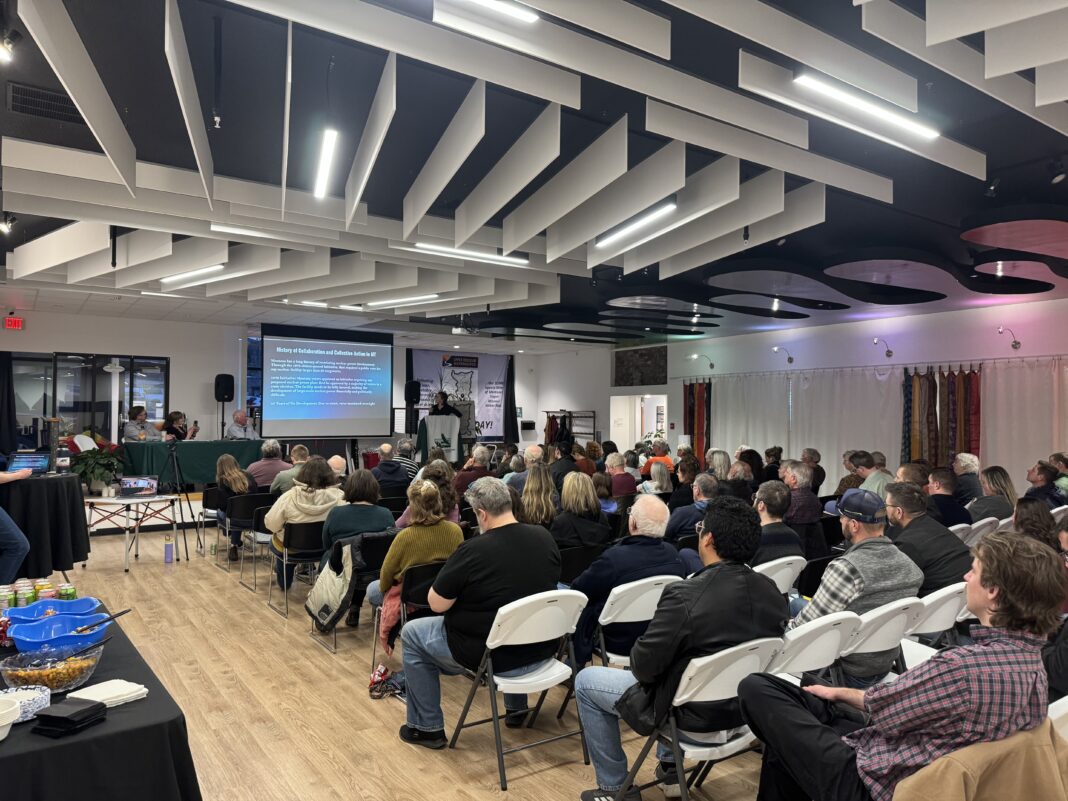
With multiple data centers planned for Butte and elsewhere across the state, Montanans have begun to express concern about the centers’ exaggerated power and water use and potential impact on their electricity rates and resources. More than 80 people turned out for a March 4 data center event in Helena hosted by MEIC and advocacy group Upper Missouri Waterkeeper.
“We in Montana deserve to know what the consequences of these choices will be, and not to simply have to live with them after the choices are already made,” UMW Founder Guy Alsentzer told the crowd.
Attendee Mary Eder, a Boulder resident, expressed concern about water usage after MEIC’s presentation asserted that data centers use up to five million gallons per day. “It appears Montana is wildly underprepared for the impact these data centers can have on local communities and the larger ecosystems,” she said.
When it comes to water, two key questions are paramount: how much will the center need, and can the surrounding area supply it. With much higher power density, AI data centers run much hotter than conventional data centers, and thus require significantly more water for cooling.
Yet since few disclosure rules have been put in place, companies tend to create their own water use reports, resulting in considerable uncertainty about data center water use. Analysts disagree on the extent to which AI data centers’ water-driven cooling systems could become more efficient in the coming years, but most estimates suggest that mid-sized facilities, like the one envisioned by Thunderhead, will continue to require millions of gallons each day.
As for the source, the Upper Missouri basin, which includes Jefferson County, is a closed basin, which means all area water rights have been allocated. The region has been in a drought for years, and this dry winter is not helping. Planned housing developments have been struggling to secure adequate water and local fears about water scarcity seem to be gaining ground.
“The water is needed for the people, wildlife, livestock and farmers over all else,” Boulder resident Dustin Gosman wrote on Facebook in response to The Monitor’s initial story on the possible data center. “It seems we are already experiencing more frequent droughts across the state, and I don’t see how this is going to help us.”
Eder made clear her stance on data centers. “There are zero benefits to local communities,” she said.
Yet one potential benefit is jobs. A mid-sized data center such as Thunderhead’s planned facility would likely have 50 to 100 workers once fully operational, in addition to the several hundred involved in construction.
“It is a full gamut of skills required to keep this place running,” said East Helena-based data center specialist Michael Callanan, sharing his personal view. This, says MEIC leader Anne Hedges, explains why labor unions tend to support the construction of data centers.
Data center jobs are “variable and often overstated,” according to the Brookings Institution, a nonpartisan, Washington-based think tank. Hedges concurred, explaining that data center jobs are often handed to high-skilled out-of-staters, rather than locals.
“The jobs are always less than promised and rarely locals are hired,” Jeffrey Benson, a Boulder rancher with corporate management experience who ran for a state senate seat in 2024, wrote on Facebook, highlighting a “mounting revolt” against U.S. data centers.
Another concern is that data centers drive up energy bills, though new government policies may be shifting that math. Last week at the White House, the world’s top tech firms – including Amazon, Google, Meta, Microsoft and OpenAI – pledged to cover the cost of all data center power requirements.
“Big Tech companies are committing to fully cover the cost of increased electricity production required for AI data centers,” said President Trump. “That would mean prices for American communities will not go up, but in many cases, will actually come down.”
The construction of most new data centers now involves energy generation companies like Thunderhead. If the Jefferson County exemption request is approved, the firm would build a battery of turbines that convert natural gas into electricity to power the center’s servers.
With AI companies seeking 85 gigawatts of power for new data centers by 2030 – a fifth more than the grid can currently supply, according to market research firm S&P Global – rural America has emerged as a primary target.
A 2025 CNBC analysis ranked Montana as the third best positioned state to host data centers due to its grid reliability and electricity prices. Montana also offers data centers the state’s second-lowest property tax rate at 0.9%, according to MEIC.
The state’s cooler climate is another draw. “From September to April, you can open up your dampers and pull in cold air,” said Callanan. “Your water consumption goes down because you’re pulling in outside air for a lot more of the year.”
Given the massive demand for AI computing, companies like Thunderhead, along with financiers, are working to build more quickly. Last year, Thunderhead partnered with Alabama-based investment firm Harbert Management Corp. to collaborate on the development of up to 1,500 megawatts of new power generation for data centers.
In line with President Trump’s AI Action Plan, EPA Administrator Lee Zeldin last year launched “Powering the Great American Comeback”, which included the EPA’s creation of an email inbox in March 2025, to receive Clean Air Act exemption requests for review by the president.
The idea was to circumvent environmental protections for places that lacked local technological capacity or if it were in U.S. national security interests. Amid hundreds of requests from coal plant operators, oil refineries, and steel manufacturers were 11 filings from Thunderhead, looking to produce 23 gigawatts of energy at data centers in Montana, Texas, and Illinois, as detailed by the news outlet Grist, which made the initial Freedom of Information Act request.
In September, Thunderhead confirmed plans for a 250-megawatt natural gas facility to power a West Texas data center – its only apparent exemption approval thus far. In January, the EPA set new rules for data center power generators, but it remained unclear whether the new regulations would impact Thunderhead’s planned turbines or potential exemptions.
Thunderhead, which offers no location details on its website, may have already received an EPA exemption approval for its Jefferson County power plant or been rejected. As of March 10, Thunderhead and the EPA had yet to respond to The Monitor’s requests for comment.
Opposing forces seem to be gaining strength. In March to June 2025 alone, opposition groups halted or delayed 20 U.S. data center projects worth $98 billion, according to the tracking platform Data Center Watch.
Learning about a data center possibly coming to the county, Eder and her husband, Josh, have begun making plans to raise awareness and organize an opposition group. “We can have a lot of influence if we come together,” Eder said. “I don’t believe it’s too late to have an impact.”