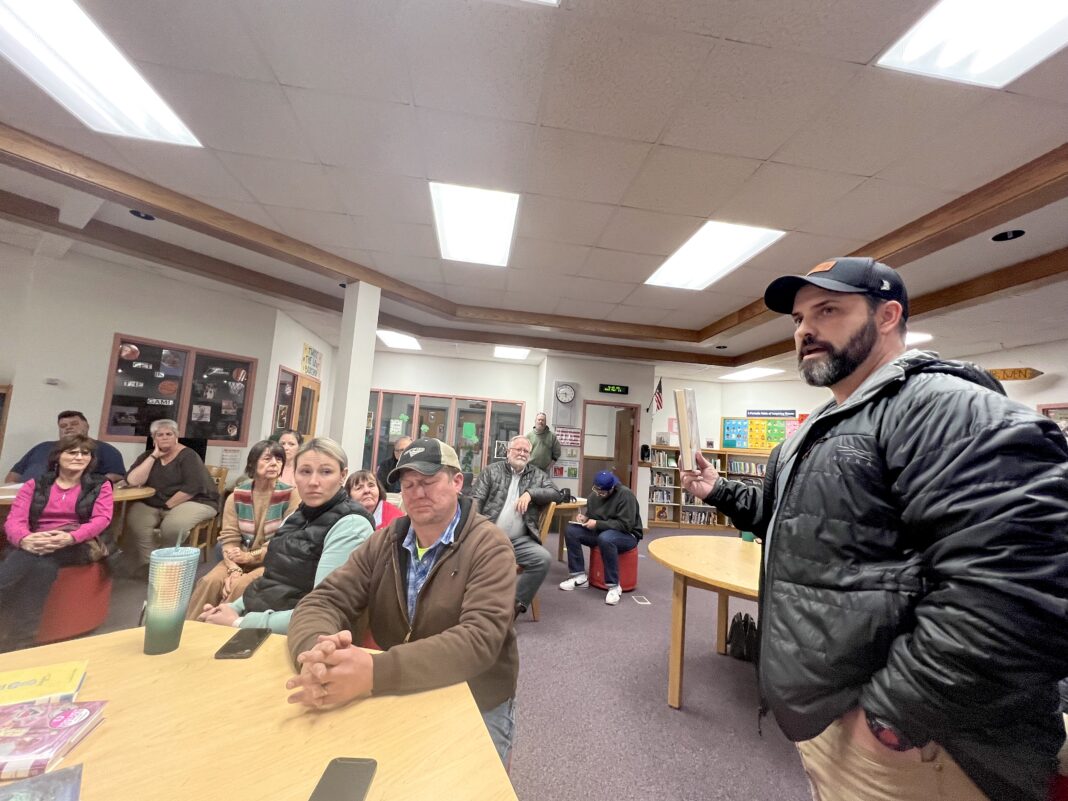
A group of parents confronted the Clancy Elementary School Board at its Mar. 13 meeting about books in the school’s library that focused on themes related to gender identity. The nine books, which describe gender dysphoria — the feeling that one’s gender identity is different from one’s biological sex — gender transitioning, and the lived experiences of transgender people to young readers were criticized by the parents as ideologically slanted, and dangerous to the development of young children.
“If it creates a seed of doubt in a child’s mind, that then grows, that’s extremely harmful,” said Clancy parent Thomas Burnett. “I don’t understand why this would be in the library. I’m not here because I have any hate for any person or any group, but because I love my daughter. And I don’t want this to happen to her.”
In a later interview with The Monitor, Clancy School Librarian Tona Iwen said, “Community members have every right to challenge library resources.” Iwen curates the library for readers grades K-8, and references national library journals and award lists to create a rigorous selection process for resources added to the library. She is in her 10th year of service as Clancy School librarian, and has personally read each book brought to attention by parents. All of the books concerned were directly approved by Clancy Superintendent Dave Selvig before entering circulation.
“Teaching kids this stuff at age six is evil, and it needs to go,” said Will Israel, former U.S. Army Ranger and parent to three Clancy Elementary graduates and two current students. “This is cult-like information, it is incorrect, and it is wrong.”
While the majority of the books brought into question were novels intended for an older audience, a picture book titled “Jack, not Jackie” by Erica Silverman, which describes a young child’s navigation of gender identity for pre-K to primary school aged readers, was criticized for conflating play behavior preferences with immutable sexual characteristics and for confusing children at a vulnerable age.
“I believe it’s dangerous to put a book into a 1st grader’s hand that says if they like playing in the mud instead of wearing dresses then their gender is something to call into question,” said Clancy grandmother and career educator Rhonda Burnett. Burnett spent 22 of her 28 years in education as a public school teacher in East Helena, and emphasized the importance of, what she calls, classically valuable children’s literature, like “Aesop’s Fables” or “Arabian Nights”.
Such texts are already freely available in the Clancy School Library, and are frequently given to students as suggested reading. However, parents claimed that having LGBTQ literature available in the library, while not necessarily promoted by library staff, circumvents their parental rights to mediate their children’s access to sexual education materials.
“When it comes to sexual education, on any level, it’s my job to teach my child.” said Clancy parent Corey Radliff. “Math, reading, science and social skills; our children already have enough to focus on. Exposure to homosexuality, transgenderism, and sexual education is too much for the age group that is in this school.”
“If you read these books as an educator, and you agree that this should be a part of our educational system, you should be removed from your position,” said Israel.
Iwen defended the selected texts as invaluable to the library’s mission to “provide a wide range of materials on all appropriate levels of difficulty, with diversity of appeal and the presentation of different points of view.” She also referenced language from the American Library Association’s Library Bill of Rights, which calls to present “material and information on all points of view on current and historical issues” and which “should not be proscribed or removed because of partisan or doctrinal disapproval.”
“I want kids to read books germane to their own life experiences, but also the experiences of others,” said Iwen. “I select books that help students discover empathy for people they’ve never met, but who they may encounter in adult life.” Of the collection’s 8,100 unique texts, there are an estimated 30 titles which, according to Iwen, may be considered LGBTQ reading material. Iwen is considering creating an explicit section within the library to more carefully present these texts to Clancy students, and to manage their access.
“My most fervent wish is for these books to remain in the library,” said Iwen. “If a student tries to take a book they aren’t ready for, I question them to make sure they know exactly what they’re checking out. And I always tell them that if they’re reading something they are uncomfortable with, put it down and bring it back.”
In order for parents to have the books removed from the li– brary, they will have to formally engage the school board through a Uniform Complaint Procedure (UCP), and move to have the issue addressed as an agenda item at an upcoming school board meeting. According to Clancy School documents and Selvig, the UCP has a tiered reporting system, with complaints being initially addressed by the building administrator, who must respond to the complaint within 30 calendar days. Should the building administrator deny the complaint, the complainant has 15 days to appeal to the superintendent. The superintendent then has 30 days to address the appeal, and, if again denied, the complainant can elevate the matter to the Clancy School Board.
“I’m fairly certain that the Board is going to follow procedure as written,” said Selvig. He did not expect the matter to formally reach the board before the end of the academic year.