
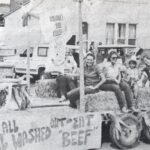


Forty years ago, a group of county residents came together to produce the first “Fair of the Heart.” This is the story of that effort, told (with some editing) by members of the original Fair Committee.
In 1981, after standing vacant for 10 years, the ranch property along Whitetail Road that had operated since 1907 under state ownership was leased to Jefferson County. A Park Board was established to steward the property, and volunteers began cleaning and fixing up the abandoned buildings and grounds.
Marilyn McCauley: People started saying, let’s see if we can get this old state ranch, and make it into a fairgrounds Shirley Vossler was probably one of the first. She was the most vocal about it.
Terry Minow: But the place had been vandalized and just abandoned for years before the county got it, and it was a dumping ground for the state. There were old bed frames piled up, and all the windows were broken out.
Greg Thackeray: My worst memory was cleaning out the damn hay loft. There was [three feet] of the driest hay, it just turned to dust when you touched it. It was a nasty job.
McCauley: Yeah, and there was no power. All the power lines had disappeared. We’ve been putting in power to different buildings ever since. And we put in water lines. We’ve drilled two wells.
Minow: And for years, all of that work was by volunteers. We only had enough money for, let’s say, the concrete, but we didn’t have enough money to hire somebody to do it. So the labor was always volunteer. We got a crew together and did things.
McCauley: There were a lot of Fair Board husbands…
McCauley: One of the first things the Park Board did was to build the rodeo arena. They actually took a lot of the old arena that had been on the east edge of town. It hadn’t been in use for probably close to 10 years. They rolled that all up, what they could salvage, and brought it out here.
By 1983, it seemed as though the county was ready to hold its first fair. In March of that year, the Commission appointed the first Fair Board.
Minow: We had just moved to Boulder, and there was a political barbecue. John Connor, the county attorney, asked me, “What are you going to do now that you’re in town?” And I said, “I think I’d like to be on the Fair Board.” Because in Missoula, where I’d been before, the Fair Board was kind of an honorary big deal thing that, as far as I could see, was mainly about riding in the parade. And John said to me, “Oh, that’s great, because we’re thinking about starting a fair.” I thought: Oh, no.
McCauley: My dad was on the Park Board. And we wanted to kind of get this place going. I could see the potential in it. That’s what’s always motivated me more than anything, the potential of what these grounds could become. And at that time, I was really into entering fairs. I would enter exhibits in the State Fair in Great Falls. I would enter stuff in Twin Bridges. I was into fair stuff.
The problem was, the Park Board kind of spent all our money. It didn’t go to waste; they were doing improvements to the grounds. But it didn’t leave us with any funds to actually put on a fair. So we did a fundraiser that year instead. We had something barrel racing in the arena, there was a community barbecue, and maybe kids’s games on the playground. It was a fun day to build funds for the next fair.
And then in 1984, the county budgeted $5,000. That included improvements on the grounds and putting on a fair, both of them for $5,000. But back then, it wasn’t $1,000 for a dance band. It was probably $75 for a band. So we had enough to do what we could do.
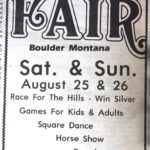
The fair opened on Aug. 24, 1984.
McCauley: All the indoor entries were in the lower part of Red Barn. The livestock building had livestock, chicken and poultry. The barbecue was just inside the entrance; the Park Board had built a cinder-block pit, and they had meat marinating on a spit all night long, Friday into Saturday. That was Jim Richardson and Les Vossler, probably Lloyd Richardson, too. We had a playground. We had a few vendors. We didn’t have the gazebo, so there weren’t bands yet — but we did have a barbershop quartet, and there was a group out of Helena, the Razzle-Dazzles, a kids’ dance troupe.
Minow: We got donations for the prizes, but we probably paid for the ribbons. There were the judging categories, and all the entries.
McCauley: A lot of people didn’t know how to enter. We just said, come on out, and we’ll help you. I remember this one young guy, he brings a photograph, and it’s just the picture, and you’re supposed to have it matted, mounted or framed. But it was a really cool picture of a mountain goat. He said, I want to enter this, but I didn’t know how to do that. So I went to the back room, and sawed out a piece of mounting board and put double-stick tape on it. He got champion, and he was just over the moon with that. And you know, that’s what brought people in and has kept them coming. It wasn’t, well, you don’t have a frame, we can’t take it. We wanted the entries, and we went the extra mile to get people involved.
Minow: We decided, if you bring something, we’ll make a category. One year, John Heide brought his restored tractor. So we made a “restored tractor” category. And he got a purple ribbon. And that tractor deserved a purple ribbon.
McCauley: I suggested, why don’t we auction the baked goods entries? I remember Terry looking at me like, really? That’s where it started. I think we took in a little over $100 that first year.
Minow: And we thought, wow, she was right!
At the time, there was no official 4-H show.
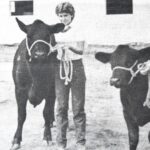
McCauley: When we started our fair, there was a huge uproar from the Whitehall area, which was very into 4-H. They went to the fair at Twin Bridges, and they thought we were going to force them to come to Boulder. We were like, no, we’re just an open fair. So the kids brought their secondary animals to our fair; it wasn’t 4-H-sanctioned.
Dixie Rennie: We got the 4-H club going here. It was called the Jefferson Rounders. There were the Rieder kids, and the Lattins, the Giulios, the Murphys and the Kosolas. And Paula Heide.
Minow: It’s interesting how these names keep coming back. Clint Reider’s band plays for the barn dance now. All these kids grow up and move on to being the volunteers and organizers, right? That’s really nice.
Then, there was the first barn dance.
McCauley: The dance was upstairs in the Red Barn. We were downstairs, and at one point, people were jumping up and down, and we could see the floor shaking.
Nora Thackeray: Greg and I were going, that doesn’t look good.
Greg Thackeray: I could just visualize what was going to happen.
Nora Thackeray: We sent Terry up to get the band out.
Minow: I told them, you’re going to have to close down. You have to tell everybody that they’re moving outside, including you. And the band’s like, haha, because everybody’s dancing, and they’re having a great time. I said, no, you get the hell out of here. And they went, Oh, she’s serious.
So they moved outside. At that time, we lived up on the side of the hill. And you could see, as the night went on, this column of dirt rising straight in the air from the fairgrounds, because everybody’s dancing outside, in the gravel. It was really cool.
The fair and rodeo ended the next day, without incident.
McCauley: In the early years, the Fair Board was doing everything. You’d go from one thing to the next. Entering people’s exhibits, serving the barbecue, showing people where to park, getting vendors set up.
Nora Thackeray: It was such a hands-on thing. Everywhere you went there was a fair board member. It was not an easy thing.
McCauley: There were days when you’d start at 7 a.m, taking entries and then shut down after the barn dance at 1 a.m. Then I remember being back at 6:30 a.m. for whoever was doing the breakfast. I don’t think I even slept.
Nora Thackeray: But I’m so grateful I had that time, and that I had these guys to work with. Everyone was involved in the very beginning of this place. The grounds were built by the community. And then the first fair was built by us. I think we really did a good job.
Minow: None of us had done it before. We just said, yeah, we’ll do a fair. Somehow we brought it together, and it was a success.
Nora Thackerary: It always came together.
McCauley: No idea how, but it always did.