As of this week, 46% of Jefferson County residents aged 12 and older had been fully vaccinated against COVID-19. That’s more than in many rural Montana counties, but lower than the state total of 49%, which in turn is slightly below the U.S. average.
It’s not good enough.
After months of close to (but not quite) zero infections here, the coronavirus is returning. It’s nothing like the vicious spike of last fall and winter, when as many as dozens of residents fell ill every day: In the two weeks ended Aug. 9, the county’s Public Health Department reported 30 new infections.
Here’s the thing, though: Of those 30 recent cases, 26 were among people who hadn’t been vaccinated, according to the county. Three of those individuals were hospitalized. “This,” said Public Health Supervisor Pam Hanna, “is a pandemic of the unvaccinated.”
In itself, that increase might not be so worrying. But like the rest of the nation, we’re also witnessing the advent of more virulent coronavirus mutations. The so-called Delta variant, first reported here in late July, is estimated by the Centers for Disease Control and Prevention to be nearly twice as contagious as previous variants; in addition, some data suggests its effects on unvaccinated people may be more severe. ”The variants are getting uglier,” Hanna said.
Although currently available vaccines don’t eliminate the risk of infection, they do dramatically reduce it. Pfizer’s and Moderna’s have demonstrated efficacy of 94–95% in clinical trials. That’s very high. And while reports of “breakthrough” COVID-19 cases among vaccinated individuals have made headlines, their actual numbers are low: A Kaiser Family Foundation analysis last month showed that the rate is well below 1%. Those few who do get infected, multiple studies show, are significantly less likely than uninoculated people to be hospitalized or to die.
So, this is your opportunity to protect yourself and help stem the next COVID wave. Get a vaccine. Please.
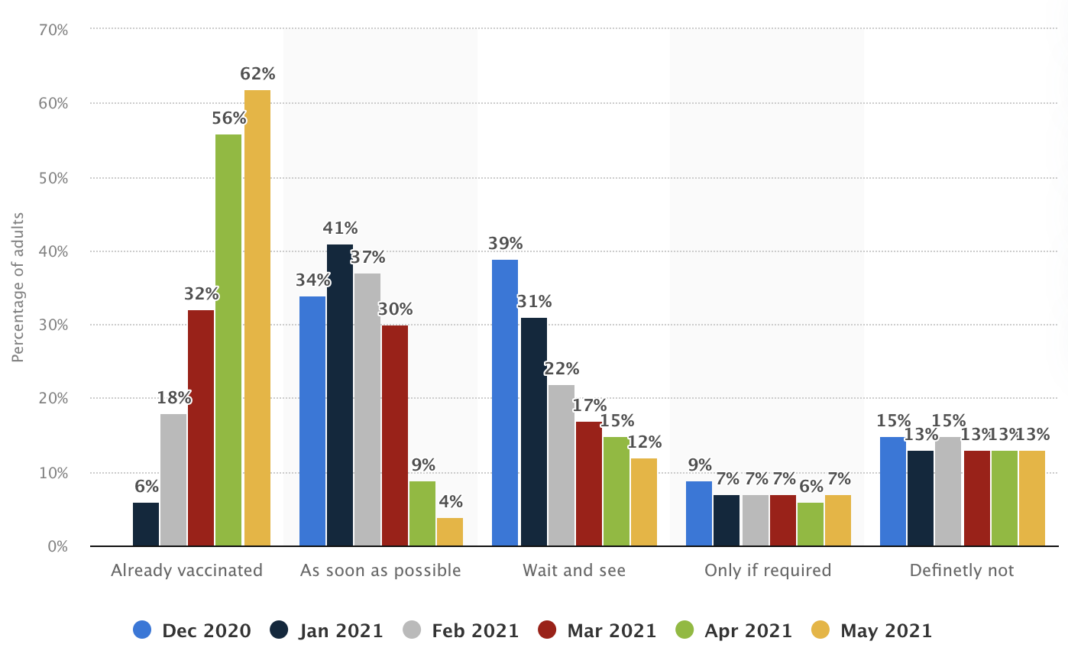
That is, of course, easier said than accepted. A significant number of people say they will not get vaccinated in any case, or will do so only if it’s required. The proportion of those saying they will “definitely not” get a vaccine is highest among men, younger adults, those who have not graduated college, and Republicans and independents, according to Kaiser tracking surveys. It is higher among Whites and Blacks than Hispanics.
This deep-seated resistance to COVID vaccines is strongest in rural areas. Some 21% of rural respondents in Kaiser’s July survey said they would definitely not get vaccinated, compared to 14% of suburban respondents and 12% of those in urban areas.
Those people are difficult to sway; their number has stayed steady throughout the pandemic, according to Kaiser’s studies and others. I probably will not move the many among them who believe that getting the vaccine is a bigger health risk than becoming infected with the coronavirus. (For what it’s worth, my wife and son had modest fevers for two days after their second immunization. I didn’t.)
Likewise, there’s not much I can say to those who don’t trust scientists, pharmaceutical companies, the health system or the government to keep them safe. If you don’t trust vaccines in general, you won’t (and shouldn’t) trust me to tell you otherwise. If you think, after the last year and a half, that COVID-19 is not a serious illness, or that you’re not at risk of getting sick from it, well, I hope you’re right.
But if you’re among those who plan to “wait and see,” as the Kaiser survey puts it, well, maybe this note is for you. Your resistance isn’t entrenched: You say you’ll be more likely to get a vaccine if its fully approved by the U.S. Food and Drug Administration—which Politico and other news outlets report could happen next month. You also say the chances would be higher if someone made it worth your while: For some, it would just take free food and drinks; for others, entry into a lottery with a shot at $1 million would do the trick. Still others just want it to be easier. You’d get the vaccine if offered free transportation, or if a mobile clinic came to your neighborhood.
For many, these concerns aren’t incidental. Transportation can be a real barrier, especially in rural communities. Some people can’t afford to take time off from work to get a vaccine, or they lack child care.
But in the end, this group is moveable. In January, according to Kaiser, 31% of those surveyed said they would “wait and see.” By July, the rate was down to just 10%.
Many of those remaining told Kaiser they expected to get a COVID-19 vaccine by year-end. I’d suggest, don’t wait that long. Coronavirus cases are increasing now. The Delta variant and others are accelerating now. Hospital intensive care beds are filling up again now.
And yes, the vaccines are available now. The Public Health Department is well stocked, and its nurses can discuss any concerns before you commit to an inoculation. Call (406) 225-4007 for an appointment.
You can help stem another infection wave. You can help keep your neighbors safe. The wait is over.