
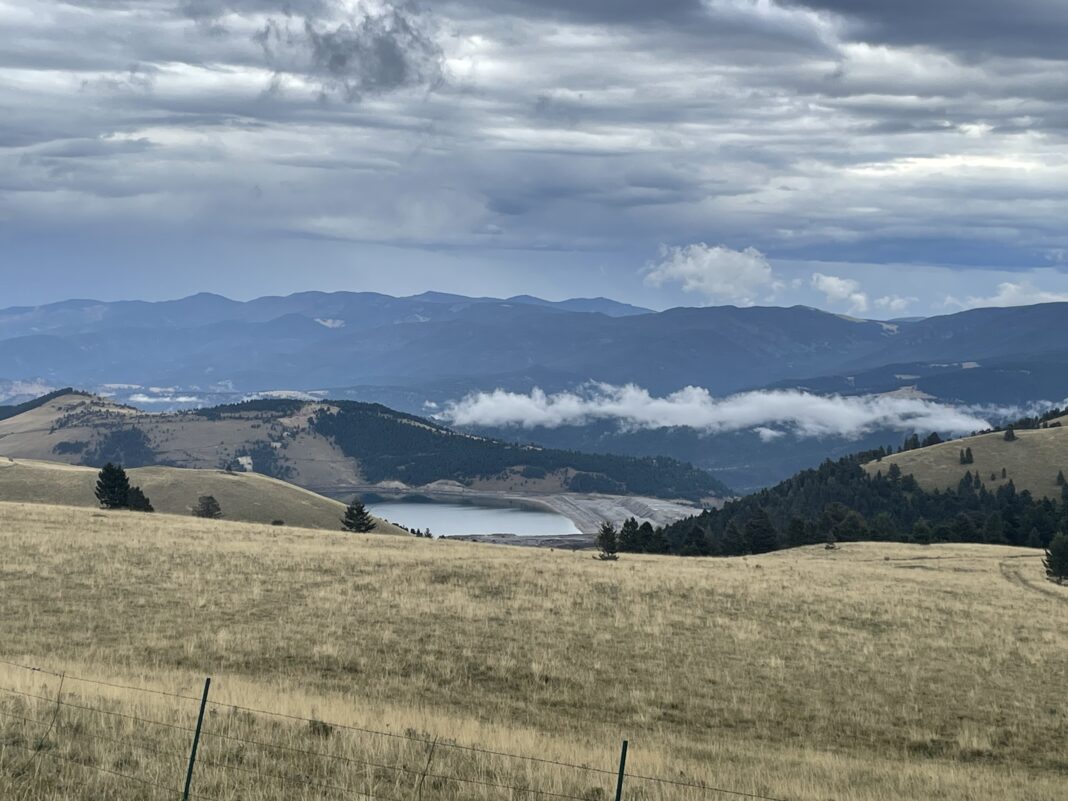
The long, tortuous, no-good existential journey of Montana Tunnels Mining, Inc. through the federal bankruptcy system took a surprising turn last week, preserving the possibility — however remote — that operations of the company’s mine outside Jefferson City could resume after 16 years in limbo.
In an unusually animated U.S. Bankruptcy Court session on Apr. 10, Montana Tunnels (MTMI) was given two weeks to explore the feasibility of a sale of its assets to Mooney Group, a limited liability corporation registered in Florida.
Mooney Group was, according to court proceedings, one of the potential suitors that MTMI had courted in its quest to raise enough capital to meet a $41 million environmental bond payment to the state’s Department of Environmental Quality (DEQ); pay off creditors including, foremost, Jefferson County; and restart its mining activities. The Jefferson City mine, which once produced gold, silver, zinc and lead, has not operated since 2008.
MTMI’s talks with Mooney, however, did not yield financing. The company missed a $1.5 million payment due the DEQ on Dec. 31, and it didn’t make monthly repayments to creditors, which its Chapter 11 reorganization plan had promised would begin in January. MTMI owes Jefferson County a total of $3,110,505 in back taxes, interest and penalties.
In the wake of those failures, the U.S. Trustee overseeing the proceedings filed a motion to either dismiss the case or to convert it to a Chapter 7 liquidation. On April 5, MTMI gave its consent to dismiss — more or less throwing in the towel on its effort to save the mine.
But in the meantime, according to DEQ attorney Steven M. Johnson, of Jardine, Blewett, Stephenson & Weaver, P.C., Mooney approached the DEQ, indicating its interest in exploring a purchase of the MTMI assets. Based on those discussions, DEQ, along with Jefferson County, asked the court to scrap the hearing originally scheduled to consider the U.S. Trustee’s motion to dismiss or convert the case, instead proposing a “status conference” to discuss Mooney’s potential bid.
“A well-capitalized buyer has stepped forward that may be acceptable to DEQ and may be capable of meeting the bonding requirements, of performing necessary reclamation, and of resuming mining operations,” the motion stated.
Mooney keeps a relatively low public profile. It advises companies on capital structuring for acquisitions related to the mining, refining and processing of base metals and precious group metals, according to the LinkedIn page of its chairman and CEO, James Mooney, who previously built what had been a family-owned chemical company into OM Group, a global mining and processing company. On March 8, according to court records, Mooney Group bid $32 million in a bankruptcy auction to win the assets of Barretts Minerals Inc., which owns two talc mines and a mill near Dillon.
“The Mooney Group has credibility in that they’ve built and run a Fortune 500 mining company,” said Matt Vincent, executive director of the Montana Mining Association. “They have the capability to do that again. And our interactions to date have been very forthright and transparent. They want to do everything right.
“It’s always been the hope that someone responsible would get their hands on that property. It is going to take a lot of capital to get it restarted — but there’s still a lot of metal in there.”
Indeed, a sale to Mooney could return the mine to production, creating jobs and generating ongoing tax revenue. It also would address the concern of DEQ and Jefferson County that MTMI’s case might be dismissed, as MTMI has said it preferred, rather than being converted into a Chapter 7 liquidation. While a liquidation could yield some sale proceeds to creditors relatively quickly, a dismissal could send the company’s liabilities, including back property taxes, into a complex tax lien process, which might take years to resolve. The MTMI tax lien is held by Montana Goldfields, an affiliate company controlled by MTMI CEO Patrick Imeson.
“Dismissal would, quite frankly, be a disaster,” Johnson told the court. “This case would go nowhere.” Jefferson County Attorney Steve Hadden explained that, in addition to property taxes, the county is owed revenue mineral extraction taxes, which likewise could be subject to judicial wrangling. “It certainly would be cumbersome, and I might be retired before the thing works out,” Hadden told The Monitor, half-joking.
During the Apr. 10 call, the U.S. Trustee’s attorney, Brett R. Cahoon, complained that the request to cancel the hearing was “inappropriate” and “disappointing.” Bankruptcy Court Judge Benjamin Hursh apologized for mistaking the “joint motion” of DEQ and Jefferson County for one that included MTMI, thinking that the mining company had been in on the talks with Mooney.
It apparently had not. “Right now, we’re completely in the dark,” said MTMI’s attorney, James A. Patten, who nonetheless acknowledged that the company was “all in favor of the sale through a plan.” He added: “It’s always a matter of what’s the sale price, and we have no information about that.”
Hursh rebuked DEQ for what he indicated he thought was a slapdash approach. “There’s no discussion of purchase price, there’s no agreement from the debtor,” Hursh said. “You’ve got nothing but a bunch of ideas, and no idea what anybody wants to do. My inclination is, it’s too little, too late.”
Further delaying a decision on the motion to dismiss or convert MTMI’s case, Hursh noted, would also be in conflict with the timeline stipulated by bankruptcy law. The hearing on the motion to dismiss was supposed to happen within 30 days of the motion’s filing; and a decision is meant to be made no later than 15 days after the hearing. The U.S. Trustee filed its motion on Feb. 6 – now more than two months ago.
But Hursh also acknowledged the desirability of further exploring Mooney’s interest in a purchase — and “the possibility that, with some small amount of time, people could sort through whether or not this is a viable option – and if so, figure out what that looks like.”
That small amount of time, it turns out, is two weeks; the parties will meet for another status conference on Apr. 26 in Missoula. Hursh advised Mooney to reach out to MTMI to begin discussions, and for the U.S. Trustee, DEQ and other parties to collaborate.
“It’s going to have to be quick,” Hursh told the Mooney representatives. “You have to understand that everyone except you has been at this for a while, so they’re looking at this through a jaundiced lens.”