
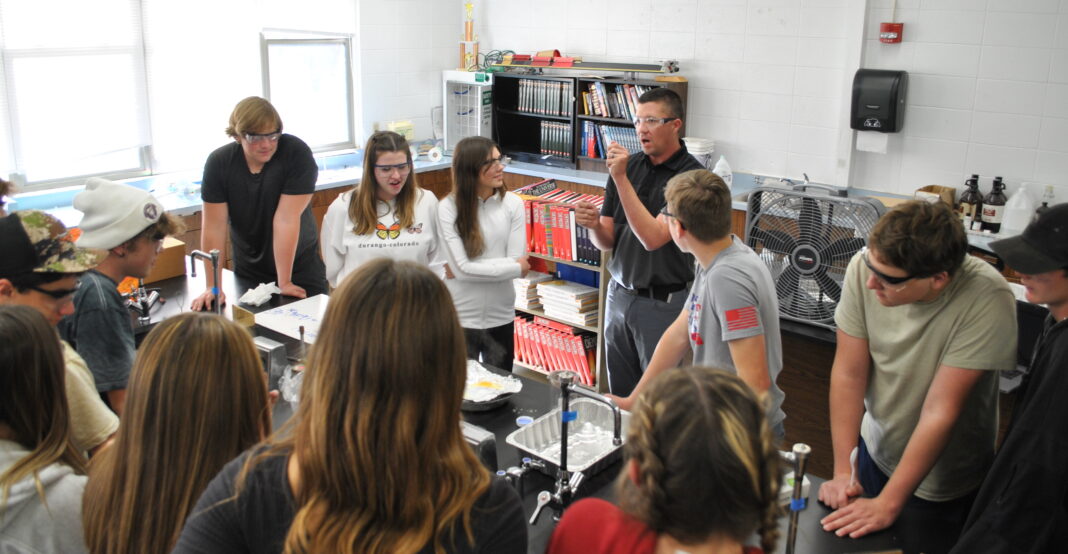
Jefferson High School’s student population keeps growing, creating complications in the classrooms for teachers.
JHS chemistry teacher Logan Brower has experienced these growing pains firsthand, as he said the average number of students he has per class is around 25. In prior years, he said, that average would be in the high teens.
This has been particularly stressful when it comes to labs.
“It can be a challenge to meet all the demands,” Brower said. “It’s a lot of Bunsen burners lit at the same time. You kind of feel on edge having a large amount of students in a classroom that requires a lot of supplies, but it’s way better than having low numbers and administrators having to tell teachers they don’t need you.”
All of the school has felt the stress, especially with a freshman class of 73 students when less than 60 were anticipated. Jefferson High Counselor Joe Michaud said JHS currently has 289 students – the largest enrollment he’s seen during his eight years at the school – and the number is only expected to rise.
“Don’t get me wrong, growing pains are always good, especially with rural schools, but we’re seeing an uptick we don’t see slowing down,” Michaud told The Monitor. “The average class size is more than 20 students. We’re packed, especially the core classes of math, science and social studies.”
JHS Principal Mike Moodry said the school’s growth is largely from an influx of families in the North County sending more students to Boulder than Helena. According to Moodry, about 99% of Boulder eighth-grade students go to JHS their freshmen year, while about 85% of Clancy graduates come to Jefferson. Around 20% to 25% of Montana City eighth graders head to JHS. This is in addition to around 10 new students who move into the district per year.
JHS Superintendent Erik Wilkerson recognizes this situation, as he experienced rapid growth during his time as superintendent in the Townsend school district. Although he is optimistic moving forward – especially considering a $12.5 million facilities bond for major expansions passed in May – there is still work to be done in the short term. The expansion won’t be completed for another two years.
This is particularly challenging, Wilkerson said, because the funding the school receives for enrollment (called Average Number Belonging) is determined by the number of students enrolled the previous year.
“Approximately 55% of the general fund is tied to ANB, but that is only a part of the final budget,” Wilkerson said.
One of the specific challenges here has been having enough materials for the excess students. Wilkerson said the school has been able to make do, but it hasn’t been easy.
“We have enough desks and more textbooks were ordered for the current influx of students,” he said. “We scavenge what we can to meet the needs of our students.”
Beyond these financial constraints and supply frustrations comes infrastructure and academic concerns.
“It’s discouraging to see kids come here for smaller classes and not have access to classes they want to take,” said Michaud. “The Jefferson County kids alone are filling up the classrooms.”
Michaud said he appreciates the steps being taken by the administration and the board, especially when it comes to the expansion. He just “wants to make sure academics are at the forefront.”
“I think the expansion is really going to help,” he said. It puts us in good shape. I’m glad the architects and administration are focused on the classrooms, too.”
Moodry said he made sure additions were included in the facilities bond.
“Space issue is the biggest challenge, but it’s being addressed through the bond,” Moodry said. “We knew this was coming five to six years ago. The 2019 demographics were especially eye-opening and led us to the process of making this expansion a reality.”
By increasing space — and adding classrooms — Michaud said classroom sizes can get back to around 12-15 students, which he considers “the sweet spot.”
Smaller classes can help ensure students have a more intimate experience, which Michaud said he believes is what the parents want for their students. It’s also the experience Michaud wants as a counselor.
“Individualized education is unique in public education,” he said. “My priority is I want to know each kid and I want each kid to have a great experience. If we get to 300 or 360 students that will still be my goal.”
Brower agrees with Michaud that 12-15 students would be a much more manageable classroom size, and one that would enhance the education of the students.
“Increasing enrollment is a huge problem, especially in science programs,” he said. “I hate to say it, but when you’ve got more students under your umbrella, you’re going to have more students fall through the cracks. I’m not saying that’s happening, and that’s a testament to the strong staff at JHS, but in this kind of situation you have to really stay on top of your students.”
Wilkerson said the board, the other faculty and administrators are also mindful of this concern.
“We’re keeping a close eye on the academics,” he said. “We’ll be doing a lot of testing to make sure students are keeping up and making sure they are where they need to be. That will determine if any interventions are needed.”
“We do what great small schools do: we continue to monitor the students and – with the staff we have – we are able to do this often and do this well,” Moodry added, stressing that monitoring is often done through benchmark testing, which includes the STAR test, the ACT and other methods.
JHS Board Chair Cami Robson said she knows this has been a challenging time for the school but she is encouraged by how the situation has been handled. Like administrators, teachers and students alike, she too is looking forward to the expansion.
“I think our teachers and administrators have done a great job of making the best of our situation,” she said. “They have been very resourceful in scheduling and planning, but it will certainly release a lot of burden when we can add the much needed space. The additional spaces will hopefully allow for more staffing where the budget will allow, to expand our offerings or keep class sizes manageable.”
Next year, Wilkerson said, and the years ahead, JHS will be more prepared.
“Our freshman class is a very large class and there are certain requirements they have to take,” Wilkerson said. “Next year, if we have the influx again, we’ll need to look at hiring more teachers.”