
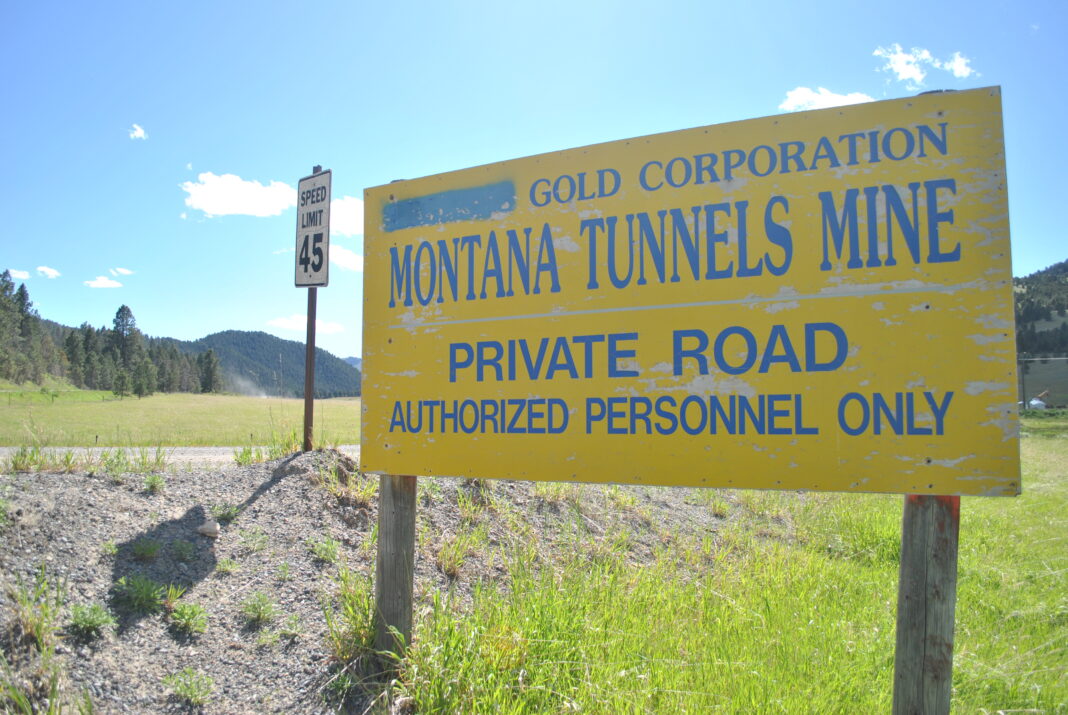
There will be no silver bullet for Montana Tunnels Mining Inc. (MTMI), no magic wand. Instead, the bankrupt company’s long struggle to restart or sell its inactive but potentially lucrative mine outside Jefferson City — and for its many creditors to collect what’s owed them — will plod on.
On July 17, more than a month after a tortuous final hearing at the U.S. Bankruptcy Court in Butte, Judge Benjamin Hursh ordered that MTMI’s Chapter 11 case be dismissed, removing the company from court protection without resolving its significant debts, including to Jefferson County.
Ultimately, Hursh’s decision amounted to a narrow interpretation of MTMI’s Chapter 11 plan for reorganization. The plan stipulated that, if the company failed to meet its obligations under the plan, its case would be dismissed. Protests from creditors notwithstanding, Hursh wrote, “The confirmed Plan is entitled to finality and its terms mandate dismissal of this case.”
It’s not clear what the long-term impact of Hursh’s decision will be. It effectively leaves MTMI and its creditors where they were a year and a half ago, before the company declared bankruptcy, without a plan for debts to be repaid — and with environmental concerns still in the balance. “It puts the parties in as close a position as possible as they were before the case,” said Jonathon Byington, professor of law at the University of Montana. “It undoes the things that happened in Chapter 11.”
MTMI owes about $18 million to the state Department of Environmental Quality to meet a bond intended to cover the potential costs of environmental mitigation in and around the mining site; $3.1 million in metal mines license taxes, plus interest and penalties, to the county; and lesser amounts to other creditors.
The dismissal clears the way for Goldfields Funding Partners, an affiliated company, to take over the land parcel that includes the mine pit. Goldfields was created in 2021 by MTMI’s owner, Patrick Imeson, to pay $6 million in property taxes due at the time from MTMI to the county. As a result, it holds a tax lien on the property which will convert to a deed on Aug. 3. County Treasurer Terri Kunz said she hasn’t yet received an application from Goldfields to assume the deed, but “I’m going to assume they’ll take it.”
DEQ and the county have said they are concerned that Goldfields’ assumption of the land will allow Imeson to defer repayment of MTMI’s debts indefinitely. In his testimony at the final hearing on June 5, however, Imeson said that Goldfields was “prepared to repatriate that title back to MTMI,” or to a new owner if the mine is sold.
And, in fact, the mine could be sold. James Mooney, whose company Mooney Group emerged last autumn as a potential buyer, told the court that he remained interested in taking over the company’s assets. But he noted that only “minimal” due diligence on the deal had been completed, and that completing a transaction could take as long as two years.
The June 5 hearing was delayed for several hours to allow Mooney, Imeson and at least seven attorneys to discuss potential pathways to a purchase, including a so-called “pre-packaged bankruptcy” that would allow a transaction to happen within the court’s protection. That apparently remains an option, but not anytime soon: The closed meeting that day ended without resolution — and Mary Mooney, James Mooney’s wife and his partner in the Mooney Group, said that their efforts to contact Imeson since “haven’t been answered. He’s seemingly uninterested in engaging.”
The failure to reach a quick resolution left Hursh and the lawyers to decide whether MTMI’s Chapter 11 case should be dismissed or converted to a Chapter 7 liquidation — which would allow a trustee to sell off the company’s assets, ensuring some repayment of creditors’ debts.
DEQ and Jefferson County favored Chapter 7, arguing that liquidation offered the best chance for a sale of the company to be completed and ensuring that the environmental bond and MTMI’s creditors would be paid. (Officials from Jefferson High School and Clancy School, which each stand to collect around $1 million if and when MTMI pays its taxes to the county, both wrote letters to the court in support of Chapter 7. Hursh said, “I’m not unsympathetic” to the schools’ concerns, “but that’s not what we’re here to consider.”)
MTMI and Goldfields lobbied for dismissal. Under questioning, Imeson noted that MTMI’s parent company, Montana Goldfields, currently is paying for maintenance, utilities and insurance of the mine and its equipment to keep them operable and to reduce environmental risks. If the case were converted to Chapter 7, Imeson warned, “Montana Goldfields won’t continue to maintain the MTMI property.”
Imeson also said that MTMI remains committed to the strategy that informed his Chapter 11 reorganization plan: He hopes to attract investors that would fund another affiliate to pay MTMI to mill ore, the proceeds of which would be used to repay creditors — and eventually would help seed MTMI’s return to full operation. The investment required for this approach failed last year, forcing MTMI’s default on its Chapter 11 plan. But “our agenda is just to do what we’ve tried to do in the past, and to get people paid,” Imenson said. (Imeson’s attorney, James Patten, didn’t respond to The Monitor’s interview request following the decision.)
At that point, Hursh narrowed the decision to a simple legal question. MTMI’s plan for reorganization, which creditors agreed to, did not allow for the option of Chapter 7 in the event of a default. Even allowing for “the trail of broken promises,” that had marked MTMI’s journey into and through bankruptcy, Hursh told the court, its plan “is binding on all parties.”
In the wake of Hursh’s dismissal, those parties were reckoning with an uncertain future. Without the structured bankruptcy process, Byington said, the lead creditor — in this case, DEQ — generally calls the shots; and eventually, a case can go to state lien proceedings.
In a statement, the DEQ’s Mining Bureau said that the “process that may allow a potential successor operator to take over” MTMI’s mining permit is still in the works. The state has up to five years, it noted, to transfer the permit to an operator that could take on the bond before the state is bound to take on reclamation itself. In the meantime, “DEQ continues to conduct regular inspections and has the authority to use a portion of the forfeited bonds to maintain the site in the interim period.”
Mary Mooney said she and her husband are “still committed to Montana, but we have to go back to the drawing board. We’re still formulating thoughts about how to go forward.”
And Kunz is waiting on Goldfield Funding Partners’ application (along with a $25 fee) to take ownership of the mine pit parcel, which would trigger the next chapter in the Montana Tunnels saga. She said: “I don’t know what the future holds.”