

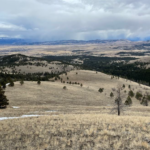

A proposed rezone of 280 acres along Holmes Gulch Road west of Montana City hit a possible snag last week when the Jefferson County Planning Board unanimously voted to recommend that the County Commission deny the proposal, which would allow residential lots of 5–10 acres on land where current zoning allows one residential lot.
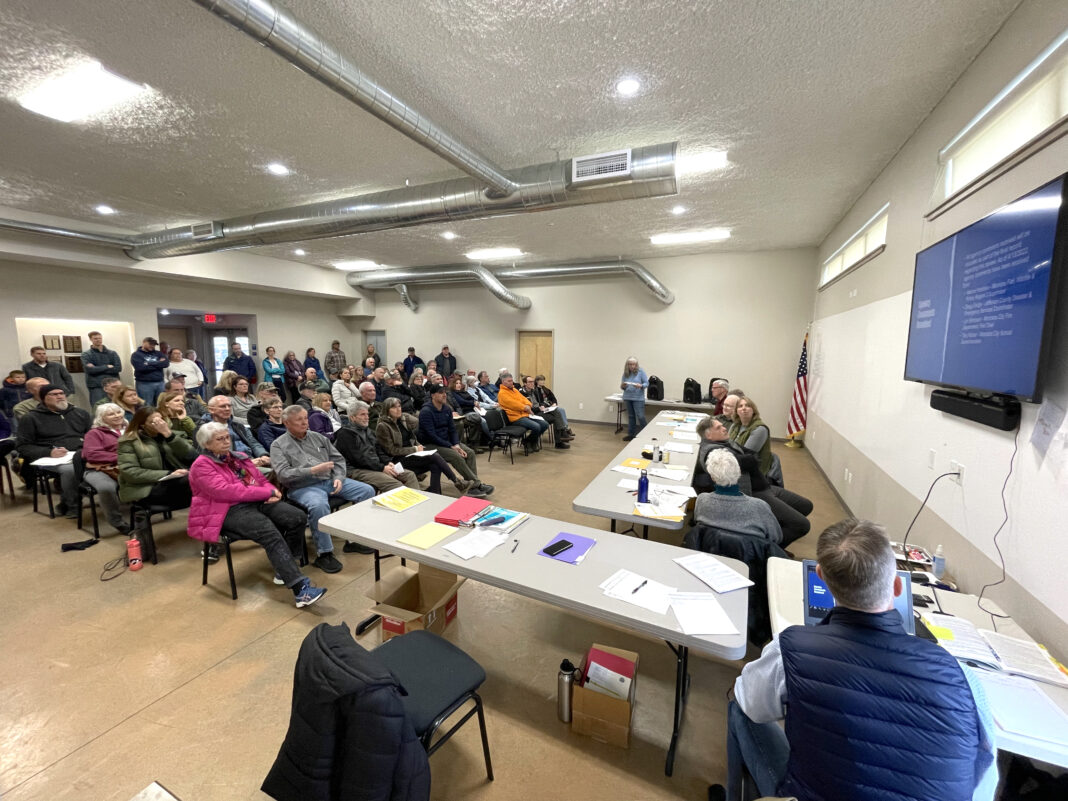
The Planning Board followed the recommendation of a staff report compiled by a contracted engineer and presented by County Planner LaDana Hintz at the board’s April 14 meeting, which included a public hearing and was held at the Montana City Fire Hall. Area residents, particularly those living near the property, packed into the fire hall’s meeting room. No members of the public commented in support of the proposal; 16 commented in opposition. The County Commission will consider the proposed zoning amendment, and the planning board’s recommendation to deny the proposal, at a public hearing on April 26 at 6 p.m. at the Montana City Fire Hall.
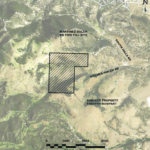
The land in the proposal is currently zoned basic resource. Landowner Timothy Bompart signed a zoning map amendment application on Dec. 10, 2020, requesting that the property be redesignated as residential R-3. The amendment would change the allowed density from one dwelling per 160 acres to one dwelling per 5–10 acres. The staff report concluded that the board should recommend denial of the request because it did not meet the review criteria outlined in the North Jefferson County Zoning Regulations, including compliance with the 2009 Jefferson County Growth Policy, road accessibility, appropriate fire coverage and availability of potable water.
Tony Prothero of J-T Engineers (pronounced “J bar T”), the Bomparts’ representative for the application, said at the meeting that “it’s unlikely that we’d ever be able to achieve one unit per 10 acre” because of terrain on the land, although some lots could be that size. “We’re just trying to explore the opportunity of whether we can do something with this property or not.” He said that the “applicants would probably consider” requesting a less dense residential zone, but that this application specified R-3 because lands adjacent to the property on its north and east sides are already in that zone. He said that impacts from possible development would be addressed through the subdivision process, if the developer were to apply to subdivide and develop the property, but that the subdivision process couldn’t occur unless the property is first rezoned to allow possible subdivision.
In the zoning map, the Bompart property is designated as a basic resource zone. Basic resource zones are intended to protect “areas for agriculture, timber and mineral resource utilization, but not to exclude other types of development,” according to the growth policy. The growth policy further explains that an area receives this zoning designation based on factors such as “steep slope, flood susceptibility, poor access, and lack of potable water supply and/or fire suppression capability to discourage development in identified areas.” The staff report on the Bompart rezoning request found that the land does not align with the county’s previously established growth policy.
Many public comments at the hearing focused on wildfire risk and impacts to roads, particularly Holmes Gulch.
The Bompart property is not within a fire district that fights structure fires, although it is covered by the state Department of Natural Resources and Conservation for wildland fire. According to Lyn Stimpson, chief of the Montana City Volunteer Fire Department, the department would offer support to DNRC staff responding to fires in the area in question but his department doesn’t have jurisdiction over the land.
Several members of the public who live in the Holmes Gulch area explained that during prior fire incidents, they’ve struggled to evacuate due to Holmes Gulch Road being the only access route. They argued that if the Bomparts developed the property in question, it would exacerbate the evacuation problem.
“It’s a very real thing,” one resident said of wildfire risk. Another pointed out that the county’s subdivision regulations require that subdivisions have at least two exit routes and be located in areas with low fire risk, and that the Bompart land, although not yet at the subdivision application phase, doesn’t meet either requirement.
“I don’t think we need to push it to the subdivision phase” to see how the developer might mitigate certain risks, another commenter argued.
In addition to using the road for evacuation, the public commented that construction machinery would cause further damage to a road that the residents—not the county—pay to maintain through a rural improvement district. Even after development is finished, an estimated additional 224–448 vehicle trips per day would require road improvements or upgrades, according to the report. The estimate assumed eight trips per day for every household. Several questioned whether the developer or the residents would be responsible for these road maintenance costs.
“The hills in this area can only support so much,” one resident said, adding that approval of the zoning change “creates precedent … that is not going to stop.”
“R-3 zoning is way too dense for that area,” another said, echoing concerns that approval of the change would “set a terrible precedent,” and that the developer was “fishing” to “see what they can get away with.”
Residents also voiced concern for a local elk herd, which according to one resident, Jamie Schafer, has reached a population of 330 head. Residents told the planning board that development of the property would push the herd out of the area and cut off the 1-mile tract route necessary for their migration. Schafer questioned how a development project in this area would facilitate wildlife migration. Prothero acknowledged that elk would likely have to find another route were development to take place. However, Prothero said, discussion of possible subdivision and development had not taken place because the land must first be rezoned to allow subdivision.
In their application, the Bomparts stated that developing the land would serve a public interest—one of the required criteria for amending zoning regulations—because it would “increase the availability of building sites within close proximity to the City of Helena.” The application listed increasing the supply of developable land in northern Jefferson County as a need for the zoning change, due to the demand for new building sites.
The application further explained that changing the zoning to allow more development would increase land values, which would in turn increase tax revenue for improvements to transportation, water, sewer, schools and parks. However, Montana City School Superintendent Tony Kloker submitted a letter to Hintz explaining that “this is not true” for the school.
“The school budget is set by state law and increasing the number of households simply spreads the tax amount out among more taxpayers,” Kloker wrote. “It does not increase the amount of money the district receives.”
Kloker recognized that development projects could increase the school’s enrollment numbers; however, he clarified that any additional funding the school received for these students would go to covering their educational costs.
At a Montana City School Board of Trustees meeting on April 13, Kloker voiced concerns that rapid development could put the district in a tough position as it nears maximum building capacity. If student enrollment increases by 100 students, the district will have to consider another building addition or potentially an entirely new building, Kloker said. The school’s current $5.6 million building addition is expected to be paid off by 2033.
According to a study conducted by the Montana City School District, the district should anticipate that new housing development will increase student enrollment by an average of 1.5 students per house. If the Bompart property is rezoned R-3, it would have the potential for between 28 and 56 dwellings depending on lot size. Using the district’s estimates, this would increase enrollment anywhere from 42 to 84 students.
“Please keep this in mind as you make decisions on zoning changes or subdivision requests that lean toward high density because those are the ones that could cause growth to happen too quickly for our current infrastructure,” Kloker wrote in the letter.
Members of the Planning Board also voiced opposition to the zoning amendment request. Planning Board Vice Chair Christina Binkowski commented that the amendment wouldn’t benefit the community.
“This rezoning would benefit one person,” Binkowski said.
The staff report explained that the Bompart property is part of the wildland urban interface, an area defined in the county growth policy as bordering “forest and/or woodland areas being settled by people desiring to live in rural, wooded settings.”
“Many of, if not all of us, bought there because of the serenity,” one Holmes Gulch resident told the board.
While many purchased property in this quiet area to live on, Steve Martinka purchased a 273-acre plot of land adjacent to the Bompart property with the hope of protecting it. Martinka, a Montana native who has lived in Helena for the past 30 years, shared his hope to preserve the land located along Holmes Gulch Road during the public comment portion of the meeting. He said that when he purchased his property, he was under the impression that land in that area couldn’t be developed.
Martinka hopes to place his 273-acre property under a conservation easement to limit future use and development.
“It’s going to probably be my legacy,” Martinka told The Monitor after the meeting.
The Planning Board will hold a public hearing regarding a separate proposal from Mountain View Meadows LLC to rezone 418 acres of land along the Lewis & Clark and Jefferson county lines at an April 21 meeting at 6 p.m. at the Montana City Fire Hall. That proposal requests that the property zoning designation change from basic resource to residential/commercial mixed use likely offering 5–20-acre lots. Permitted uses for land zoned for residential/commercial mixed use includes residential properties as allowed in R-1, R-2 and R-3, plus clinics, offices, theaters, restaurants, hotels and other business.
The Jefferson County Commission will hold a public hearing for the Mountain View Meadows LLC map zoning amendment on May 3 at 6 p.m. at the Montana City Fire Hall.