
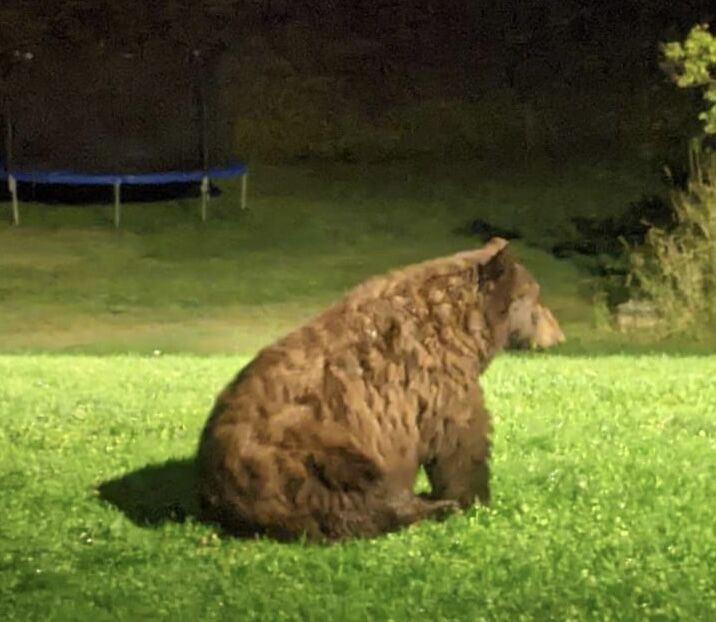


After years on the Endangered Species List, grizzly bears are making appearances throughout Montana, including in northern Jefferson County. With these powerful creatures returning to the area, it’s more important than ever to responsibly coexist in rural areas.
Living and recreating in Montana, wildlife encounters are an inevitable event; regardless, local officials aim to reduce conflicts by managing not only the animals, but the humans that attract them too.
“Bears are dispersing through this area,” area Game Warden Troy Hinck told The Monitor after a recent grizzly sighting in Jefferson County.
The bear in question, Hinck said, was spotted on a landowner’s game camera west of Clancy Creek and verified by Fish, Wildlife and Parks’ Region 3 Bear Specialist Jeremiah Smith.
“Grizzly bear numbers and range continue to expand, particularly in areas between the Northern Continental Divide and the Greater Yellowstone ecosystems,” read a July 17 FWP news release.
The dispersion of grizzly bears, Hinck said, is good for the species’ genetic diversity and it is hard to determine how long bears will remain in an area.
Although grizzly bears make the occasional appearance in Jefferson County, their smaller cousins make nearly daily visits in North County communities, such as Blue Sky Heights, Gruber Estates and Forest Park.
“Black bear in Gruber Estates. If you have your garbage can out on Hanging Tree, there’s a good chance he paid you a visit,” Steve Paasche posted on Nextdoor – a social networking app for neighborhoods – on Aug. 4.
It’s this exact instance — getting into garbage cans and animal feed — that Hinck said conditions bears to associate humans with food, and leads to more negative encounters. With black bears in the area exercising these behaviors, Hinck said it’s only a matter of time before the known grizzlies in the area follow suit.
“[We] don’t want the potential for a grizzly bear learning that behavior in this community,” Hinck said, adding that people often get complacent until a bear shows up. “If you can be vigilant all the time, you will reduce your problems in the future.”
Once a bear receives a food reward, it’s more likely to return and cause property damage. Hinck went on to say that a rewarded bear will likely start impacting more than one home too.
“If he learned to do that [get into garbage] at one house up the drainage, he’s probably going to go down to the next house,” he said.
To curb problems with bears, Hinck said it requires management of both the humans and the bears.
“I look at it as a whole community vigilance,” he told The Monitor. “We know that bears are going to show up and travel through Jefferson County.”
The first step in black bear management, Hinck said, is securing the attractants, such as free range chickens, animal feed, beehives and garbage cans. This could be done with the installation of electric fences around feed sheds and chicken coops or switching from traditional trash cans to bear-resistant bins.
“That is a very good start,” Hinck said in reference to an entire community using bear-resistant bins.
When it comes to making these shifts, some homeowners may find the cost to construct an electric fence or swap to a bear-resistant bin daunting; however, programs exist to help shoulder the costs of these efforts.
Defenders of Wildlife, an organization dedicated to protecting native animals and plants, offers to pay 50% of a homeowner’s cost (up to $500) to install an electric fence to deter bears. This program serves eligible counties in Alaska, Idaho, Washington, Wyoming and Montana. Jefferson County residents are eligible for the program.
Those interested in applying can do so at www.defenders.org/got-bears.
Montana’s Outdoor Legacy Foundation and the Vital Ground Foundation also offer annual grants to help educate and assist landowners with coexisting with bears.
Although some Jefferson County residents already utilize bear-resistant garbage cans, without a community-wide effort, conflicts with bears will continue, Hinck said, explaining that it only takes one person not doing it properly to attract a bear.
Acting under this mindset, several rural communities in bear country have adopted policies requiring – or encouraging – homeowners to use bear-resistant bins, including Bozeman and Whitefish.
“Implementing neighborhood wide usage of bear bins is one of the best ways to reduce conflict,” reads the city of Bozeman website.
In Bozeman, a limited number of bins are provided to neighborhoods where bear conflicts occur most often. The bins work with city garbage trucks and cost homeowners an additional $5/month in addition to their regular fee.
In 2022, Whitefish began the city-wide swap to bear-resistant bins, asking for an additional $5.79 a month from homeowners to cover the added costs. As of August 2023, the city was in the final stage of transition, according to Whitefish City Manager Dana Smith.
“The final delivery of bear resistant containers is scheduled for the end of this month,” Smith said.
Although the transition is still in progress, Smith said the Whitefish Police Department and local FWP have received “significantly less calls this year reporting bear activity in the city.”
However, an unusually wet year could be the reason. The moist season has resulted in a bounty of natural food sources, such as berries, Hinck said.
“Justin Vallieres, the Wildlife Conflict management specialist for FWP Region 1, shared that calls are down all over the region and state,” Smith explained. “It is hard to gauge the effectiveness of the bear resistant containers so far, but we have heard reports of black bears unsuccessfully attempting to access the garbage in the new containers.”
Whitefish city officials will continue to monitor the effectiveness of containers as food sources dry in the warmer, autumn months.
The swap to the new bins has not been without challenges, Smith said, adding that overflowing garbage cans have in some cases defeated the purpose of the bins entirely. Additionally, there has been a learning curve for properly latching and securing the lid.
“When properly used, we expect a decrease in conflicts,” Smith said.
Until attractants are secured, bears will continue to be a presence in north Jefferson County. And as black bears repeatedly get into attractants and become nuisances to the community, Hinck said FWP must initiate the next level of management: hazing.
Hazing includes non-lethal tactics, such as shooting a bear with rubber bullets or bear spray. The purpose of hazing, Hinck said, is to deter the bear and re-instill a fear of humans.
If hazing techniques don’t work, FWP will tranquilize, trap, relocate – or the worst case scenario – euthanize the bear, Hinck said.
“We don’t want to take a problem bear and move them to another location,” Hinck said, adding that food conditioned bears will continue those behaviors in their new home.
The sooner residents contact FWP to report a problem bear, the better the result for them and the survival of the bear, Hinck said.
Management methods for grizzly bears are similar to those for black bears, but requires FWP to communicate with the U.S. Fish and Wildlife Service.
Aside from swapping to bear-resistant bins and implementing electric fences around attractants, Hinck suggested several other tactics for residents to reduce bear conflicts around their homes: Never placing garbage beside trash cans, bringing cans into the garage at night and storing large quantities of livestock or animal feed where bears can’t access it.
“If it’s not easy to get to, that bear is moving through,” he said.
Hinck also cautioned residents not to shoot bears with shotguns or to use traps, explaining that this could cause more problems since an injured animal is more likely to become a conflict animal because it will struggle to get natural food sources.
Whether residents like it or not, bears are an integral part of life in Montana. And as community members, it’s our job to be vigilant and limit confrontations.
“For the most part, people are doing a good job,” Hinck said.
Residents wanting to report a problem bear can contact the Helena-Area Resource Office at (406) 495-3260 or contact the Jefferson County Sheriff’s Office for public safety concerns at (406) 225-4075.