
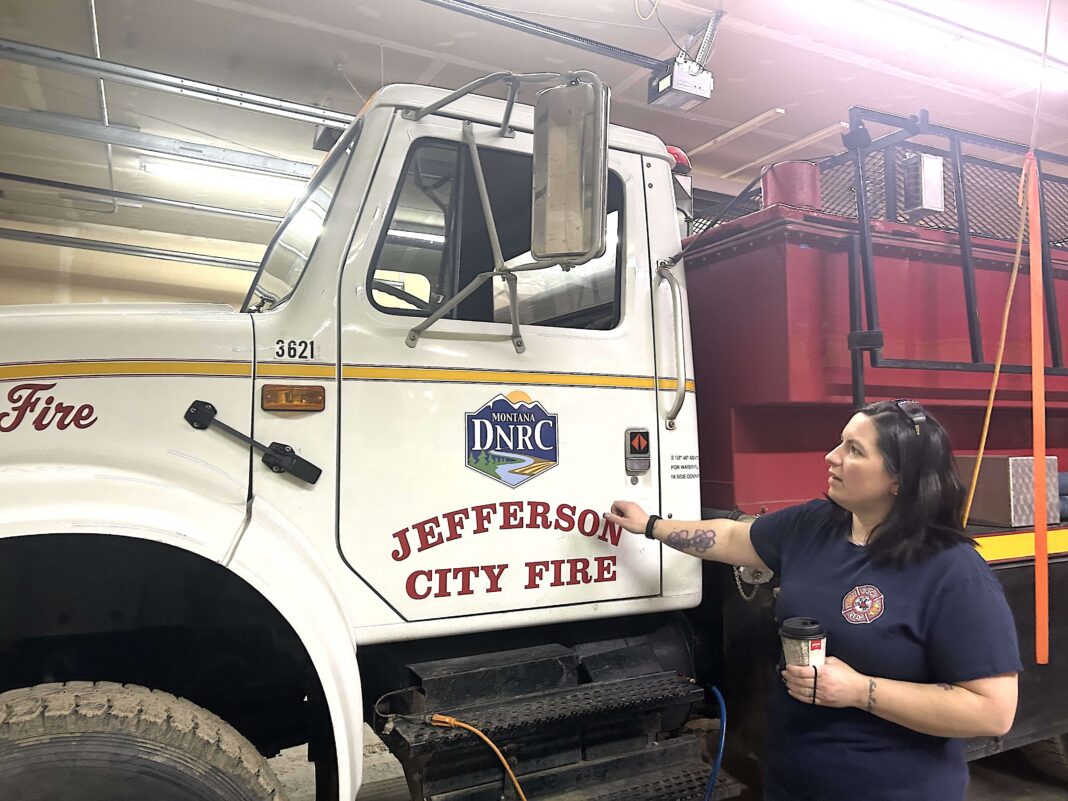
Soon after moving to Jefferson City in 2018, Grace Williams came upon a vehicular accident on Interstate 15, just north of the Jefferson City exit, and stopped to help.
She was one of three people on scene who tried to save the driver, staying with them while others kept onlookers from taking photos, but the driver ultimately passed away. A white cross with a sunflower marks the spot today.
“That kind of put it in my head,” she said, the thought of being someone who could respond. “Maybe there was something more that could have been done.”
Not long after, she drove past the fire hall and saw then-chief Bud Siderits, standing on top of a truck. Williams pulled in and said hello.
“That guy is like a sweet talker,” she said with a laugh. “He just lures you in. Before you know it, you’re coming to meetings.”
Women firefighters are rare across Montana and the West – only 13% of U.S. Forest Service fire positions – and rarer still in leadership roles. After attending meetings, she became a firefighter, and in mid-2024, the department’s ailing chief handed her the reins. Today, nearly two years into a job she never planned to have, Jefferson County’s only female fire chief is still learning on the job.
Most afternoons around 2 p.m., the 40-year-old Williams drops by the Jefferson City Volunteer Fire Hall to check the thermostat, walk the building, and go truck-to-truck inspecting fuel levels, tire pressure, and breathing equipment tanks. She’s usually done in 30 minutes and off to pick up her 13-year-old from Boulder Elementary.
Williams grew up in the country in Pennsylvania. The only girl in her high school automotive class, she was mocked for it. After graduating she joined the Air Force and found herself as one of very few women repairing aircraft. She met her Montana-born husband while stationed in Germany, and when they left the service, they had to choose between Pennsylvania and Montana. Montana won.
They settled in Jefferson City and Williams took a job at Boeing, where again she worked mostly with men. She eventually left and began working at Clancy Elementary as a substitute teacher and paraprofessional, then joined the fire department – where, as in every professional space before it, she was one of the only women in the room.
She spent three years as a firefighter and safety officer before the department’s chief, Keith Wear, got sick and handed over the responsibility faster than either of them expected. Within a few months, Williams had the title and boxes of department materials at her door.
“It was the fastest turnover I’ve ever seen with anything in my life.”
The department has eight active members. A ninth is nearly through the basic fire course, a roughly month-and-a-half training run through MSU’s fire school that covers the fundamentals of firefighting. Each firefighter is also required to complete 30 hours of training annually, covering everything from how to pull water from a waterway to how to set up for a traffic call.
The job extends well beyond training. Williams also coordinates community events, handles incident documentation, manages equipment maintenance and attends meetings at the county and state level.
Williams and firefighter Kylene Laroque, who joined the department in September 2023, are the only two women in the department. Williams wishes there were more.
Women make up about 9% of U.S. firefighters, with the vast majority serving in volunteer roles, according to the 2020 U.S. Fire Department Profile. Only about 6% of fire chiefs are women, according to Women in Fire, a national advocacy organization.
Research suggests that part of what keeps the numbers low is how people picture the job: studies have found that when the firefighter prototype is defined primarily by physical strength, it becomes harder for people to imagine women in the role, and qualified female firefighters are undervalued as a result.
Williams has spent most of her career aware of what a wrong call could cost her beyond the obvious. “I just don’t want somebody to say that call was wrong because she was the one that made it,” she said.
What she talks about instead is knowing limits. If something on scene is too heavy for her to manage safely alone, she says so and someone takes over.
“If I don’t say something, I could hurt somebody,” she said. “Or it could actually kill somebody.”
She has noticed that children at accident scenes tend to come to her before they go to the men on her crew, and calm down faster once she’s there. At community events, kids sometimes approach her in disbelief. You’re a firefighter? She tells them they can be one. But parents sometimes pull their children away at the suggestion, and it stays with her.
“You don’t know,” she said. “Maybe one day your little daughter is going to be ripping a car open with an extraction tool and saving somebody’s life. And you’re going to look back and go, ‘I almost stopped that.’”
It is a sentiment that traces back to her own childhood. Her father was a firefighter, and she credits him as her earliest inspiration – proof that the people who shape you don’t always look like you.
Contrary to what people may picture, fire is a small fraction of what the department actually does. Williams puts it at about one fire call for every 10 accident calls. When a call comes in she usually takes the smaller brush truck first and gets to the scene fast, tracking on her phone who is coming and what she has to work with.
There are nights she is the only one who can make it, and she has to call another department. She has made peace with this. “We can’t assume we’re going to have three or four people. We have to assume it could just be the one.”
Williams is constantly analyzing and reanalyzing once she’s on scene. Last year, a tractor‑trailer on the highway had its air brakes fail, causing enough heat that the wheels were close to catching fire and the rear tires could have exploded.
While her crew put water on it, Williams remembered an incident in Helena where tires on a similar rig blew out and struck firefighters. She had read about it, so she yelled at her firefighter to back off.
“I’m constantly worried I’m going to make a decision that could hurt somebody,” she said.
That awareness extends beyond safety. Last year, after a fatal accident on Boulder Hill, the family arrived on the scene and asked to gain access, but couldn’t due to the severity of the crash. Williams called dispatch, already knowing what the response was.
“I knew it was no, but there are some things you have to go through the motion of, just for the person,” she said. She had to be the one to tell the family they couldn’t come through, she explained, then took a pause. “That’s just a punch right in the stomach.”
A house fire in Boulder, also last year, brought a different kind of weight. Jefferson City arrived as mutual aid, and the blaze was mostly out by the time they arrived. Williams’ crew was tasked with pulling down the ceiling and checking for hot spots.
When Williams got there, what she noticed first wasn’t the house, but the father sitting on the ground beside it, unable to do anything. She knew the family, as she substitutes at Boulder Elementary, and she saw the kids the next morning at school.
It is, she said, part of the job – the part that doesn’t show up in the training manuals. Knowing when to call for help, what a family needs to hear even when the answer is no. Knowing how to walk into someone’s worst day and keep moving.
She has been doing it for five years, and she is good at it. So when people tell her women don’t belong in the fire service, she doesn’t argue.
“That’s your opinion,” she said. “You can buzz off.”