
Editor’s note: A previous version of this story misspelled the name of a project manager with FourFront Design. Her name is Jessica Holdren. The story has been updated.
Jefferson County has launched a new phase in its effort to make use of the former Montana Developmental Center’s South Campus and the area south of the county fairground. The Jefferson Local Development Corporation, Headwaters Resource Conservation and Development, and the state Department of Environmental Quality have pooled funds to create a development plan for two county-owned buildings on the South Campus, as well as for state-owned property south of the fairgrounds that the county could acquire, according to JLDC Project Director Eric Seidensticker.
The organizations hired consultants from FourFront Design, SMA Architects, DJ&A Engineering, and Headwaters Economics in January 2021 to create a master plan and preliminary architectural report, FourFront Project Manager Jessica Holdren said. The organizations held an open house to receive community feedback at the fairground on June 30.
“We’re really at the listening stage,” Holdren said. “It pains me when we get to the end of a project and then people want to give feedback. This is the time to really get involved.”
She said that there is currently no concrete plan for the areas, but the organizations hope to formulate goals based on community input. The June 30 open house was the first of four community meetings that the organizations will hold in order to take input, she said. She said that the next meeting will likely be in September, and the planning stage of the project will stretch until February 2022.
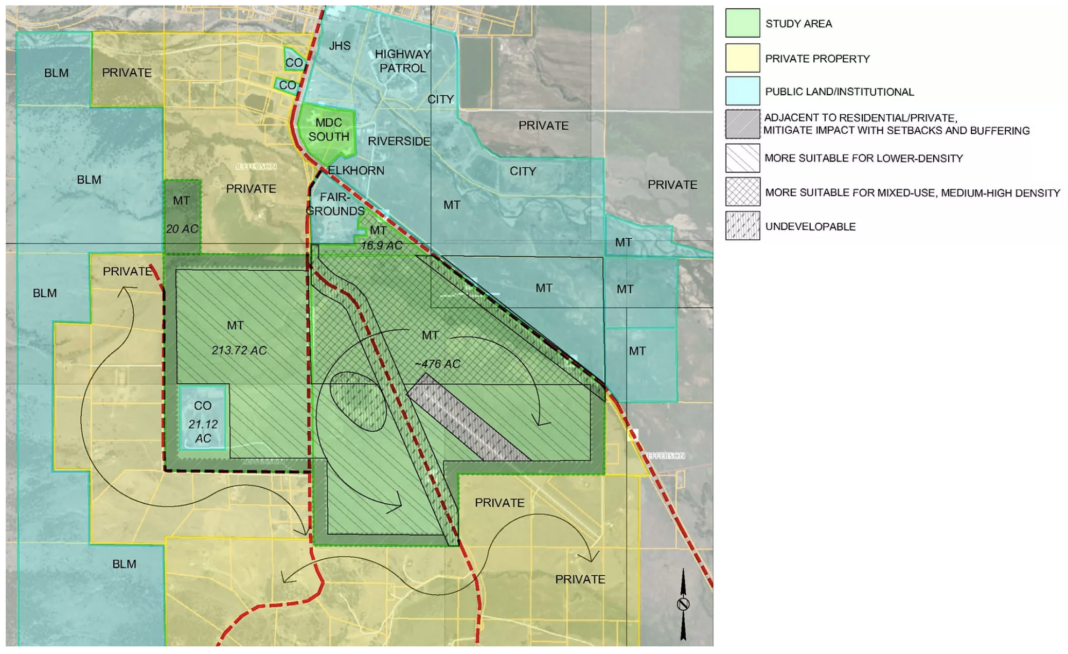
With the input from the June 30 community meeting, the consulting team plans to create “rough concepts” of what the South Campus and an approximately 706-acre “development area” south of the fairgrounds could potentially look like, Holdren said. She added that they would present the concepts at the next meeting to receive more input and refine their plans.
Seidensticker said the JLDC began working on the project when it received a $25,000 planning grant from the state Department of Commerce. JLDC then pooled funds with the DEQ and Headwaters RC&D in order to start the project, he said.
Originally, the organizations were looking at both the North and South campuses of the former MDC, Seidensticker said. However, the project was put on hold in April when the Montana Highway Patrol initiated their move into the North Campus, he said. Within the former MDC grounds, he said, the project is now focused on only the south campus.
Holdren said that the organizations do not plan on “creating a new Main Street,” but she sees the potential in the “development area”—south of the fairgrounds—for a mix of low-density residential development and industrial or commercial spaces.
County Commissioner Cory Kirsch said he envisioned the land as residential mixed with commercial elements, adding that any residential area around Boulder would benefit the community.
JLDC Project Coordinator Tom Harrington agreed that there are “a lot of good arguments” for converting the area into a commercial and housing zone, and for expanding the fairground.
“It’s almost like there’s too many options of what it could be, so we need to narrow that down,” Holdren said. She added that the community’s feedback is invaluable since residents are aware of the town’s history and needs.
The organizations are also assessing the economic and logistical feasibility of various land uses and developments, she said. For example, a residential development may grapple with water rights, and commercial construction would need to suit the needs of businesses that might locate there.
“The sky’s the limit,” Boulder resident and City Council candidate Pat Lewis said at the June 30 open house, adding that she is open to all possibilities. Since Boulder is “landlocked,” she said, she was excited to see the potential for growth, and an expanded tax base.
City Council President Drew Dawson said he would be happy with the plan as long as it “works for the land and for the community.”
According to surveys of the 15 people who attended the June 30 open house, there was consensus that the community should utilize the South Campus as a resource, that the property should include trails, open space and recreation amenities, and that it should provide services that do not already exist downtown.
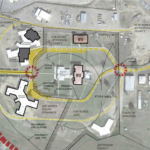
Architects are currently advising the organizations on whether it makes more sense to salvage county-owned buildings five and nine or to knock them down and rebuild, Holdren added. She said that the team is only looking at these two buildings because the Youth Dynamics center operates out of the other buildings on the South Campus.
Kirsch said that the South Campus is a great resource to the community, either as a historical site if they choose to preserve the buildings, or as something else if it makes more sense to “start over.” He said that architects estimated that preserving and refurbishing the buildings would cost several million dollars.
Many in attendance were adamant that the buildings are preserved, however. Boulder resident Jan Ziettlow said she hoped to see the old buildings kept in good shape with this plan.
Planning has been complex because different entities—including the city of Boulder, the county and the state—own different sections of land in the area. Holdren said the organizations have also been collaborating with the Elkhorn Treatment Center and the state Department of Corrections Riverside Special Needs Unit, both of which operate near the South Campus area.
“Since there’s so many entities here, we want to make sure that if anyone wants to do something specific, or is thinking of selling, we just want to make sure we’re aware of it as we plan,” Holdren said.
However, the majority of the land that the organizations are eyeing is currently state-owned and lies south of the fairground and state Highway 69, north and east of the county landfill, and west and north of the airport. Whitetail Road and Little Boulder Road run through the parcels.
She said that the organizations hope that the state lands would be bought by the county or a private developer, although the state could retain ownership and rent it out. The land needs improvements to be attractive to a developer, she said.
Kirsch said that the county had begun discussion with the state in order to “put a bug in their ear” that the county is hoping to develop the area south of the fairgrounds. Harrington said it could take up to a year to get the property transferred from state to county ownership.
Harrington added that the state only gives up property if there is a good reason.
“[The state] ask[s] a lot of tough questions. They want to know exactly what you’re going to do with it,” Harrington said.
Holdren said that part of this planning project is to find potential funding sources for infrastructure and development. Because of the South Campus buildings’ age, she said, there is potential to receive historic tax credits.
After a master plan is created, Holdren said, the use of the spaces ultimately depends on who eventually owns them.
Holdren said that people who could not attend the meeting can visit www.planMDC.com to learn about the project, and can share feedback on an online survey at www.planmdc.com/june-meeting.
The survey closes July 14.