
Don Woody owns 20 acres in Craig. He generally mows 11 of those acres each summer in an effort to prevent wildfires, but for him, it’s not an ideal approach.
“Once you finish mowing the last of the 11 acres, you have to start from the beginning,” he said.
Woody figures there has to be a better way.
Dave Fabian owns land west of Clancy. His goal is to create a “healthy property and a healthy wildlife” on his mix of forest, pasture and wetlands.
In an effort to reach their differing goals, the two landowners recently attended the Montana Forest Stewardship Workshop, conducted by the Montana State University Extension Forestry Program.
The three-day workshop is for private landowners who wish to promote the health and longevity of their forests and develop long-term plans to achieve their goals.
The course program was offered this year in four locations across Montana: Bozeman, Frenchtown, Columbia Falls and Clancy. Clancy was picked due to increased local interest as well as the participation of Mark’s Lumber, which allowed the indoor portions of the course to take place at their headquarters.
Registered individuals receive pre-workshop materials to lay the groundwork for the information and techniques taught in the workshop. Every workshop follows the same schedule: eight-hour sessions on both Thursday and Friday, and another eight-hour concluding session the following Friday. The break allows participating landowners to return home and use the information from the prior sessions to evaluate the status of their own forests and begin the development of their own Forest Stewardship Plan to be finalized during the last day of the program.
Cindy Peterson, associate forest specialist with the MSU Extension Forestry program, recently led a group of four landowners at Mount Helena City Park.
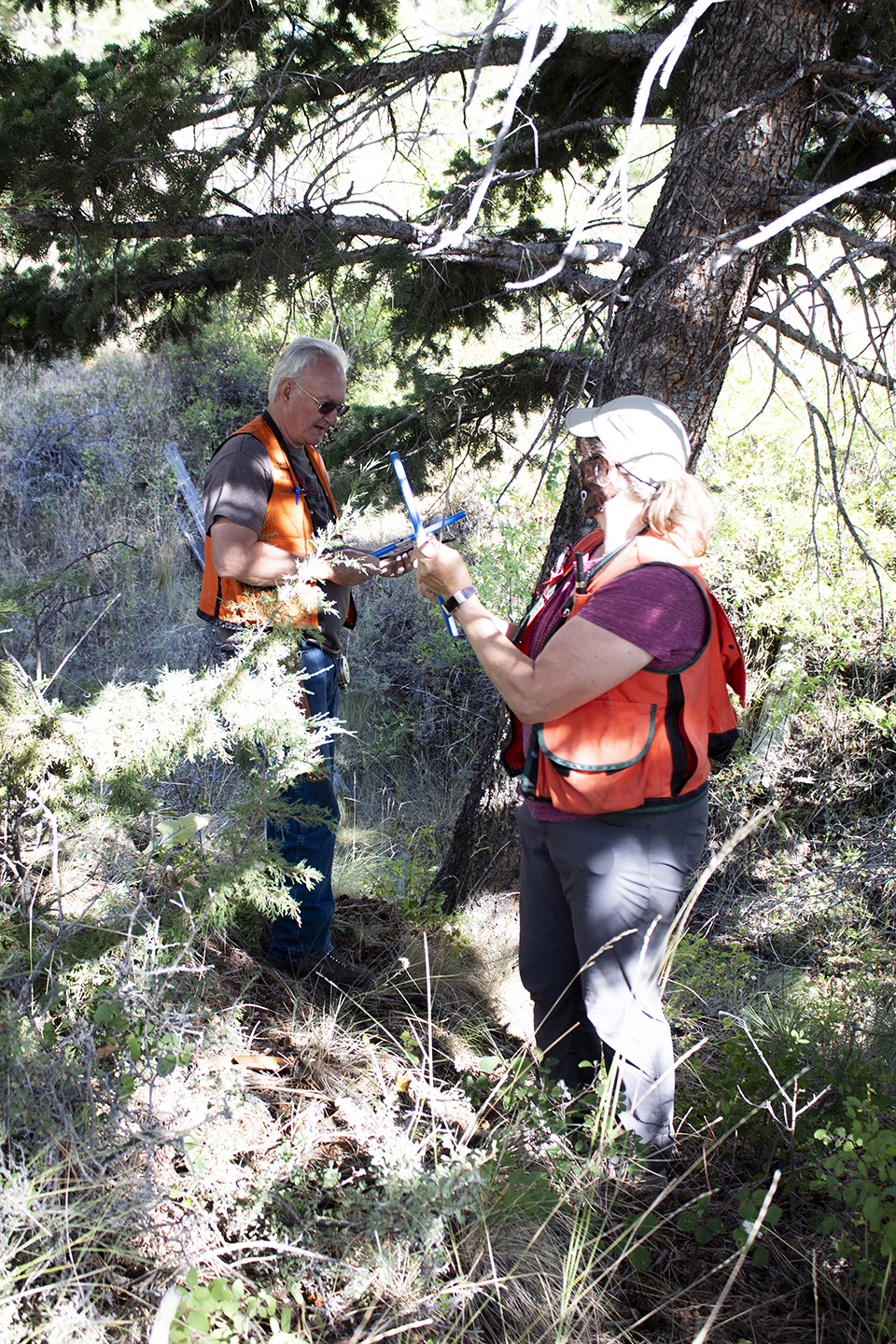
The goal of this field day was to put into practice what had been learned at home and in the classroom through the development of a forest plot. The plot is an ecological survey that creates a sample of a property. This sample will give landowners a better idea of the composition, health and fire-risk of their private forests.
The participants measured soil depth and composition; surveyed ground cover, seedlings, saplings and larger trees; assessed wildfire risk in relation to grasses, tree proximity and downed trees; and learned about tree health through the identification of species, quality, age and hazardous insect activity. All of this information will inform their stewardship plans.
Gary and Susan Dalton of Wolf Creek joined the program to “encourage wildlife, birds, wildflowers and native growth,” said Susan who emphasized that their stewardship plan would focus on creating forage and habitats to attract wildlife. Gary and Susan took advantage of a perk in the course — the cost is $110 per ownership, meaning family members or partners are welcome and encouraged to attend at no additional cost.
Peterson stressed that in the program, “we don’t tell them what to do, but we give them options and help them to learn about the forest and how to manage it for their objective.”
Since its inception, 171 Forest Stewardship workshops have been attended by 3,848 participants. This means 1.3 of Montana’s four million private acres have benefitted from the program. Recently, there have been second and third-generation participants in the program, wishing to carry on a family legacy through their forest stewardship according to MSU Extension Forestry.
“A lot of industry land is being sold to private people, who look at the land and realize something needs to be done but they don’t know what it is. They want to know how they can do their best for their forest,” said Peterson, referring to land sold by mining and lumber companies. She also attributes the success of the program to results and word of mouth.
“We try to revisit landowners again after several years and we get to see the result of people’s management. It’s pretty amazing. The positive changes in their forest are really neat. Then other people see the change in their forests and ask “What did you do? Where did you learn this? Why are you doing this” and word starts spreading around,” she said.
After the program sessions have ended, the participating landowners will be visited by advisors from the program.
“When they finish the course they come out with a Forest Stewardship Management Plan … we give them a lot of information about fire resilience, wildlife and range management, best management practices. Then an advisor goes out and visits after the workshop,” said Peterson. These advisors could be from the Forest Service, the DNRC, MSU Extension Forestry specialists and agents, private consulting foresters, as well as many other kinds of Montana industry professionals. According to Peterson, this industry participation combined with private landowners helps to create a state-wide network of support.
For the past few years, the workshops have all filled up quickly, and currently, there is a waiting list to participate in the program. Those interested in participating in the Montana Forest Stewardship Workshop should fill out the 2021 Forest Stewardship Workshop survey on the MSU Extension Forestry website. This survey will help determine the location of future workshops.
Started in 1991 and authorized under the Cooperative Forestry Assistance Act of 1978 (CFAA), the Forest Stewardship Program’s goal is to “provide quality learning opportunities to landowners who voluntarily seek them. It also assists landowners in developing comprehensive, multi-resource management plans that provide the information needed to manage their forests … according to the goals they have established for their own property,” as stated in “Montana Forest Stewardship Program: A Snapshot” by Jamie B. Yule Ph.D.
Funding for this program comes from a federal award from the U.S. Forest Service, Department of Agriculture, and is sub-awarded by the Montana Department of Natural Resources and Conservation and the Forestry Division to the Montana State University Extension.