
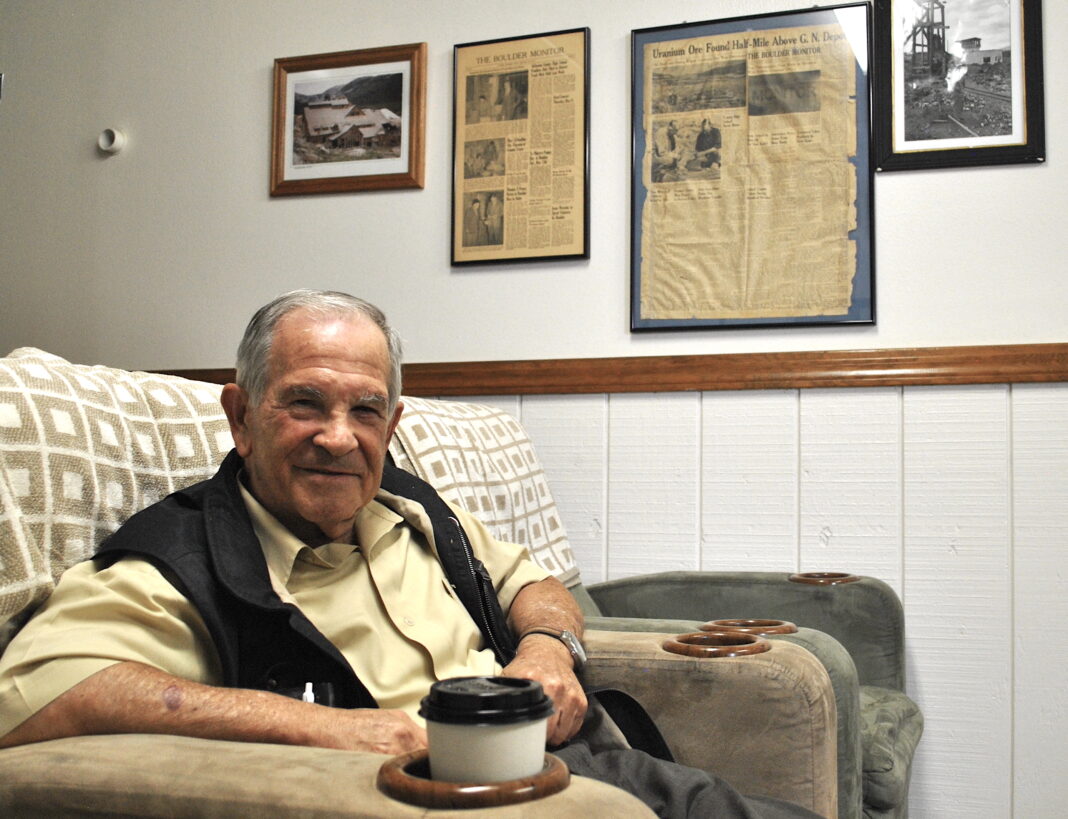
Jerry Cuttler has spent most of his professional life around radiation. As one of Canada’s leading nuclear engineers, he helped build and run multiple nuclear power plants. And in retirement, he has conducted credible research on the effects of low-level radiation in treating chronic disease — most recently focusing on patients with Alzheimer’s Disease.
Now, after an absence of 20 years, and facing his own age-related infirmity, Cuttler is coming back to Boulder’s Free Enterprise Health Mine, to get radiation treatment himself.
“I’ve been worried about my head and my brain,” he said. “I’ve got a problem with glaucoma. One eye has really deteriorated the last couple of years, and my hearing is going.”
So here he is, spending four-hour shifts in the health mine’s radon room, a space at surface level where radon from the mine is pumped in, a subject now in his own research.
* * *
There are three competing research stances on radiation. One is the LNT school, which holds that any amount of radiation is bad, and that the effects of radiation are linear. The threshold model holds that radiation has no effect up to a certain point, above which it’s harmful. And the radiation model – to which Cuttler subscribes – says that low-level doses can actually be beneficial.
“Radiation treats the immune system,” Cuttler says. “The immune system treats the disease.”
Using radiation to improve patient health is not new. “X-rays and radium have been used to treat cancer, stop infections, relieve inflammations and treat arthritis and asthma as early as 1896,” Cuttler notes. But radiation scares such as the 1986 accident at the Chernobyl nuclear power plant has dampened interest, especially in the United States.
“Many consider even low-dose radiation to be harmful now,” Cuttler said. “Some groups even insist cell phones can cause cancer, though they don’t have ionizing radiation at all. What changed? One reason radiation therapy fell out of favor was the availability of antibiotics but a second, and more important factor, was efforts to stop atomic bomb development.”
A native of Toronto, Ontario, Cuttler said he has always had an interest in engineering and physics. He took this interest further in the late 1960s, and by 1971 had earned a doctorate degree in nuclear sciences. From there he worked 26 years at Atomic Energy of Canada, LTd., leading teams that designed and managed nuclear reactors in Canada and elsewhere. He served as President of the Canadian Nuclear Society and as a member of the American Council on Science and Health Board of Scientific Advisors.
Now 80, Cuttler has stayed engaged and alert, spending a large amount of his time researching and raising awareness on the health benefits involved with low-dose radiation (in the form of CT scans). His wife, Vera, was successfully treated with CT scans after a one-inch tumor was detected in her uterus.
In addition to Alzheimer’s, Cuttler’s work has addressed positive results in Parkinson’s and diabetes. He is currently looking into potential benefits of treating four different kinds of cancer. “What’s funny is everyone tells you radon causes lung cancer, but low-dose radiation has been used to treat lung disease,” he said.
Cuttler was intrigued by the possibility that low-dose radiation could have positive effects — and by the corresponding popular fear of such treatment. He had met Patricia Lewis, who owned and operated the Free Enterprise mine with her husband Burdette Anderson, at a conference in the late 1990s, and he became interested in the Boulder/Basin area, America’s foremost location for radiation therapy, with Earth Angel, Sunshine, Merry Widow and the Free Enterprise health mines. Cuttler visited the Free Enterprise mine in 2002, and the results impressed him. At the time, he had an issue with a root canal, he said, and, as he suspected, the inflammation stopped and pain alleviated significantly after several sessions in the radon room.
Lewis was not surprised. This was just another example of the results she had witnessed in her 20 years at the Free Enterprise. Although such mines are practically unheard of in the United States, Lewis said such radon therapy is far less unusual and much more accepted in other countries, especially Austria, Germany, Russia and the Czech Republic, home of Marie Curie’s Hotel Radium Palace, the birthplace of radiation therapy.
“Radon therapy is practiced worldwide in medically supported facilities,” said Lewis. “It’s recognized as part of the health care systems in some countries.” (Lewis currently is The Monitor’s office manager, as well as a Boulder city councilor.)
Cuttler began seriously pursuing research on the effects he had just witnessed, further inspired by the experience of He since has researched radon therapy around the world and continues to write studies on how inflammatory conditions benefit from this kind of treatment.
“In 2015, a friend asked me to help [find treatment] for his wife, in hospice, with severe Alzheimer’s disease. We tried X-rays to her head, and she improved,” Cuttler recalled. “Repeated treatments gave her better quality of life until the end of 2017. Her appetite was restored and she was more responsive.”
Cuttler was inspired by the works of Dr. Myron Pollycove, who was giving lectures about the beneficial effects of radiation, which contradicted information coming from the Nuclear Regulatory Commission. “He would send me papers, I would ask him questions and then we got to writing papers together about effects of radiation on health,” Cuttler said. “From there I started meeting other medical scientists on this topic, including Dr. Kiyohiko Sakamoto and Dr. Shuji Kojima of Japan.
In 2017, Sakamoto, Kojima, Cuttler and others collaborated on a paper regarding the treatment of cancer and inflammation with low-dose ionizing radiation. One excerpt shares some insight into the difficulties involved with shedding light on the positive impacts of low-dose radiation: “According to the ‘linear-no-threshold (LNT)’ ionizing radiation is harmful to living organisms no matter how low the dose may be. However, recent studies have revealed that low-dose radiation can be beneficial to living organisms, since the mild oxidative stress induced by low-dose radiation induces adaptive responses, including enhanced cell damage repair/protection.”
Unfortunately, he said, much of this treatment is still not taking place here in the U.S. “There are 50,000 patients treated in Germany every year by X-rays in 300 clinics for inflammatory and degenerative diseases,” Cuttler said.
But here in Boulder, Montana, radiation therapy is available, and Cuttler was not disappointed by his recent trip south of the Canadian border. After a couple four-hour treatments, Cuttler said he didn’t need his hearing aids, claiming his hearing had improved significantly.
This is one of the many reasons why Cuttler strives to break down the stigma and make the general public aware of the health effects involved with radiation. Most recently, Cuttler wrote an article for the American Nuclear Society’s newsletter shedding light on the “enormous international consensus opinion that has been falsely informing everyone, everywhere in the world, into believing that even a small dose of radiation causes cancer.”
“I want to stop the false radiation scare,” he said, adding, in his opinion, “except for radon therapy, there are no good remedies for autoimmune diseases.”