The dust is clearing on an extraordinary budget season for local government, confirming the answer to the question: Will this year’s starkly higher property assessments in Montana mean big increases in taxes for county residents?
It turns out: Not so much.
Jefferson County property taxes will go up by an average of 4.4% following the County Commission’s approval Sept. 5 of the final budget for the 2023-24 fiscal year. “We felt pretty good about that,” Bob Mullen told his fellow commissioners.
The county’s overall budget jumped by 7.9% to $30.65 million from $28.4 million in 2022-23. Of that total; though, much of the increase was accounted for by changes in grant funding and state allocations. Non-voted tax levies will increase to $4.5 million, and total tax revenue to $7.6 million.
Many property owners were startled — and angered — last June when they received notices from the Department of Revenue reporting that the state’s valuations of their homes had increased by large amounts since 2021, a function in most cases of a red-hot real estate market. The notices indicated that property taxes would soar accordingly — in many cases around Jefferson County by 50% or more.
Jefferson County’s taxable value — the basis for property taxation – increased by 32% for 2023-24, to $45.5 million from $34.4 million, according to Ginger Kunz, the county’s clerk and recorder.
The reality, however, is that most municipal taxes, those levied by counties and cities, can’t go up that much. State law limits increases in local government expenditures to one-half the rate of inflation over the previous three years. Local school systems are similarly constrained, with their core budgets set by the state’s Office of Public Instruction based primarily on the number of students they serve.
As a result, the county, as well as school districts and the cities of Boulder and Whitehall, have had to lower their millage rates — in many cases, by a lot — to accommodate the state’s higher assessments. (See table, page 5.)
For example, the 2023-24
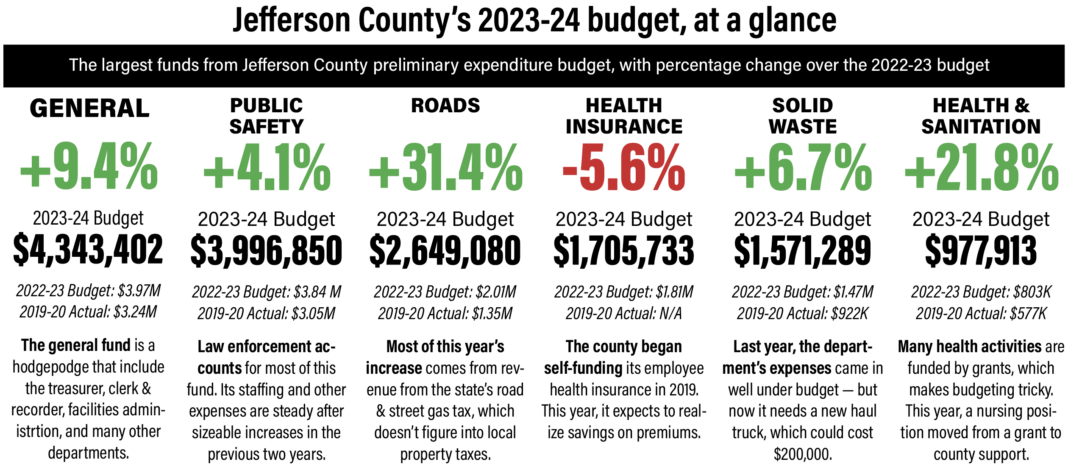
budget for the county’s general fund — which includes a wide range of government services including the Justice Court, Treasurer, Clerk and Recorder, and Legal Services — increased by 9.3%.
But the corresponding millage rate decreased to 28.78 from 33.42.
Similarly, the county’s Public Safety budget, which includes the Sheriff’s Office, saw a modest 4.1% increase for the coming year — but its millage rate dropped by over 25%, to 34.23 mills.
The city of Boulder, whose budgeting process is separate from the county’s but is conducted in the same way, approved a levy rate for 2023-24 of 137.72 mills, down from 184.26 the previous year. Its total budget increased by about $11,000. The City Council’s vote was delayed from Sept. 11 to Sept. 13, after The Monitor’s deadline.
Millage rates for the county’s school districts also mostly declined, but generally not by as much as those for the county and cities. County School Superintendent Sarah Eyer explained that in 2022-23, some schools saw the benefit of a $5.2 million payment of overdue taxes from Montana Tunnels and Mines, which dramatically lowered that year’s property taxes. This year, schools won’t enjoy that windfall — so taxes should return to a level similar to that in the 2021-22 fiscal year.
Jefferson High School’s budget of $3.8 million is essentially unchanged from a year ago; the corresponding property tax burden of $1.2 million represents a 3.95% increase. Taxes connected to the special levy funding the school’s expansion project will not change.
While most county department expenditures for 2023-24 are consistent with last year, some are taking on steep increases. The Roads Department budget will jump to $2.6 million from just over $2 million the previous year. Some of that, Mullen noted, is a function of higher oil prices, which makes road materials and fuel more expensive. In addition, the department is taking on new projects, such as the improvement of Court Street in Basin. And it plans to purchase a motor grader, which levels surfaces — a $160,000 investment, according to Mullen.
The good news: taxpayers won’t see that increase. House Bill 473, passed by the State Legislature this year, authorized a significant increase in the state’s gas tax, which supports local road construction and maintenance projects. As a result, the county budgeted $812,865 for expenses covered by the gas tax, up from $135,056 a year ago.
The county’s Health and Sanitation budget increase is more complicated. Its budget for the new fiscal year jumped by 21.9% — but the associated levy mill rate increased to 10.58 from 7.19, implying an average levy increase of 94.4%.
Public Health Supervisor Pam Hanna explained that federal funding for the county’s COVID response, which had covered large chunks of staff salary and overhead for the last three years, is now ending. A smaller grant, $15,000 to support nutrition for women, infants and children (WIC), which supported part of a nurse’s salary, is also being terminated.
Other grants, she said, haven’t increased to reflect inflation; the department therefore must cover salary increases from general funds.