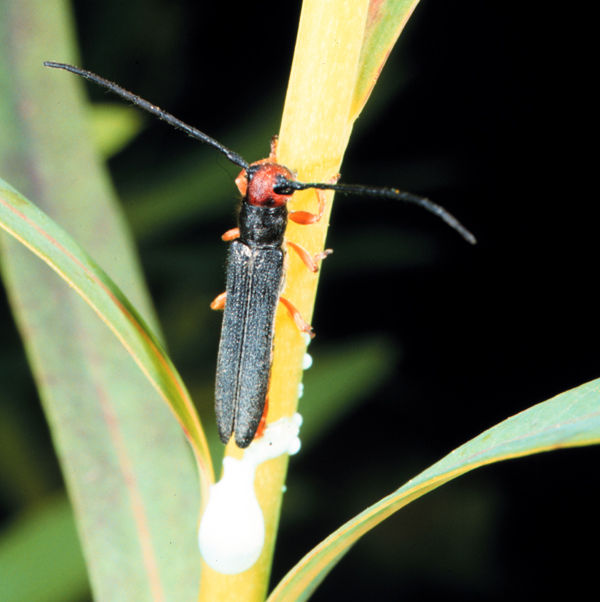
Leafy spurge is a perennial noxious weed that has sticky, milky white sap. The sap can cause a bad reaction if it gets in people’s eyes or on their skin. Cows, and much of Montana’s native wildlife, will not regularly graze it, but sheep and goats can be taught to like it. Spurge has a very deep and extensive root system so pulling or burning it does not work. There are herbicides that work well if used correctly, contact your County Weed Coordinator for information, equipment and chemicals.
The Whitehall Project deals with the insects that help control it. We are also monitoring 10 research plots we set up last summer for a long-term study about the effects of the site environment in the success of the bio-control insects. This study is being done by the ARS (USDA Agricultural Research Services) out of Sidney. They have given us some funding for this, and we are glad to help gather data.
Several insect species have been released on leafy spurge in Montana. The two types that we work with are: 1) the leafy spurge flea beetles (Aphthona spp., six species), and 2) the red-headed stem/root boring beetles (Oberea ethrythrocephala). We also mess a bit with the leafy spurge hawk moth Hyles euphorbiae. The moth is large and is often mistaken for a hummingbird as it hovers and feeds on flowers in the evening. The moth larvae are quite large and are black, red and white-colored with a red spike sticking off the back end. Usually, when an insect is brightly-colored, it is advertising that it is toxic to predators. If you could survive eating just that icky-sticky spurge sap, you would be toxic to predators too. They will also spit an icky green fluid on you if you pick them up. As they grow, the larvae can defoliate several spurge stems. Unfortunately, though they look impressive, they emerge too late in the season to hurt the plant much.