It’s August. If you are a municipal or school employee in Montana, chances are you’ll be spending a good part of this month engaged in building a budget.
And if you are a Montana taxpayer, especially this year, chances are you’ll be paying attention.
Across the state over the next few weeks, cities, counties, schools and other taxing districts will finalize and approve their budgets for the 2023-24 fiscal year. This year’s deliberations may well get more attention from residents than usual: Property assessments, mailed to taxpayers in June, increased by 51% at the median — in large part because demand for homes, and so prices, in many communities have soared since the COVID pandemic.
In reality, property taxes probably will not go up nearly that much. City and county budget increases are limited by statute to just half the rate of inflation over the previous two years; and school budgets are similarly constrained.
Still, attention has now focused sharply on bureaucrats’ annual ritual of crafting the budgets that will inform mill rates and levies that residents find on their tax statements in October.
For Jefferson County and the City of Boulder, like other municipalities, that process is not mysterious. Beginning last April for the city, and in May for the county, department managers were asked for estimates of next year’s expenditures and revenues. The County Commission and the Boulder City Council, respectively, reviewed requests by each department and decided whether to incorporate those requests into preliminary budgets.
This month, according to County Clerk Ginger Kunz, the County Commission will determine salaries for elected officials and their deputies. The county also will resolve negotiations with the International Brotherhood of Teamsters, which represents roads and solid waste employees, and the Montana Federation of Public Employees, representing non-supervisory workers.
By next Monday, Aug. 7, the state Department of Revenue will certify the total taxable value for each taxing authority’s jurisdiction, including counties, cities, schools, and districts for services like libraries, fire departments, and water.
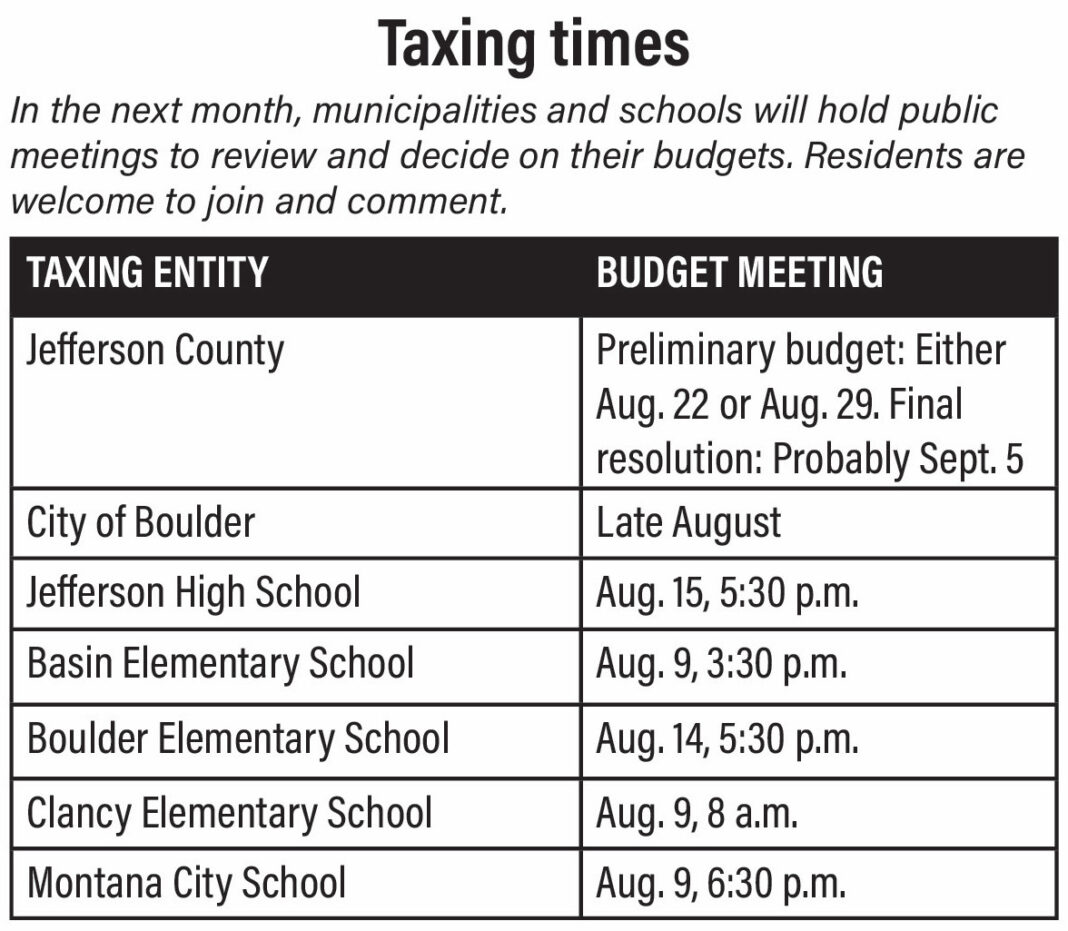
The County Commission will hold a preliminary budget hearing in late August, and a final hearing by Sept. 7. Both, like all Commission meetings, are open to the public. Kunz says the County will post the preliminary budget on its website; a paper copy will be available at the County Clerk’s office. “All the information is there,” Kunz said. “People are welcome to it.”
By Sept. 7, municipalities also must calculate the mill rates that will need to be levied to fund their budgets. Final budgets are due to the state Department of Administration by Oct. 6. This year, municipal mill rates likely will be much lower than in the past, to adjust for sharply higher property assessments.
For school districts, the budget cycle is similar — and it must synchronize with the county process — but it’s determined in large part by the state’s Office of Public Instruction (OPI).
Each March, schools public post their plans to increase permissive levies for specific expense categories, including their general funds, transportation, technology and tuition. This year, says Jefferson High School’s Business Manager Lorie Carey, the school’s transportation levy probably will be higher than what was estimated in March, a function of a new, five-year contract with Harlow School Bus Service; other levies will stay about the same.
In July, schools receive their general fund appropriation from OPI — the maximum budget that they can adopt without a public vote. This is based on many factors, according to Carey — most notably, schools’ enrollment the previous year. When enrollment increases, schools are allowed by OPI to expand their budget to serve the greater number of students.
Schools populate their OPI appropriations with expense allocations — and in August, school boards meet to consider the resulting budgets. These meetings are open to the public. This year, the Jefferson High trustees will meet Aug. 15. Basin Elementary, Clancy Elementary, and Montana City School will discuss their budgets Aug. 9, and Boulder Elementary on Aug. 14.
School trustees have until Aug. 25 to approve their budgets. The county’s superintendent of schools, Sarah Eyer, then works with County Treasurer Terri Kunz to calculate the corresponding mill rates — which, like the municipal mills, are incorporated into tax bills.