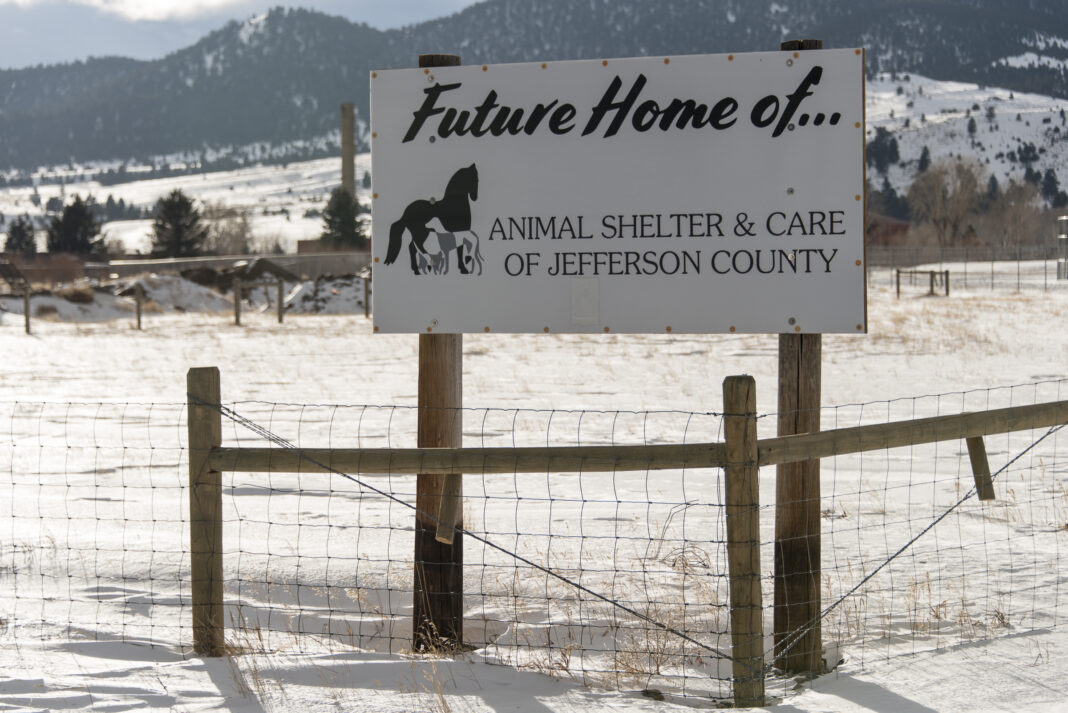
An updated mill levy revenue estimate and a revised budget proposal from the Animal Shelter and Care Committee of Jefferson County show increased property values generating greater overall tax revenue than a previous estimate, as well as a revised floor plan and operating budget that could spring to life if county voters approve the mill levy this June and if the committee is ultimately selected to build and operate a shelter in the county.
The Monitor reported on Jan. 27 that the Jefferson County Commission, at its Jan. 25 meeting, unanimously voted to place on the upcoming June 7 primary ballot a proposal to establish a permanent mill levy of nine mills on all taxable property in the county. According to the resolution that placed the proposal on the ballot, if passed, the funds generated by the mill levy would go toward constructing “a nonprofit animal shelter facility in Jefferson County, Montana, for the sheltering of lost or unwanted animals, the quarantine of animals ordered to be quarantine by court order, fostering and adoption of the animals in Jefferson County for the welfare and protection of the animals and citizens of Jefferson County.” Funds would also go toward the ongoing operation and expenses of an animal shelter once it is established, as well as the continuation of a spay and neuter program, microchipping, vaccine clinics, and other services that are currently offered by the Animal Shelter and Care Committee of Jefferson County.
At that time, The Monitor reported that the mill levy was projected to raise a total of $265,365 annually.
Following the publication of the Jan. 27 story, representatives from the committee pointed out that the figure was outdated—it originated from an initial version of a similar proposal on the 2020 primary ballot that failed by just 38 votes—and that the figure for this year’s initiative, which will appear on the ballot, had increased. A copy of an unsigned resolution provided to The Monitor by the County Commission at the January meeting contained the outdated figure.
The mill levy, if passed, is now estimated to generate $291,952 annually, according to a copy of the resolution that the commissioners signed on Jan. 25. The committee provided a copy of the resolution and of its current budget proposal in a meeting with The Monitor last week.
The increased tax revenue estimate was due to an increase in property values across the county since the 2020 proposal was originally drafted, committee members said. The proposed number of mills, nine, remained the same, as did the estimated increase in annual property taxes: Taxes for a $100,000 property would increase by $12.15 annually; taxes on a $200,000 property would increase by $24.30 annually; and taxes on a $300,000 property would increase by $36.45 annually.
Committee member Vickie Cordeiro also clarified in the meeting with The Monitor that the 40-animal figure presented in the Jan. 25 commission meeting was the number of animals that the committee and other community volunteers foster each year. About 140 animals are picked up in Jefferson County each year, she said, and some end up going to the Lewis & Clark Humane Society in Helena, which charges $125 per animal, although that facility takes some animals from the county for free. Cheryl Haassakker, who heads the committee, told the commission on Jan. 25 that the county currently pays the Lewis & Clark shelter about $3,000 to $5,000 each year for animals taken there.
Haassakker reiterated that mill levy funds wouldn’t automatically flow to her organization—if passed, the county would take bids from any interested group, such as other animal shelter nonprofits, to provide services, meaning that the Animal Shelter and Care Committee would have to compete to be selected.
If the initiative passes, the Animal Shelter and Care Committee will submit a bid, she said. The committee originally developed proposals for a shelter facility and accompanying operating budget ahead of its first attempt to get a mill levy passed more than five years ago, Haassakker said. That proposal, bundled into a broader proposal from the Sheriff’s Office, failed.
Updated plans shared with The Monitor last week showed a facility with 20 dog kennel runs—down from 30 in the original plan—which allowed more room for a spay and neuter program, an enlarged activity and clinic recovery room, and space that could be used by a visiting veterinarian. The plans still showed a 42 cat cattery, a community cat lounge and a cat isolation room, and additional room to continue community programs, along with pet boarding, microchipping, personalized collar tags, and training programs for pet owners and prospective pet owners. The facility could cost upward of about $715,000 to construct.
The committee also updated its budget and staffing plan. An earlier budget called for a shelter director paid a $35,195 annual salary; an animal care technician paid hourly at $12.45, or $23,904 a year for full-time work; four animal caretakers paid $10.86 hourly, or $83,404 annually for all four; and two part-time animal control officers paid $14.72 an hour at a total cost of $28,262 annually. In that budget, salaries and wages totaled $170,765 annually.
The current budget omitted the animal control officers because “both county sheriff and city police department will have 24/7 access after shelter hours to drop off stray and/or vicious dogs in isolation kennels.”
The current budget listed a shelter manager paid $17 an hour with basic healthcare benefits for a total cost of $48,460 annually; a part-time veterinary technician without benefits paid $13.14 hourly for a total cost of $24,083 annually; two full-time caretakers each paid $11 hourly with basic healthcare benefits for a combined total cost of $68,618 annually; and two part-time caretakers without benefits paid $11 hourly for a combined total cost of $40,322 annually.
In the current budget, wages cost a total of $181,485 annually—nearly $11,000 more than under the original plan.
In addition to personnel expenses, the current budget showed annual facility expenses of $45,235, which Haassakker said included debt service on the construction of a shelter, as well as upkeep and taxes. She said she’s still working on the exact breakdown of those costs. The budget also listed annual expenditures of $15,000 for office expenses, $50,000 for veterinary services, $40,000 for animal care, $3,000 for euthanasia, $8,000 for spay and neuter programs, and $11,000 for miscellaneous expenses.
Total annual expenses in the budget were $353,720, an increase of $25,720 from an earlier budget estimate of $328,000.
Against those expenses, the current budget included a total of $83,720 in annual revenue: $15,620 from “grants, donations and fundraising;” $9,600 from boarding and reclaiming fees; $16,700 from impound fees; $37,000 from adoption fees; and $4,800 from “miscellaneous fees and services.”
With $353,720 in expenses and $83,720 in revenue, the budget showed a $270,000 annual shortfall. That’s where the mill levy revenue would come in, offering an estimated $291,952 annually for a $21,952 surplus—if county voters pass the measure in June.