
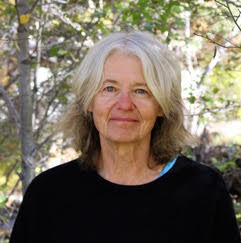
“A lot of us don’t know that we need poetry,” says Melissa Kwasny. “Our attention spans have been shattered by screens, and it’s often hard to look up and out at our own lives.
“I really do believe that poetry is the language of the interior life, maybe more explicitly than the other arts. It particularly asks us to pay attention to our senses, and it gives form to things that are often hard to articulate.”
Kwasny, a Jefferson City resident and former Montana Poet Laureate, released “The Cloud Path” this April, her seventh published collection of poems and an examination of personal loss amid global crises. Kwasny is scheduled to present selections from “The Cloud Path” in a public reading at the Boulder Public Library on May 28.
Through “The Cloud Path,” Kwasny grapples with the passing of her mother and the minutia and detail of caregiving and grieving. She engages with her own loss as an intimate framework for examining shared public traumas and concerns, such as the COVID-19 pandemic, environmental violence, and an increasingly divisive political atmosphere.
The poetry, she says, is couched in vivid depictions of wildlife and natural spaces, and she invokes color and sensory language to connect scenic and social themes. She writes in one such poem, “Glass Vocabulary”: “We grind blue seeds of juniper under our shoes. Cow bones bleach in the creek, broken and scattered. You say you like to revisit places, to come back to them, over and over again. Whoever you are with now, the news analyst says, is who you will be with for the long term.” The poem is just one example of how Kwasney wields descriptive language, and invites the reader to confrontation with memory, boundary, and image in her work.
“The Cloud Path” didn’t begin with an intentional focus. “When I’m starting out on a new project, I don’t necessarily think of it as working on an entire collection,” said Kwasny.
“I work on a specific poem, and then I work on the next poem. Sometimes I’ll try to write with a specific focus, and sometimes I’ll see where the poems lead me.”
Born in Indiana, Kwasny graduated from the University of Montana in 1998 with an MFA in poetry and an MA in literature. For 10 years, Kwasney taught at the California Poets in the Schools Program in San Francisco, which is presently one of the largest literary artists-in-residence programs in the United States. At Carroll College in Helena, she is a part-time English department faculty member. She also taught at Lesley University in Cambridge, MA for over 20 years, as part of the Integrated Teaching Through the Arts Program.
“When I was teaching full-time, poetry was just something I had to make time for,” said Kwasny. “And I did. Everyday, no matter how busy, I’d manage to carve out a little room to write.”
Kwasny says that poetry is experiencing a national resurgence in popularity and a heightened level of commercial success. She attributes this to younger, more diverse readers finding a voice for their concerns in poetry.
“More and more people are finding meaning in poetry, which I think is quite promising. I do hope for a general audience, but I wouldn’t say I write with any particular one in mind. Readers ultimately gravitate towards what they need, and they seemingly, in this moment, need poetry.”
Despite her commitment to and love of poetry, Kwasny’s last published book was a piece of non-fiction prose in 2019 titled “Putting on the Dog: the Animal Origins of What We Wear”. The book took on the relationship between fashion and animal product manufacturing, and explored human relationships with non-human forms of life. Over the course of five year’s research for the book, Kwasny visited silk farms in Japan and a sustainable-pearl harvesting operation in Mexico.
“I studied silk, and wool, and pearls, and feathers, and leather,” said Kwasny. “I’m a confirmed poet, but I don’t shy away from opportunities to examine things differently.”