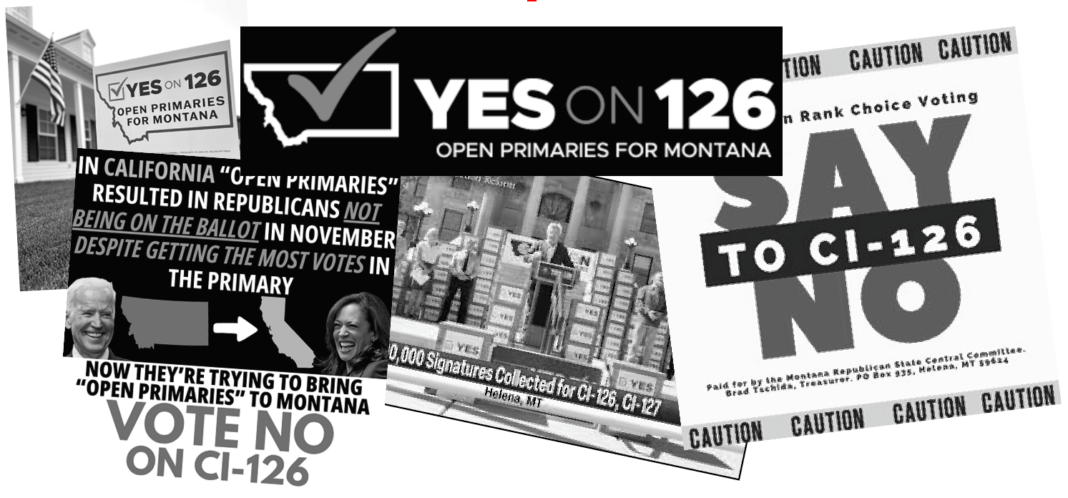
With the 2024 general election less than a month away, I thought to revisit some of the pieces we’ve published this past year on Constitutional Initiatives (CI) 126 and 127. I, myself, was confused as to the actual consequences these initiatives might have on democracy in Montana. I am now less confused, but still very much opposed to them.
On that, more later. First, the state of things!
If passed on Nov. 5, CI-126 would end party-specific primaries in Montana and replace them with open primaries, which would send the top four performing candidates from primary season to the general election, regardless of their party affiliation. CI-127 would require general election candidates to win a majority, rather than a plurality, of the total vote in order to be seated to office.
The debate over these initiatives has been broad and impassioned. In the Sept. 24 edition of The Monitor, political scientist and Clancy resident Jessi Bennion argued that CI-126 and CI-127 would weaken party and donor influence on elections in Montana, while also improving our state’s democratic process by allowing voters to freely select among primary candidates in an open field. Another writer reasoned that open primaries would help alleviate political polarization by preventing more radical candidates from dominating party-specific primaries and from blocking more centrist ones from the general election. A third, who opposed the measures, claimed that open primaries, and weakened parties, would allow candidates to obfuscate their true policy positions by taking whichever party label was most convenient to the geography they were running in — resulting in a flood of primary candidates and worsening political polarization.
So, what is true? These letters are, I think, fairly representative of the support and concern to be found in orbit to CI-126 and CI-127, as well as some of the myth-making and genuine confusion getting in the way of a fair conversation. In regard to candidate, donor, and voter behavior, both sides have compelling arguments as to how these initiatives might improve or harm democracy in Montana. I don’t know which version of events is more likely to play out.
However, I am against these initiatives because I do know how they will impact party behavior. Both proponents and critics of the measures suggest they will weaken Republican and Democratic party influence on elections. I do not believe this is true. This claim stems from a critical language error, one that conflates “party” with “partisan” and fails to consider the most important question of all: Should CI-126 and CI-127 pass in November, how does one actually win an election in Montana?
When I wrote about these initiatives back in April, I argued they were harmful because they effectively created political fiefdoms. I predicted that a dominant party could swell the primary field with candidates and, after claiming the top four spots, lock out the opposition from representation in the general election, potentially forever. Barring dramatic redistricting, I argued, the road to victory was simple, and eternal!
I’ve come to realize that is an extremely inaccurate characterization of what would actually happen during an election, in this hypothetical new world under CI-126 and CI-127, and that I failed to consider how organized political power structures function.
Pretend you, yourself, are the entire reasoning arm of either the Republican or Democratic party and are trying to field winning candidates for every race in Montana. For some races, you are in friendly territory. However many primary candidates take the party label, you are likely to send three, if not four, to the general ballot.
In unfriendly territory, in order for your party to be so much as represented on the general ballot, you must manipulate your primary candidate pool. If you can successfully coalesce your party’s voters behind one or two candidates, you should have sufficient support to claim one of the top four spots, as the opposition cannibalizes itself and splits votes among several campaigns.
But you are nonetheless forced to manipulate the candidate pool. Party-specific primaries are open to anyone who chooses to run as an affiliate, while retaining at least the guise of honest competitiveness. In an open primary system, parties are forced to choose between abandoning certain offices based on demographics alone or shutting down the campaigns of eager, yet troublesome upstarts.
With CI-126 having paved the way for political parties to more heavily influence their primary candidate pools, the general election is where CI-127, the “party” and “partisan” confusion, game theory, and American political history would all collide. Montana Republicans claim that European-style run-off elections, or ranked-choice voting, a system in which voters rank their preferences among a group of candidates with a winner determined through weights assigned to each rank, would determine final election outcomes. But it would likely never get that far!
Yes, for races in which a single party occupies all four ballot slots, there might be some internal politeness agreed to that would allow for run-offs or rankings to occur and for a winner to emerge organically. But imagine your party only occupies three slots. Would you really risk those three candidates each taking a measly 20 percent of the total vote, while your solitary opponent takes 40 percent? Would you risk, in the chaos of run-offs or ranking, a small percentage of your support trickling over to the opposition, which would perhaps push them past the 50 percent required for victory? That would be humiliating! Could you trust your three candidates to themselves determine who should remain in the race, and who should drop out? I think not. CI-126 and CI-127, together, would turn Montana elections into a prisoner’s dilemma, forcing party involvement beyond anything yet recognizable in this state’s history.
We already have extremely clear examples of such party influence on our national politics. While Republicans use party leadership to influence candidate decisions (witness the effective termination of Rep. Matt Rosendale’s U.S. Senate bid last February), the Democrats have had partial, formal, institutional control over Presidential candidate selection since 1982, when they created the “superdelegate” — an unelected partisan delegate whose vote is not bound by any state’s primary election. In any given election cycle, roughly 15 percent of the total number of Democratic delegates electing the party’s presidential nominee are superdelegates.
The justification for superdelegates, which the Republican Party does not use, is that they make it more difficult for fringe candidates, like former President Donald J. Trump or U.S. Senator Bernie Sanders, to win nominations and radically change the party’s platform. The superdelegate is a “party” defense mechanism against “partisanship,” or the more radical beliefs often touted in party-specific primaries that CI-126 and CI-127 aim to mitigate.
Whether or not CI-126 and CI-127 actually would accomplish this is extremely uncertain. Perhaps party controls prevent radical candidates from winning nominations, but maybe, as with former Secretary of State Hillary Clinton’s failed presidential bid in 2016, they also interfere with the emergence of candidates who might best defeat radicals. Either way, should these initiatives pass in November, both parties would need to develop tools to more carefully control candidate pools. Which, I believe, is bad.
All things considered, I urge you to vote “no” on CI-126 and CI-127. American democracy is a beautiful, messy process. I see these initiatives as a corruption of that process.
Contact Conor Reilley at conor@boulder-monitor.com.