An elderly client called Jefferson Public Health Department Supervisor Pam Hanna on May 18, asking for help registering for a vaccine appointment. The client mentioned that he “had trouble getting around,” so Hanna asked if she could just bring a vaccine to his home.
“He said, ‘Oh that would be wonderful,’” said Hanna.
Hanna said she sometimes feels like a character from the Netflix show “Call the Midwife,” where the characters ride their bicycles from door to door to help their community with medical issues. Except those women are on bicycles, “and we drive a Subaru,” Hanna joked.
This is the kind of one-on-one communication and attention that is possible in a small rural community. Although rural areas like Jefferson County face considerable obstacles to the delivery of vaccines — people live far apart over larger areas, often far from medical facilities — personal connections and trust can help close the gap.
That may be why, almost six months after the first vaccine landed in Jefferson county, 40 percent of those eligible have been fully vaccinated, slightly higher than Montana’s 38 percent, and comparable with the national average of 41 percent.
How has Jefferson county managed to vaccinate nearly half of its residents? “A lot of it is about knowing your community,” Hannah said. “I think that’s really what we’re good at.”
Hannah herself is a prime example. After working as the school nurse for Jefferson County School for five and a half years, she stepped forward to take the position of public health supervisor in July of 2020.
She said the job “was rough, especially at the beginning” with the constantly changing vaccination requirements and four different vaccination plans from the state of Montana before doses started being administered.
“The reason I stay is because these are the people that raised me,” said Hanna, who, like most of her staff, grew up in the area. “Hopefully I’ll have some influence on the people who will take care of me when I’m old.”
According to Hanna, only three organizations in the county have been trained and certified to vaccinate people: the Health Department; Elk Horn and Whitehall Pharmacies; and Whitehall Medical, a private practice. Hanna said pharmacy co-owner Josh Morris coordinated with the Boulder clinic to acquire enough vaccines and organize the effort to administer them.
The health department was able to get Moderna and Johnson & Johnson vaccines from the state, and Morris procured two federal allotments of 1,070 doses of Pfizer. From March 11 through April 20, Hanna and Morris worked together closely, using Morris’ vaccine allotments and the health department’s resources. They scrambled to administer the first and then second allotments of 1,070 doses within three weeks, as is required, said Hanna.
With the initial high demand, the health department did not have the capacity to administer all of their doses in its small clinic, said Hanna. So the clinic began conducting off-site clinics in large locations such as Jefferson High School and Montana City Volunteer Fire Station. In March and April, when the county began receiving one-hundred doses at a time, between 250 and 300 doses were administered in three to four hours at these off-site clinics, said Hanna.
Hanna said both facilities were “very gracious,” volunteering their space and helping with set-up and clean-up.
“I was so very humbled by the number of people that stepped forward to help us,” said Hanna. Six nurses and one physician came out of retirement to administer the vaccine, she said, and an additional four nurses that were working other jobs and ten student nurses from Helena College also came forward to help. At many of the larger immunization clinics, out of the 20 or 30 people working, two-thirds were volunteers.
The experience has been much the same in Meagher County, a similarly rural but much smaller community. Neighborly intimacy and one-on-one communication have helped Meagher’s clinic fully vaccinate 46% of those eligible — one of the highest rates in the state.
The Mountain View clinic in White Sulphur Springs called all of its patients as they became eligible to ask if they wanted the vaccine. CEO Rob Brandt said that was “definitely a lot of extra work.” The calls were made by two receptionists and two nurses working overtime and on weekends.
“Bigger counties just wouldn’t have had that capability,” said Meagher Public Health Supervisor Eva Kerr.
As in Jefferson County, Kerr believes the Meagher Health Department Facebook page has also been an effective way of circulating information about vaccine eligibility. “[Facebook is] my main means of contact,” said Kerr, “It’s the best thing for getting information out to people.”
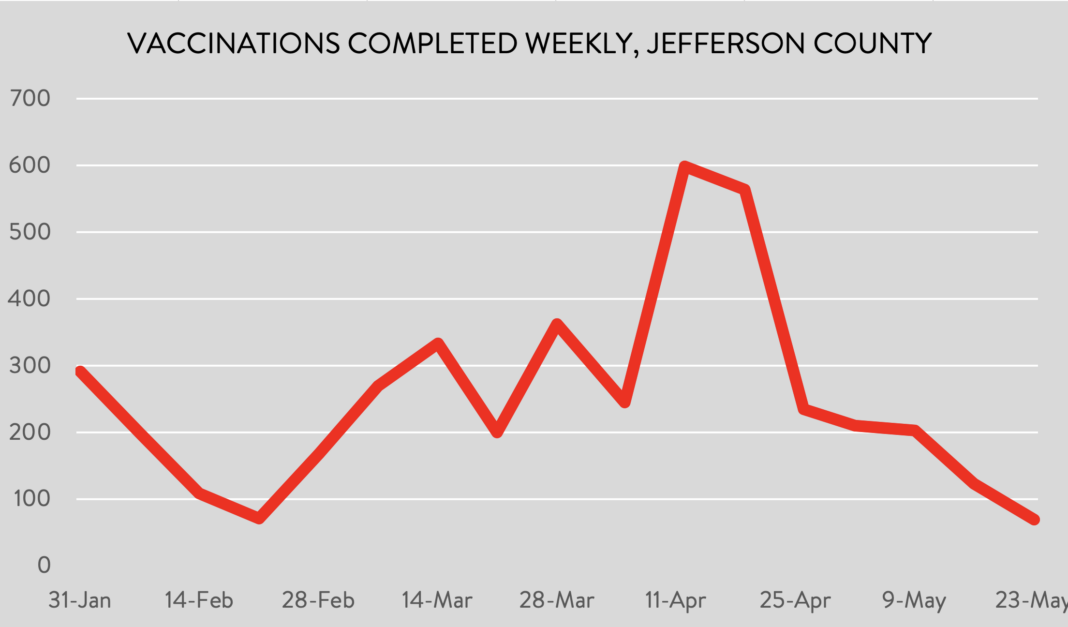
Now, however, both counties are confronting the challenge of diminishing demand for vaccinations. In Jefferson, inoculations peaked the second week of April, a week after all adults became eligible for the vaccine, with almost 600 people receiving a dose according to data from COVID Act Now. Last week, in comparison, only 70 people came in for a dose.
Likewise, according to Kerr, Meagher’s health department now sees “seven or eight if we’re lucky” for vaccines each week, down from 30 at its peak.
Why? It’s a delicate question. The Monitor invited residents across Jefferson County to talk about the vaccine. Some refused to comment, and others skirted the conversation, saying their opinion was irrelevant. A few explained that vaccinations are a contentious issue, and that in a small community, no one wants to be judged for their opinion.
Hanna explained that people’s attitudes towards vaccinations run along a spectrum; most, she said, are in the middle and just need more information to decide. Many who initially resist decide to get vaccinated after they know someone who has gotten extremely sick or after having been quarantined with a close call.
Kerr and Hanna both stressed the importance of listening to and addressing people’s concerns. Hanna acknowledged that not everything is known about the vaccine, and there are side effects which can be “unpleasant.” She tells people that “no vaccine is one-hundred percent effective, but doing nothing creates one-hundred percent risk.”
When people are uncomfortable with or skeptical about the science behind vaccines, Hanna says she tells them about the history, which is “often more relatable,” and also presents “cold hard facts.”
“I’m old enough now that I’ve seen some diseases eradicated with the help of a vaccine,” she said, citing the eradication of polio and smallpox, and the near-eradication of measles before people stopped getting vaccinated.
Jefferson’s Health Department is still looking for people they missed, such as elderly shut-ins and those who work long hours and haven’t had time. Home visits take time, but they’re effective in reaching those who can’t make it to the clinic. According to Hanna, an older gentleman who received a home visit said it made him feel “like royalty.”
Jefferson County Health Board Chairperson Christina Binkowski said at the County Commission meeting on May 18 that the health department had moved to a “targeted approach.” Public health nurses are calling Jefferson county businesses to ask if any employees want a vaccine and offering to administer inoculations at workplaces.
Meagher County has also begun looking for people who were “missed” by targeted businesses, starting with an upcoming clinic at the Bank of the Rockies.
The next challenge: younger residents. On May 10, the U.S. Food and Drug Administration approved the use of the Pfizer vaccine for adolescents twelve and older. Now the county must acquire Pfizer vaccine for young people aged 12 to 18. The hurdle: The vaccine is delivered only in allotments of 1,070 doses, which must be administered within three weeks. Smaller counties can’t possibly use that many.
Jefferson County has overcome that obstacle by partnering with St. Peter’s Health in Helena. According to Hanna, St. Peter’s Health will provide the Health Department with a smaller amount of vaccine. On June 2 and 9, the Boulder Clinic will administer the Pfizer vaccine to adolescents by appointment.
Hanna said it is currently a “guessing game” as to how many are interested in getting their adolescents vaccinated. No adolescents have made appointments yet to receive the shot. Hanna suspects many who wanted it already received it at a pharmacy, and 12 of Boulder’s residents in the target age bracket were vaccinated at a clinic in Lewis and Clark county.
“I was hoping they would make appointments,” said Hanna. “But we still have access to it as needed.”